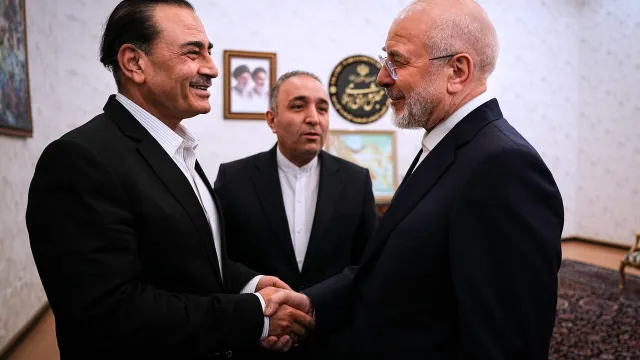
In this photo released by Islamic Consultative Assembly News Agency, ICANA, Iran’s Parliament Speaker and top negotiator Mohammad Bagher Qalibaf, right, shakes hands with Pakistan’s Army Chief Field Marshal Gen. Asim Munir during their meeting in Tehran, Iran, Monday, Aug. 24, 2026. (Mahmoud Hosseini/ICANA via AP)
Reported by:

Cherry Meigh Timbol
News Content Editor
Published August 25, 2026
Iran’s economic crisis deepened dramatically Monday as the Iranian rial plunged to its lowest value ever recorded, coinciding with the Trump administration’s announcement of sweeping new sanctions designed to isolate Tehran from the global economy.
Treasury Secretary Scott Bessent said the United States is launching an unprecedented financial offensive aimed at blocking every potential source of revenue available to the Iranian regime, warning that countries and companies continuing to do business with Tehran could face American retaliation.
The coordinated economic pressure comes as President Donald Trump intensifies his administration’s “maximum pressure” campaign following months of heightened conflict in the Middle East.
Rial sinks to historic low
Iran’s currency fell to approximately 2.02 million rials per U.S. dollar on the open market, marking the weakest exchange rate in the nation’s history. While Iran’s central bank maintains an official rate of roughly 1.5 million rials per dollar, ordinary Iranians largely rely on the far higher market rate for everyday transactions.
The collapse reflects mounting inflation, dwindling foreign reserves, and growing fears that additional U.S. sanctions will further restrict Iran’s already struggling economy. Currency traders in Tehran reported intense demand for dollars as citizens rushed to protect their savings from continued depreciation.


Bessent: No more economic lifelines
Speaking at the Treasury Department, Bessent delivered one of the administration’s strongest warnings yet against nations maintaining commercial ties with Iran.
He declared that the new sanctions are intended to “block all potential sources of revenue” for Tehran and emphasized that operating in the economic gray zone is no longer acceptable. The administration warned that any meaningful financial engagement with the Iranian regime could expose businesses and governments to the full reach of U.S. sanctions.
Although officials did not immediately identify every target, Bessent indicated the measures are designed to sever Iran’s remaining access to international finance, shipping networks, energy revenue, precious metals, and other channels used to evade previous sanctions.
Who could be affected?
The warning extends beyond Iran itself.
Countries that maintain significant trade relationships with Tehran—including some of Iran’s largest commercial partners—could face secondary sanctions, a powerful tool allowing Washington to penalize foreign entities that facilitate Iranian commerce. Analysts say China, Turkey, and the United Arab Emirates remain among Iran’s most important trading partners, making the new policy globally significant.
Rather than immediately imposing penalties on every trading partner, the administration appears to be offering a limited opportunity for governments and companies to disengage before broader enforcement begins.
Why the rial keeps falling
Iran’s currency has been under relentless pressure for years, but recent events have accelerated its decline.
Several factors are driving the crisis:
-
New U.S. sanctions targeting oil revenue and financial networks
-
Inflation exceeding 40% in recent years
-
Reduced foreign investment and capital flight
-
War-related economic damage and shrinking export capacity
Economists warn that continued depreciation will likely push food, medicine, and imported consumer goods even further out of reach for many Iranian families.


Iran dismisses U.S. pressure
Iranian officials have publicly insisted that sanctions will fail to change Tehran’s policies, arguing that the country has developed alternative trade networks and a so-called “resistance economy” capable of withstanding Western pressure.
Despite those claims, financial markets inside Iran reacted immediately to the sanctions announcement, with the rial’s record collapse signaling deep concern over the country’s economic outlook.
🧩 Bottom Line:
The record collapse of Iran’s rial suggests financial markets believe Washington’s latest sanctions could inflict even greater damage on an economy already under severe strain. Whether the strategy forces Tehran to alter its behavior remains uncertain, but the Trump administration has made one point unmistakably clear: the next phase of its confrontation with Iran will be fought as much through economic isolation as military deterrence.
SOURCES: NEWSMAX – Iran’s Rial Hits Record Low as US Prepares More Sanctions
THE HILL – Bessent says new US sanctions aim to block all potential sources of revenue for Iran
MONTEREY HERALD – Bessent says new US sanctions aim to block all potential sources of revenue for Iran