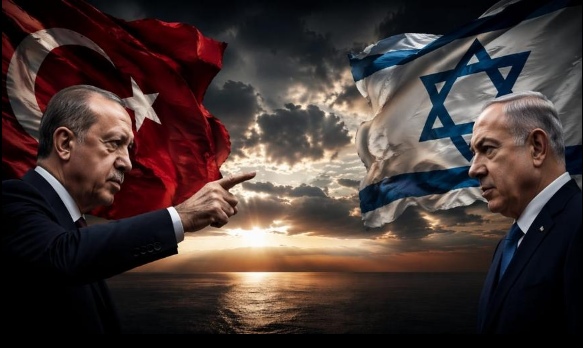
Israeli Prime Minister Benjamin Netanyahu and Turkish President Recep Tayyip Erdoğan face a rapidly escalating confrontation as Israel moves against what it describes as a potential Turkish military buildup in Syria. The dispute has transformed Syria into a new flashpoint between two powerful U.S. partners in the Middle East.
Reported by:

Cherry Meigh Timbol
News Content Editor
Published August 25, 2026
JERUSALEM — Israeli Prime Minister Benjamin Netanyahu is increasingly portraying Turkey and President Recep Tayyip Erdogan as a major emerging threat to Israel, as tensions between the two regional powers intensify over Syria, Gaza and the future balance of power in the Middle East.
The confrontation has escalated rapidly in recent days. Israel carried out an airstrike on the Abu al-Duhur military airbase in northern Syria, saying it was acting to prevent a potential Turkish military presence from moving closer to Israel’s security perimeter. Turkey has rejected Israel’s justification and accused Netanyahu of destabilizing the region.
The dispute now threatens to open a new front in an already volatile Middle East.
Netanyahu Issues Stark Warning to Turkey
Netanyahu has warned that Israel will not tolerate what he describes as Turkish military entrenchment in Syria.
The Israeli prime minister said Israel had learned of plans that could have brought Turkish forces closer to Aleppo and toward areas of strategic concern to Israel. According to Netanyahu, Israel sent Ankara a warning that such a move would not be tolerated.
Israeli Defense Minister Israel Katz has also accused Erdogan of dragging Turkey into what he called dangerous adventures in Syria, insisting that Israel will defend itself against any emerging threat.
Syria Has Become the New Battleground
The heart of the dispute is Syria.
Following the fall of Bashar al-Assad, Turkey has developed close ties with Syria’s new government under President Ahmed al-Sharaa and has expanded its military and political influence inside the country.
Israel, meanwhile, is determined to prevent hostile or potentially threatening military forces from establishing positions near its borders.
The result is an increasingly dangerous collision between Turkish and Israeli strategic interests.
Israel’s strike on Abu al-Duhur brought those tensions into the open. Syria acknowledged that Turkish officers had visited the facility but said their presence was connected to military training and cooperation—not preparations for a Turkish military base.


Washington Caught Between Its Allies
The Israeli strike has also exposed an unusual disagreement between Jerusalem and Washington.
U.S. envoy Tom Barrack, who is also the U.S. ambassador to Turkey and special envoy for Syria, criticized the Israeli operation and questioned whether Washington had been adequately informed before the attack.
Barrack suggested the strike could have been connected to Israeli political calculations ahead of Israel’s upcoming election, while Israeli officials rejected that characterization and maintained that intelligence justified the operation.
The disagreement is significant because Washington is simultaneously trying to prevent a direct confrontation between two important regional powers.
The United States has been working on mechanisms for communication and deconfliction between Israel, Turkey and Syria in an effort to prevent an accidental military clash.
Erdogan and Netanyahu Trade Fire
The political confrontation has become increasingly personal.
Netanyahu recently described Erdogan as an “antisemitic dictator”, accusing the Turkish president of supporting Hamas and attempting to expand Turkish influence into Syria.
Erdogan, meanwhile, has repeatedly condemned Israel’s military operations in Gaza and accused Netanyahu’s government of serious violations of international law.
The relationship deteriorated further after Turkey announced that it intends to seek an Interpol red notice for Netanyahu over a Turkish criminal case involving Israel’s interception of the Gaza-bound Global Sumud Flotilla. Turkey says arrest warrants include allegations involving genocide, crimes against humanity and torture. Israel has rejected the accusations.
Turkey Becomes an Israeli Election Issue
The confrontation with Turkey is also taking place against the backdrop of Israel’s upcoming parliamentary election.
Netanyahu has increasingly placed national security at the center of his political message, presenting threats from Iran, Hezbollah and now Turkey as evidence that Israel requires strong leadership.
A recent Likud campaign billboard in Tel Aviv prominently featured Erdogan alongside other figures portrayed as threats to Israel, reflecting the growing importance of Turkey in Netanyahu’s political messaging.
Critics, however, question whether the Turkish confrontation is purely a security matter or whether domestic politics are also influencing Netanyahu’s strategy. Analysts say the coming election could make security issues particularly powerful politically.
Turkey’s Military Capabilities Raise Israeli Concerns
Israel’s concerns extend beyond Syria.
Reports this week have highlighted Turkey’s development of increasingly advanced missile capabilities, including the Tayfun Block-4, which Turkish media reports describe as having a range capable of reaching Israel.
For Israeli planners, Turkey’s growing defense industry, its military presence in Syria and its increasingly confrontational political relationship with Jerusalem represent a combination that cannot easily be ignored.
At the same time, Turkey remains a NATO member and a major regional power, making a direct confrontation with Israel potentially far more consequential than previous disputes.
🧩 Bottom Line:
The Israel-Turkey confrontation is rapidly becoming one of the most consequential new rivalries in the Middle East.
What began largely as a dispute over Gaza has expanded into a struggle over Syria, military influence and regional power. With Netanyahu warning against Turkish expansion, Erdogan pursuing international legal action against the Israeli prime minister, and American officials attempting to prevent the two sides from colliding, Syria may now be emerging as the next dangerous flashpoint between Israel and Turkey.
SOURCES: AP NEWS – Strikes in Gaza kill 4, including 2 children, a week after US asked Israel to curb attacks
LE MONDE – Israel-Turkey tensions expose personal, strategic rivalry between Netanyahu and Erdogan