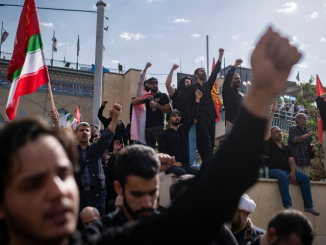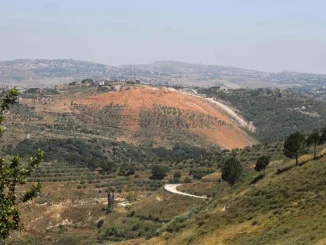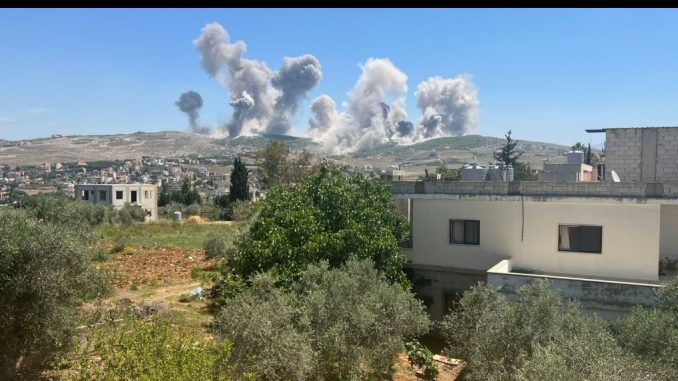
A wide photograph showing the Ali al-Taher ridge in southern Lebanon with a large explosion/fireball or heavy smoke rising from the mountain, ideally from the September 10 operation.
Reported by:

Cherry Meigh Timbol
News Content Editor
Published September 12, 2026
Israel has destroyed a major underground Hezbollah complex beneath the strategically important Ali al-Taher ridge in southern Lebanon, dealing a significant blow to the Iran-backed militant organization as tensions continue to rise despite a U.S.-brokered ceasefire.
The Israeli military said the operation destroyed more than two kilometers of underground infrastructure that included command facilities, weapons storage areas and living quarters. Israeli officials described the complex as a central command and operational center for Hezbollah’s Badr Unit.
The development marks another escalation along Israel’s northern frontier and raises fresh questions about whether the fragile ceasefire between Israel and Hezbollah can survive.
Strategic High Ground
The Ali al-Taher ridge is located roughly 15 kilometers from Israel’s border and occupies a commanding position over parts of southern Lebanon.
For Hezbollah, the terrain provided an important strategic position from which to operate against Israeli targets.
Israeli officials say the underground network contained rockets, missiles, drones, anti-tank weapons and explosives. The military also said the complex had been constructed with Iranian support and was designed to facilitate Hezbollah’s military operations.
Israel had previously announced that its forces had established operational control of the ridge both above and below ground. The destruction of the tunnel network was presented as the completion of that operation.
Prime Minister Benjamin Netanyahu and Defense Minister Israel Katz said Israeli forces would remain positioned in the area to prevent Hezbollah from returning and rebuilding its military infrastructure.
A Massive Demolition
The scale of the destruction demonstrated the importance Israel placed on eliminating the underground network.
Reuters reported that a massive explosion tore through the ridge as Israeli forces demolished the tunnel routes. The U.S. Geological Survey recorded the resulting seismic activity as a magnitude-4.1 event.
The operation also illustrates the continuing importance of underground warfare in the Israel-Hezbollah conflict.
Hezbollah has spent years developing tunnels and concealed military positions designed to survive airstrikes and allow its forces to move weapons and personnel without detection.
Destroying such infrastructure requires substantially more than conventional airstrikes. It can involve intelligence gathering, ground operations, specialized engineering units and large quantities of explosives.
The Ceasefire Is Under Pressure
The Israeli operation comes despite a U.S.-brokered ceasefire framework that called for Israeli forces to withdraw and Hezbollah to disarm.
The arrangement has effectively stalled.
Hezbollah has refused to surrender its weapons, while Israel has maintained that the group must be prevented from rebuilding its military infrastructure before Israeli forces can fully withdraw.
Reuters reported that Israel and Lebanon had been expected to continue diplomatic discussions, but planned talks in Rome have now been postponed until October.
The diplomatic delay comes at an especially sensitive moment.
Israeli forces remain active in southern Lebanon, while Hezbollah continues to maintain its opposition to disarmament.
Lebanon Fears Another Escalation
Lebanese President Joseph Aoun visited Nabatiyeh on Saturday, close to the area where Israel recently seized positions on the Ali al-Taher ridge.
The visit came amid growing fears among residents that Israeli operations could expand further into southern Lebanon. AP reported that Aoun was accompanied by senior Lebanese security officials and sought to reassure residents that the Lebanese state was committed to protecting them.
The situation remains volatile.
Israel has continued conducting operations and airstrikes in southern Lebanon, while Hezbollah has also been accused of launching explosive drones. Both sides’ continued military activity has raised concerns that the ceasefire could eventually collapse.
Earlier this week, Israeli strikes in southern Lebanon killed at least 12 people, including two children, according to Lebanese authorities cited by Reuters. Israel said it was targeting individuals involved in weapons transfers.
Why This Matters to Israel
For Israel, the destruction of the Ali al-Taher complex is about more than eliminating one tunnel system.
It is part of a broader effort to prevent Hezbollah from recreating the military infrastructure that allowed the group to threaten Israeli communities near the border.
The ridge’s elevation and location make it particularly valuable militarily. Israeli officials believe controlling the area reduces Hezbollah’s ability to establish firing positions and rebuild underground facilities close to northern Israel.
The operation therefore represents an attempt to create a deeper defensive buffer rather than simply respond to individual rocket or drone attacks.
Hezbollah Remains a Larger Threat
Despite the destruction of the complex, Hezbollah’s broader military infrastructure has not disappeared.
The organization remains one of the most heavily armed non-state military groups in the region and maintains extensive political and military influence in Lebanon.
The central question is whether Hezbollah will attempt to rebuild its presence in areas where Israeli forces are currently operating.
If it does, the chances of renewed fighting will increase.
If Hezbollah accepts a reduced military presence in southern Lebanon, diplomatic efforts could have more room to succeed. At present, however, the two sides remain far apart.
Iran’s Role
The conflict also remains inseparable from the broader struggle between Israel and Iran.
Hezbollah is backed by Tehran, and Israeli officials have repeatedly described the group’s military infrastructure as part of Iran’s regional network.
The destruction of the Ali al-Taher complex therefore sends a message beyond Lebanon: Israel is demonstrating that it intends to prevent Iranian-backed forces from establishing offensive infrastructure immediately across its borders.
That strategy is likely to remain a central element of Israeli security policy.
The Bigger Picture
The destruction of the Hezbollah underground complex gives Israel a significant tactical achievement, but it does not resolve the larger political problem.
Israel wants security and the removal of Hezbollah’s military infrastructure from southern Lebanon.
Lebanon wants Israeli forces to withdraw.
Hezbollah refuses to disarm.
And the United States is attempting to keep the ceasefire and diplomatic process alive.
Those competing objectives have created a fragile situation in which a single major attack could trigger another cycle of escalation.
For now, Israel appears determined to use military force to prevent Hezbollah from rebuilding the capabilities it developed over decades.
The destruction of the Ali al-Taher complex shows just how far Israel is prepared to go to enforce that objective.
Bottom Line
Israel’s destruction of Hezbollah’s extensive underground complex at Ali al-Taher represents a major tactical victory, but the larger conflict remains unresolved. With Hezbollah refusing to disarm, Israeli forces maintaining positions in southern Lebanon and diplomatic talks delayed, the risk of another major confrontation remains high.
🧩 Bottom Line:
Israel’s destruction of Hezbollah’s extensive underground complex at Ali al-Taher represents a major tactical victory, but the larger conflict remains unresolved. With Hezbollah refusing to disarm, Israeli forces maintaining positions in southern Lebanon and diplomatic talks delayed, the risk of another major confrontation remains high.
SOURCES: REUTERS – Israel says it destroyed Hezbollah underground complex at Lebanon’s Ali al-Taher