Published March 30, 2026
A sudden security scare triggered a temporary airspace shutdown and rapid military response Sunday near a major Florida airport, sending fighter jets scrambling and raising fresh concerns about aviation safety around high-profile flights.
Authorities confirmed that restricted airspace was briefly violated, prompting an immediate response that included F-16 fighter jets and aerial support assets deployed to intercept the aircraft.
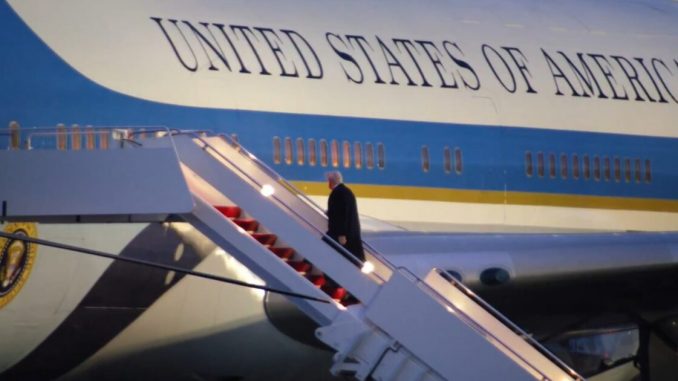
According to officials, the incident unfolded just hours before a scheduled departure involving a presidential aircraft, dramatically escalating the urgency of the situation.
Aircraft Intercepted After Losing Communication
The North American Aerospace Defense Command (NORAD) confirmed that a civilian plane entered a Temporary Flight Restriction (TFR) zone after losing communication with air traffic control.
Military aircraft were quickly dispatched to intercept the plane, with pilots deploying signal flares to get the attention of the unresponsive aircraft—a standard but rarely seen tactic in domestic airspace enforcement.
The aircraft was ultimately escorted safely out of the restricted zone, and communication was reestablished without further incident.
Flights Disrupted, Airspace Locked Down
During the height of the scare, airport operations were temporarily halted, with a ground stop issued as authorities assessed the situation.
Witnesses reported confusion and delays, with early speculation ranging from drone activity to a broader security threat. Officials later clarified that no drone was involved, and the breach stemmed from a communication failure with the civilian aircraft.
Despite the dramatic response, authorities emphasized that there was no direct threat to the presidential aircraft or passengers.

The Air Force scrambled F-16s like the ones seen here during a security scare near Air Force One on March 29, 2026.Anadolu via Getty Images
Growing Pattern of Airspace Security Incidents
The incident is the latest in a string of airspace-related security events in 2026, raising questions about coordination and response protocols.
In recent weeks:
- Airspace closures have been triggered by suspected drone threats and military activity, including incidents in Texas and overseas.
- A separate near-miss involving a military helicopter and a commercial jet is currently under federal investigation.
Aviation experts warn that increasing drone use, military operations, and communication lapses are putting added pressure on already complex airspace systems.
Situation Resolved Without Injury
Officials confirmed that the situation was resolved quickly and no injuries or damage were reported. Flights resumed normal operations shortly after the aircraft was escorted away.
Still, the incident underscores the high-stakes environment surrounding restricted airspace, particularly when tied to presidential movements.
Authorities say a full review is underway to determine how the aircraft lost contact and whether additional safeguards are needed to prevent future breaches.
🔍 Critical View: Another Airspace Breach, Another “No Threat” — How Many Close Calls Before It’s Too Late?
The official line is familiar: no injuries, no damage, no threat.
But beneath the reassurances lies a far more troubling reality—a civilian aircraft was able to penetrate restricted airspace near a presidential flight, triggering a full military response.
Fighter jets scrambled. Flares deployed. Airspace locked down.
And yet, the public is told everything worked as it should.
If This Is “Working,” Why Does It Keep Happening?
Restricted airspace isn’t a suggestion. It’s one of the most tightly controlled elements of national security—especially when tied to presidential movement.
These zones are clearly mapped, widely communicated, and backed by layers of monitoring.
So how does a civilian aircraft simply drift in?
Officials point to a “loss of communication.” That explanation might check a procedural box, but it doesn’t answer the bigger concern:
Why does a single point of failure still exist in a system this critical?
Reactive, Not Preventive
What unfolded wasn’t a seamless defense—it was a reaction.
By the time military aircraft were deployed, the breach had already happened. The system didn’t stop the problem; it responded to it.
That distinction matters.
Because in high-risk scenarios, response time is not the same as prevention.
Americans are expected to trust that layers of defense are constantly working behind the scenes. But incidents like this suggest those layers may not be as solid as advertised.
The “No Harm Done” Narrative
Time and again, officials lean on the same conclusion: no one was hurt.
But that’s not a measure of success—it’s a matter of luck.
Near-misses don’t make headlines for long. They fade quickly, filed away as isolated incidents.
Until one day, they aren’t.
A Pattern That Can’t Be Ignored
This is not a one-off event.
Airspace disruptions, communication breakdowns, and last-minute military interventions are becoming increasingly common. Each is explained away. Each is resolved. Each is forgotten.
But taken together, they point to something bigger:
a system under strain, where the margin for error is quietly shrinking.
Accountability or Another Report?
There will be an investigation. There always is.
There will be findings, recommendations, and assurances.
But the real question is whether anything will actually change—or whether this will join a growing list of warnings that went unheeded.
Because the next time, the outcome may not be so easily dismissed.
And at that point, “no threat” won’t be an acceptable answer.
👥 On the Ground: Confusion, Delays, and Unease After Sudden Airspace Lockdown
Passengers expecting routine departures instead found themselves caught in a tense and confusing situation Sunday, as a sudden airspace shutdown brought operations at a major Florida airport to a halt.
Without warning, flights were delayed, security tightened, and overhead, the unmistakable presence of military aircraft signaled that something had gone wrong.
“Nobody Knew What Was Happening”
Travelers described a scene marked by uncertainty.
Announcements were limited. Information was slow to come. Many passengers were left piecing together what was happening through scattered updates and word of mouth.
“You could tell something serious was going on,” one traveler said. “Flights just stopped, and then people started talking about jets in the sky.”
Outside the terminal, witnesses reported seeing aircraft moving at unusual speeds and hearing what sounded like flares being deployed—something rarely observed in civilian areas.
A System That Feels Increasingly Unpredictable
For many on the ground, the most unsettling part wasn’t just the disruption—it was the lack of clarity.
In an era where air travel is tightly controlled and heavily monitored, passengers expect precision and coordination. Instead, what they experienced felt reactive and uncertain.
Delays are one thing. But a sudden security response involving military assets raises a different level of concern.
Trust Tested in Real Time
Officials later confirmed that the situation stemmed from a civilian aircraft entering restricted airspace after losing communication.
No injuries. No damage. No direct threat.
But for those caught in the middle of it, the experience left lingering doubts.
If safeguards are as robust as promised, how does a situation escalate to that point before being contained?
More Than Just an Inconvenience
Flights eventually resumed, and operations returned to normal.
But the disruption wasn’t just logistical—it was psychological.
Moments like this remind travelers that beneath the routine of modern air travel lies a system that can shift instantly from calm to crisis.
And when that shift happens without clear communication, confidence takes a hit.
Lingering Questions After the Planes Depart
As passengers rebooked flights and terminals slowly returned to normal, one thing remained unchanged: the questions.
What exactly failed?
Why wasn’t it caught sooner?
And could it happen again?
For those on the ground, the incident wasn’t just a delay.
It was a glimpse into a system that, at least for a moment, didn’t seem as controlled as it should be.
🎯 The Final Word:
Another incident brushed off as routine should not be mistaken for reassurance. A civilian aircraft breached restricted airspace, triggered a military response, and disrupted operations near a presidential flight—and yet the conclusion is once again that everything functioned as intended. That answer may satisfy internal reports, but it does little to address the growing pattern of near-misses and last-minute interventions that continue to surface. When a system designed to prevent threats instead relies on reacting after the breach has already occurred, it raises serious concerns about whether the safeguards in place are truly effective—or simply overstated.
What’s more troubling is the normalization of these events. Each time, the public is told there was no danger, no harm done, no reason for alarm. But repeated close calls are not proof of strength—they are warning signs. They suggest a margin for error that may be narrowing, quietly and without sufficient scrutiny. In high-stakes environments like restricted airspace, especially around presidential movement, even a single lapse should demand rigorous accountability, not routine dismissal.
Confidence in critical systems is not built on reassurances alone—it is built on consistency, transparency, and results that prevent incidents from happening in the first place. Until those standards are clearly met, these “isolated” events will continue to accumulate, and with them, public doubt. Because the real issue is no longer just what happened in this moment—but what it reveals about the system as a whole. And if those questions remain unanswered, the risk is not just another disruption, but a failure that can no longer be explained away.
SOURCES: THE NEW YORK POST – F-16 fighter jets scramble, deploy flares after security scare near Trump’s Air Force One at Palm Beach airport
THE GATEWAY PUNDIT – Air Space Briefly Closed and F-16s Deployed After Private Plane Security Scare at Palm Beach Airport With Air Force One on Tarmac