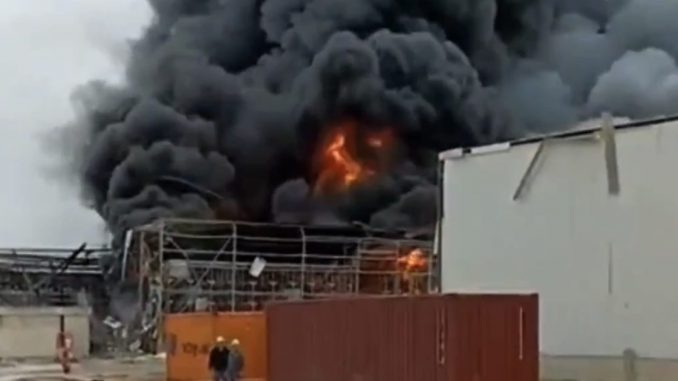
An Iranian missile attack in an industrial zone on Sunday obliterated a factory and prompted concerns of a hazardous materials leak, with potential pesticides being emitted from the fiery wreckage.
Published March 30, 2026
A sudden missile strike hit an industrial facility in Israel Sunday, prompting an urgent emergency response and raising concerns about a potential hazardous material leak in the surrounding area.
Authorities confirmed that the facility, which handles chemical materials, was struck during heightened regional tensions, triggering immediate containment measures and evacuation warnings for nearby residents.
Missile Strike Targets Industrial Facility
Israeli defense officials said the missile impact caused significant structural damage to the facility, which stores potentially toxic substances. Emergency teams were immediately dispatched to assess the situation and secure the perimeter.
“The risk is not only from the blast but from the potential release of hazardous materials into nearby communities,” a senior official said, emphasizing the public safety concern.
Hazmat Teams Deployed Amid Evacuations
Authorities urged residents in adjacent neighborhoods to stay indoors while hazardous materials specialists monitored air and water quality. Early reports suggest the possibility of toxic compound release, though the full scope of contamination is still under investigation.
Regional Tensions Escalate
The strike marks a significant escalation in the ongoing hostilities between Israel and Iran, with both sides increasingly engaging in direct confrontations. Analysts warn that targeting industrial sites could dramatically raise the risk of civilian harm and environmental damage.
International Concerns Mount
Global leaders and humanitarian observers have called for restraint, emphasizing the dangers of attacks on infrastructure containing hazardous materials. The incident has renewed calls to avoid strikes that could trigger widespread environmental or civilian crises.
Authorities continue to investigate the materials involved and are working to contain any potential hazards, while security analysts caution that further attacks could have far-reaching consequences.
🔍 Critical View: Another Missile Strike, Another “No Immediate Danger” — How Many Close Calls Before Civilians Pay the Price?
The official line is familiar: no casualties, no confirmed leak, no immediate threat.
But beneath the reassurances lies a far more troubling reality—an Iranian-backed missile struck an Israeli industrial facility storing hazardous chemicals, triggering an emergency response and evacuation warnings.
Hazmat teams deployed. Residents sheltered. Air and water monitoring began.
And yet, the public is told everything worked as it should.
If This Is “Working,” Why Are Critical Facilities Still Vulnerable?
Industrial sites containing toxic or flammable materials are not just ordinary infrastructure—they are potential disaster zones if targeted.
These facilities are supposed to be secured, monitored, and protected against attack, especially in a region with known missile threats.
So how does a missile strike reach such a facility without detection or interception before impact?
Officials point to broader regional tensions and ongoing hostilities as context. That explanation may check a geopolitical box, but it doesn’t answer the bigger concern:
Why does a high-risk, high-value target remain exposed despite repeated warnings?
Reactive, Not Preventive
What unfolded wasn’t prevention—it was reaction.
By the time emergency crews arrived, the missile had already hit. Hazmat teams are mitigating damage after the fact, not preventing the strike in the first place.
That distinction matters. In high-stakes scenarios involving toxic materials, response time is not the same as prevention.
Citizens are expected to trust that industrial sites handling dangerous chemicals are fortified and monitored. But incidents like this suggest those safeguards may not be as solid as officials claim.
Until preventive measures are strengthened, every industrial facility in a conflict zone remains a ticking hazard—one missile away from a full-blown disaster.
👥 On the Ground: Iranian Missile Strike on Israeli Factory — What Locals Are Seeing and Feeling
The scene outside the industrial facility Sunday was tense and chaotic. Residents reported loud explosions and thick smoke rising from the plant, which stores potentially hazardous chemicals.
Authorities quickly cordoned off the area, ordering nearby communities to stay indoors while emergency crews assessed the site. Hazmat teams worked to contain any potential leaks, while firefighters and security personnel secured damaged structures.
Visible Damage, Lingering Questions
From the streets, witnesses described shattered windows and damaged walls, signs of a direct missile hit. Yet officials continue to insist there is “no immediate danger” to civilians—a claim that does little to reassure locals watching toxic clouds drift toward their neighborhoods.
“The smoke is frightening. We don’t know if it’s safe to breathe,” one resident said, speaking near the perimeter under heavy security.
Emergency Response in Motion
Crews deployed specialized equipment to monitor air and water quality, testing for chemical contamination. The operation is reactive: containment is happening after the missile impact, not before.
Security experts warn that relying solely on post-strike response leaves communities exposed to risk. Preventive measures, such as advanced early-warning systems or reinforced chemical storage, remain limited.
A Pattern of Vulnerability
This strike is the latest in a series of attacks on critical infrastructure in the region, underscoring the persistent threat posed by Iran’s missile program and allied proxies. Local authorities, while efficient in managing immediate dangers, are confronted with the broader question: are these industrial sites ever truly secure?
As air and water quality monitoring continues, residents remain anxious, and experts caution that one more strike could easily turn into a humanitarian and environmental disaster.
🎯 The Final Word:
The missile strike on the Israeli industrial facility is more than an isolated incident—it is a stark reminder of how vulnerable critical infrastructure remains in a volatile region. Officials may assure the public that containment is under control, but reaction after the fact is no substitute for prevention. When toxic materials are involved, the margin for error is razor-thin, and every delay, every oversight, carries consequences for civilian lives and the environment. If lessons are not learned and safeguards not reinforced, these near misses will continue—and the next strike could be far less forgiving.
SOURCES: THE JERUSALEM POST – Iranian missile hit on Ne’ot Hovav factory leads to fear of chemical leakage
THE GATEWAY PUNDIT – WATCH: Israeli Factory Hit by Iranian Missile Causing Potential Hazardous Material Leak (VIDEOS)
HAARETZ – Hazardous Leak Reported in Southern Israel Following Iranian Missile Shrapnel
THE TIMES OF ISRAEL – Officials checking possibility of hazardous materials leak at factory hit by Iranian missile; public told to stay away