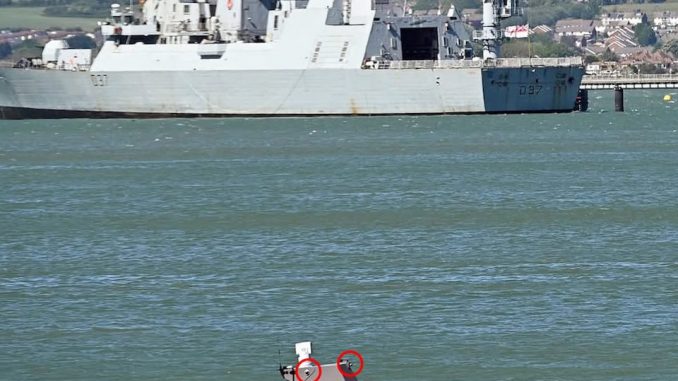
The camera on top of a K3 Scout uncrewed vessel, used by the Royal Navy in Portsmouth harbour. Parts of the camera were made in China
Reported by:

Cherry Meigh Timbol
News Content Editor
Published August 10, 2026
LONDON, United Kingdom — A security controversy is unfolding in Britain after reports revealed that components inside Royal Navy unmanned vessels were communicating with an internet address in China, raising fresh concerns over Chinese technology embedded in Western military supply chains.
The issue involves K3 Scout unmanned surface vessels, which were acquired by the Royal Navy for surveillance, force protection and precision-strike missions. The vessels are produced by British company Kraken Technology Group under a contract worth roughly £12 million.
The revelations were first reported by The Telegraph and subsequently highlighted by Breitbart and other international outlets. According to the reports, cameras installed on the drones contained Chinese-made components that generated communications with an IP address in China.
Chinese Components Discovered Inside Military Equipment
The controversy centers on the supply chain behind the drone’s camera systems.
According to the reports, the affected equipment contained components manufactured in China despite assurances concerning the security and origin of the systems. A military source cited by The Telegraph reportedly described the discovery as a serious failure to properly verify component origins.
The K3 Scout is part of Britain’s expanding effort to incorporate autonomous systems into military operations.
The Royal Navy says uncrewed systems are already delivering operational capabilities, while the K3 has undergone testing in British waters and has been evaluated for rapid deployment.
‘Heartbeat’ Communications Raise Questions
The reported communications did not necessarily mean that classified military intelligence was transmitted to Beijing.
The U.K. Ministry of Defence said a routine cybersecurity assessment identified a vulnerability involving a subsystem used by the Royal Navy.
The ministry said its investigation found no evidence that Ministry of Defence data or systems were accessed, compromised or transmitted externally.
However, reports indicate that the affected vessels were disconnected from the internet after the problem was identified.
That distinction is significant: the existence of communications with an address in China does not by itself establish that classified information was stolen. But the discovery of an unexpected communications pathway inside military equipment has nevertheless raised questions about supply-chain security and the adequacy of pre-deployment testing.
Supplier Says Vulnerability Was Addressed
Kraken Technology Group has defended the security of its equipment.
The company said some third-party cameras contained a small number of components originating outside Britain. Following audits by Kraken and the Royal Navy, the company said it was confident that sensitive information had not been shared outside intended channels and that potential vulnerabilities had been identified and closed.
The controversy therefore appears to center less on confirmed espionage and more on how Chinese-origin components entered a sensitive military system in the first place.
China Supply Chains Under the Microscope
The incident comes amid growing concern in Britain and other Western countries about dependence on Chinese technology.
China occupies a dominant position in global drone manufacturing and component production, creating a difficult challenge for militaries attempting to rapidly expand their use of unmanned systems while simultaneously reducing potential foreign security risks.
The issue has already reached Britain’s political debate. Earlier parliamentary discussions warned about the vulnerability created by China’s dominant role in the global drone-component supply chain.
Britain has also previously taken action against Chinese technology in sensitive infrastructure. The government reversed course on Huawei’s participation in Britain’s 5G network, while military organizations have increasingly scrutinized Chinese-made technology.
Why the Discovery Matters
Military drones are particularly sensitive platforms because they can contain cameras, communications equipment, navigation systems and other network-connected electronics.
Even when a component does not directly transmit classified information, an unexpected communications capability can create questions about whether an adversary could potentially exploit the system in the future.
For Britain’s armed forces, the episode highlights the growing challenge of maintaining secure supply chains while rapidly adopting commercially available drone technology.
The problem could become even more significant as Britain expands its use of autonomous systems across the Royal Navy, Royal Marines and other branches of the military.
Broader U.S. Concerns
The controversy could also attract attention in Washington because Kraken Technology has reportedly secured a separate agreement with U.S. Special Operations Command worth approximately $49 million.
That connection raises questions about whether similar component-vetting procedures are being applied to unmanned systems supplied to U.S. forces.
The discovery therefore has implications beyond Britain’s military procurement system, particularly as the United States and its allies increasingly view China’s technological supply chains as a potential national-security vulnerability.
👥 Public / Political Reactions:
🇬🇧 U.K. Government
The Ministry of Defence has emphasized that national security is its highest priority and said its investigation found no evidence that MoD data or systems were compromised or transmitted externally.
⚓ Royal Navy
The incident could intensify scrutiny of how unmanned systems are tested and certified before being introduced into operational service.
🛡️ British Security Community
The discovery is likely to increase calls for stricter examination of foreign-origin components, particularly those capable of connecting to the internet.
🇺🇸 U.S. Defense Community
Because the company involved also has a U.S. military contract, the episode could prompt questions about whether similar supply-chain vulnerabilities exist in American unmanned systems.
🇨🇳 China
The discovery comes amid broader Western concerns over Chinese technology and potential security risks associated with Chinese-made components in critical infrastructure and defense equipment.
⚠️ Resulting Effects:
The discovery of Chinese-origin components communicating with an address in China could produce significant military, cybersecurity, political, and supply-chain consequences. Although Britain says there is no evidence that sensitive military data was compromised, the incident exposes potential weaknesses in the vetting of components used in modern defense systems.
1. Increased Military Supply-Chain Scrutiny
🇬🇧 Britain could intensify inspections of foreign-made components.
🔍 Defense contractors may face more extensive security checks.
⚠️ Suppliers could face greater scrutiny over undisclosed component origins.
➡️ Result: Chinese component discovery → tighter military supply-chain controls.
2. Greater Restrictions on Chinese Technology
🇨🇳 Britain could consider additional restrictions on Chinese-origin electronics in sensitive military systems.
🛡️ Defense agencies may establish stricter procurement requirements.
⚠️ Companies dependent on Chinese components could face additional compliance costs.
➡️ Result: Security concerns → reduced reliance on Chinese technology.
3. Increased Cybersecurity Testing
💻 Military equipment could undergo more extensive vulnerability assessments before deployment.
🔐 Network-connected components may receive additional scrutiny.
⚠️ Previously overlooked communications capabilities could become a major testing priority.
➡️ Result: Drone vulnerability → stronger cybersecurity testing.
4. Potential Review of Existing Military Equipment
🔍 Britain could examine other military platforms for similar components.
🚁 Other drone systems may face additional inspections.
⚓ Naval equipment using commercial electronics could receive particular attention.
➡️ Result: One discovered vulnerability → broader equipment reviews.
5. Greater Pressure on Defense Contractors
🏭 Contractors could face tougher requirements concerning component origins.
📋 Procurement contracts may require more detailed supply-chain disclosures.
⚠️ Failure to identify foreign components could damage companies’ credibility.
➡️ Result: Security failure → greater contractor accountability.
6. Possible U.S. Security Review
🇺🇸 U.S. authorities could examine systems supplied by companies connected to the incident.
🛡️ Special operations equipment could receive additional scrutiny.
🤝 Britain and the United States may exchange information about supply-chain vulnerabilities.
➡️ Result: British discovery → potential allied security review.
7. Growing Debate Over China’s Role in Western Technology
🇨🇳 The episode could strengthen arguments for reducing Western dependence on Chinese technology.
🌍 Allied governments may coordinate restrictions on sensitive components.
💰 Alternative suppliers could receive greater investment.
➡️ Result: Security concerns → accelerated technological diversification.
8. Questions Over Procurement Standards
⚖️ Parliament could demand answers about how the components passed procurement checks.
🗣️ Defense officials may face questions over supplier assurances.
📋 Procurement procedures could be revised.
➡️ Result: Component controversy → potential changes to defense procurement rules.
9. Potential Impact on Autonomous Warfare
🤖 Militaries are rapidly expanding their use of autonomous and remotely operated systems.
⚓ Unmanned naval vessels could become increasingly important.
⚠️ Security vulnerabilities could complicate the rapid adoption of commercial technology.
➡️ Result: Cybersecurity concerns → more cautious expansion of military autonomy.
10. Broader Western-China Security Tensions
🌍 The episode could reinforce concerns among Western governments about Chinese technology.
🇺🇸🇬🇧 Britain and the United States could strengthen cooperation on secure defense supply chains.
⚠️ Additional discoveries could trigger tougher restrictions.
➡️ Result: Military technology concerns → heightened Western scrutiny of Chinese components.
🔮 Future Outlook:
The discovery is unlikely to end with the affected drones alone. Britain’s military is rapidly expanding its use of autonomous systems, making supply-chain security increasingly important. The coming months could bring additional audits, procurement reviews and pressure on defense contractors to demonstrate that foreign components cannot create hidden vulnerabilities.
1. Expanded Audits of Military Drones
🇬🇧 British authorities may inspect additional unmanned systems.
🔍 Components and network connections could receive greater scrutiny.
⚠️ Other vulnerabilities could potentially be uncovered.
➡️ Outlook: Current discovery → broader military technology audits.
2. Tougher Component-Origin Requirements
📋 Defense contracts could require more detailed disclosure of component origins.
🏭 Contractors may need to provide greater supply-chain transparency.
⚠️ Chinese-origin components could face additional restrictions.
➡️ Outlook: Security concerns → stricter procurement requirements.
3. Increased Investment in Domestic Technology
🇬🇧 Britain could seek to reduce dependence on foreign components.
🏭 Domestic manufacturers may receive greater defense opportunities.
💰 Government investment could increase in secure electronics and drone technology.
➡️ Outlook: Supply-chain vulnerability → push for greater domestic production.
4. Possible U.S.-U.K. Coordination
🇺🇸 Washington could examine whether similar issues exist in equipment supplied by companies serving both countries.
🤝 Intelligence and cybersecurity cooperation could increase.
🛡️ Allied procurement standards could become more closely aligned.
➡️ Outlook: Shared defense suppliers → greater U.S.-U.K. security coordination.
5. Continued Scrutiny of China
🇨🇳 Chinese involvement in Western technology supply chains will likely remain under examination.
⚠️ Additional discoveries could increase political pressure.
🌍 Allied countries may adopt similar restrictions.
➡️ Outlook: Technology concerns → continued Western scrutiny of China.
6. Uncertain Impact on Britain’s Drone Expansion
🤖 Britain is unlikely to abandon unmanned systems because of one incident.
⚓ Autonomous platforms remain strategically important.
🔐 However, security requirements may become considerably stricter.
➡️ Outlook: Drone expansion continues → stronger cybersecurity safeguards.
🧩 Bottom Line:
The discovery of Chinese-origin components communicating with an address in China inside British military drone equipment represents a significant supply-chain and cybersecurity warning, even though the U.K. Ministry of Defence says there is no evidence that sensitive military data was accessed or transmitted externally.
🇬🇧 For Britain, the incident raises questions about whether military procurement systems are sufficiently checking the origins and capabilities of every component entering sensitive platforms.
🇨🇳 For China, the episode adds to broader Western concerns about the security implications of Chinese technology embedded in foreign critical and defense systems.
🇺🇸 For the United States, the connection between the manufacturer and U.S. Special Operations Command could prompt additional scrutiny of allied defense supply chains.
🛡️ For Western militaries, the episode demonstrates that cybersecurity risks can exist not only in software but also in seemingly ordinary hardware components.
⚠️ For defense contractors, the controversy could lead to tougher disclosure, testing and certification requirements.
🔴 Bottom Line: The available reporting does not establish that China successfully stole classified British military information. What it does reveal is a potentially serious failure in component vetting: technology incorporated into a sensitive military platform was communicating with an address in China. That discovery is likely to intensify Britain’s efforts to secure defense supply chains and reduce hidden technological dependencies on strategic rivals.
SOURCES: BREITBART – British Military Drone Boats Had Unknown Components Communicating With China: Report
THE TELEGRAPH – Spy cameras on Navy drones secretly sent data to China
THE KYIV POST – Chinese-Made Components on UK Naval Drone Cameras Sent Info to Beijing
FIRSTPOST – UK military drones with Chinese cameras found sending data to Beijing: Report