by Diana Zapata • News Writer /Editorial Specialist
Published August 20, 2026
CEUTA, Spain — Spain is facing mounting pressure over the security and humanitarian fallout from a mass migrant crossing into Ceuta, after authorities reported a series of sexual-assault cases involving women and minors and announced plans to move about 500 unaccompanied migrant children, including vulnerable girls, to mainland Spain.
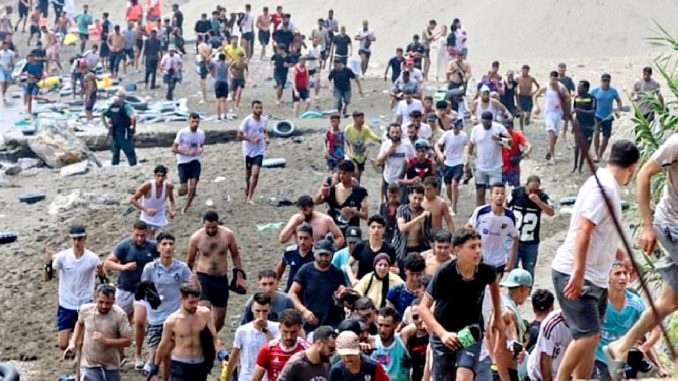
The crisis follows the extraordinary July 30 border surge, when more than 72,000 people entered Ceuta from Morocco, according to Spanish authorities. Most have since left, but thousands remain in the enclave, placing significant pressure on shelters and social services.
 At least 500 migrant girls will be moved from the North African enclave of Ceuta to mainland Spain following reports of sexual assault. Pictured: Women and children who crossed from Morocco into Spain father at a makeshift camp in Ceuta
 Migrant women and children take refuge under tarps and tents in a sports field set up by local residents as an improvised shelter for women and children, following a mass crossing of migrants from Morocco, in the neighboorhood el Principe in Spain’s North African enclave of Ceuta, August 19, 2026
 Migrants live under precarious conditions near the CETI (Temporary Immigrant Reception Centre) facilities on August 16, 2026 in Ceuta, Spain
Sexual-assault reports raise alarm
Spanish authorities have recorded at least 15 reports of sexual assault since the mass influx, with many of the alleged victims being minors. Reuters reported that five women received medical treatment for sexual violence, while other reports have described women living in overcrowded and insecure conditions near reception facilities.
Doctors at Ceuta University Hospital have also reported treating migrant girls following alleged sexual assaults, including several victims under the age of 14.
Authorities have responded by increasing police patrols and calling for safer accommodation, including measures designed to better protect women and children.
Spain prepares to relocate 500 children
The Spanish government announced plans to transfer approximately 500 unaccompanied migrant children from Ceuta to mainland Spain. The move is intended to ease pressure on the enclave’s overwhelmed child-protection system while providing vulnerable minors with more stable accommodation and care.
The decision has generated political controversy, particularly because some opposition politicians argue that children who entered Spain irregularly should ultimately be returned to Morocco when legally possible.
 Police officers escort migrants from the Trampolin beach to a shelter in Ceuta, Spain, 20 August 2026
 Moroccan migrant Wafae Atid sits on her inflatable mattress as workers spray water on the road nearby, near the Temporary Immigrant Reception Center (CETI) in Ceuta, Spain, August 16, 2026
 Police officers escort migrants from the Trampolin beach to a shelter in Ceuta, Spain, 20 August 2026
Ceuta struggles to cope
Ceuta, a Spanish territory on the North African coast, has been placed under extraordinary pressure since the July influx. Thousands of migrants remain in makeshift camps, while local authorities have struggled to provide adequate shelter and basic services.
The Spanish government has opened temporary accommodation and increased security forces in the territory. More than 500 additional officers were deployed as authorities attempted to prevent another mass crossing.
Another border surge remains a concern
Spanish and Moroccan authorities have also been preparing for the possibility of another mass crossing following social-media messages claiming that the border could reopen. Morocco has arrested migrants attempting to reach Ceuta, while Spain has strengthened its border security presence.
The prospect of another surge has heightened concerns among residents already dealing with overcrowding, strained public services and growing tensions.
What’s next?
The immediate challenge for Spain is balancing its legal obligations toward unaccompanied minors with demands for tighter border enforcement and greater public safety. The relocation of hundreds of children may relieve pressure on Ceuta, but it does not resolve the broader question of how Spain and Morocco will manage the thousands of migrants still caught in the aftermath of the border crisis.
💬 Overall Takeaway:
What happened in Ceuta raises a deeply uncomfortable question: how did a situation involving thousands of migrants reach the point where women and children were allegedly being sexually assaulted while authorities struggled to keep the situation under control? Whatever someone’s views on immigration may be, women and children should not have to live in fear of being attacked, and residents should not feel that their neighborhoods have become unsafe.
The reports also raise questions about prevention and accountability. Could stronger screening, better separation of vulnerable women and girls from adult men, adequate shelter, surveillance, faster police intervention and a more coordinated border response have prevented some of these incidents? Those are reasonable questions for authorities to answer.
Just as importantly, the public deserves to know whether the alleged perpetrators have been identified and arrested. Reports of sexual assault should lead to transparent investigations, prosecutions where evidence supports them, and clear communication with victims and the public. If suspects remain at large, authorities should explain why and what is being done to find them.
The apparent difficulty in maintaining order during such a large-scale border emergency also raises legitimate concerns about policing. A police force should not be judged by how many officers are deployed, but by whether people are actually protected when they need help. Ceuta’s crisis demonstrates what can happen when border management, public safety and humanitarian services are overwhelmed at the same time.
For the women and girls affected, this is not simply a political argument about immigration. It is personal. They were people who deserved protection, dignity and security. The lasting lesson for Spain should be that humanitarian responsibility and public safety cannot be treated as competing priorities. Both must be protected—and authorities need a plan to make sure a crisis of this scale does not happen again.
SOURCES: THE GATEWAY PUNDIT – Women Desperate to Flee Spanish City of Ceuta as Rapes Explode in Wake of African Invasion
THE WESTERN JOURNAL – Women Desperate to Flee Spanish City of Ceuta as Rapes Explode in Wake of African Invasion
DAILYMAIL ONLINE – Spain moves 500 migrant girls from Ceuta following spate of rapes since North African ‘invasion‘