The French Ministry of the Interior has found that street violence has reached record levels fuelled in part by the violent student uprisings seen in multicultural hubs across the country in recent weeks.
Reported by:

Cherry Meigh Timbol
News Content Editor
Published October 7, 2026
France is facing a rapidly escalating wave of street unrest as nationwide student demonstrations have increasingly spilled into violent confrontations with police, prompting renewed concerns over public order, political polarization and the ability of the government to contain unrest.
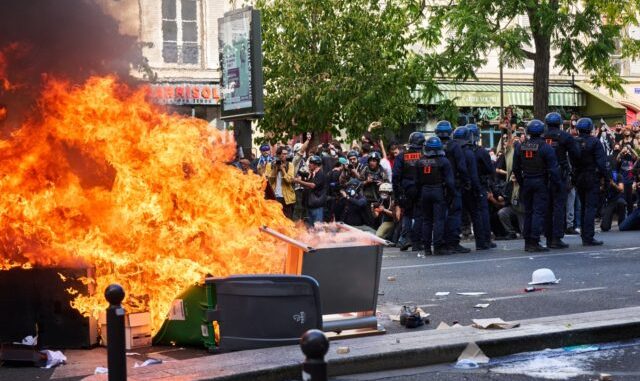
The developments came into sharper focus on October 6, when more than 250,000 people took part in demonstrations across France, according to Interior Ministry figures. Organizers put the number considerably higher. Although the movement began with complaints about schools, teachers, overcrowding and deteriorating facilities, parts of the demonstrations have developed into clashes involving masked youths, fires, projectiles and police interventions.
Street violence reaches a new level
Breitbart, citing French government data reported by Le Figaro, said violence in public spaces outside the home reached roughly 20,000 incidents in September, equivalent to nearly 700 incidents a day. The figure represented a 7 percent increase from August. Breitbart linked the increase partly to the youth unrest that has swept through French cities since September.
France’s Interior Ministry separately reported that several crime indicators increased in September. Physical violence outside the family setting rose 7 percent, while violent theft without weapons increased 8 percent. The ministry cautioned, however, that certain crime statistics are affected by a technical data problem involving recorded property damage, meaning some figures could later be revised.
The distinction is important: the broader monthly crime statistics should not automatically be interpreted as being caused entirely by the student protests.
Nevertheless, the scale of the current unrest has become impossible for French authorities to ignore.
From school protests to street disorder
The demonstrations began largely around education.
Students have complained about overcrowded classrooms, teacher shortages, deteriorating school buildings, long school days and inadequate resources. The protests expanded rapidly from the Paris region to cities across the country.
But the movement has increasingly been accompanied by violence.
Reuters reported that demonstrations on October 6 drew more than 250,000 people according to the Interior Ministry, while police reported 488 arrests and 48 injured security personnel that day. Police used tear gas and water cannons in several cities as some groups clashed with officers.
France’s Justice Ministry has described the violence surrounding the demonstrations as particularly serious, citing attacks on police and education personnel as well as millions of euros in property damage. Authorities have instructed prosecutors to pursue rapid and firm criminal responses and to seek, where legally possible, civil responsibility from parents of minors involved in the violence.
A divided debate over France’s youth
The unrest has triggered an increasingly bitter political argument over what is driving the violence.
The government has accused outside political forces and radical activists of exploiting legitimate student grievances. Critics, meanwhile, argue that authorities are focusing too heavily on policing while failing to address the underlying problems that pushed students into the streets.
The issue has become particularly sensitive because many demonstrators are teenagers.
According to Reuters, thousands of mostly teenage protesters have been arrested since the unrest began, while authorities and rights groups have sharply disagreed over the appropriate use of force.
The debate intensified after a 15-year-old boy lost his hand during clashes with police. On October 7, Interior Minister Laurent Nuñez announced the temporary suspension of stun-grenade use during student demonstrations while the circumstances surrounding the injury are investigated.
Political tensions deepen
The unrest is unfolding only months before France’s next presidential election, making the demonstrations particularly consequential.
Far-left figures, including Jean-Luc Mélenchon, have backed the students and criticized the government’s handling of the protests. On the right, politicians have demanded stronger measures against violent demonstrators and those accused of encouraging disorder.
Breitbart highlighted the participation of La France Insoumise figures and accused elements of the far left of helping to intensify the unrest. Those allegations remain politically contested, while independent reporting confirms that the protests include a mixture of peaceful students, teachers, parents, unions and more confrontational groups.
That distinction matters because describing the entire movement as a single violent uprising risks obscuring the legitimate educational grievances that brought many young people onto the streets in the first place.
Police under growing pressure
French police are increasingly caught between demands to restore public order and accusations that their tactics are escalating tensions.
On October 6, clashes in Paris involved groups of masked protesters, while similar confrontations were reported in Strasbourg, Rennes, Toulouse and other cities. Reuters reported that several storefronts were damaged and police deployed tear gas and water cannons.
At the same time, rights groups and student organizations have criticized the use of crowd-control weapons against minors.
The French government now faces the difficult task of preventing violence without turning peaceful demonstrations into an even larger confrontation.
🧩 Bottom Line:
France’s current crisis is more complicated than a simple story of either student rebellion or law-and-order breakdown. Genuine anger over education and social conditions has brought hundreds of thousands into the streets, but violent elements have transformed portions of the movement into a serious public-order challenge.
The government’s greatest challenge is now finding a way to address legitimate grievances without allowing street violence to become a substitute for democratic politics. With a presidential election approaching, the unrest could become one of the defining political issues of France’s next electoral cycle.
SOURCES: BREITBART NEWS – France Street Violence Hits Record Levels Amid Multicultural Youth Revolts
FOX NEWS – France explodes again as students riot over education