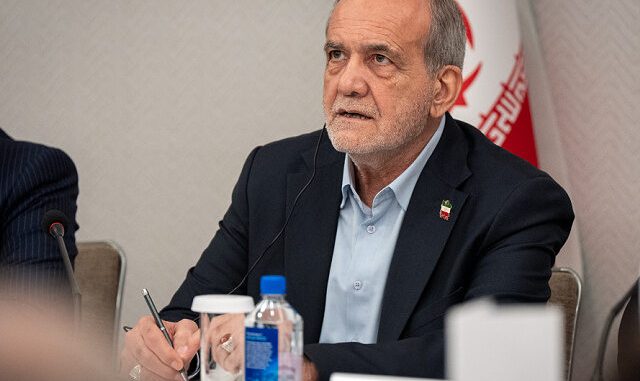
Iranian President Masoud Pezeshkian acknowledged Friday that the U.S. blockade has slashed Iran’s trade and left critical imports
Reported by:

Cherry Meigh Timbol
News Content Editor
Published August 29, 2026
As the Trump administration intensifies what officials describe as an unprecedented campaign of economic isolation, senior figures inside Tehran are openly warning that essential goods are disappearing, imports have slowed dramatically, and growing public frustration could erupt into widespread unrest.
The latest developments mark a significant escalation in Washington’s strategy to pressure the Islamic Republic—not primarily through military force, but by squeezing its financial lifelines, shipping routes, and international trade relationships.
Tehran admits the crisis is worsening
In a striking public acknowledgment, Iranian President Masoud Pezeshkian conceded that U.S. economic pressure has severely disrupted the country’s supply chain, warning that “goods are not coming in” as imports struggle to reach Iranian markets.
Officials say foreign trade has fallen sharply while inflation continues to surge, leaving businesses unable to secure raw materials and ordinary families facing rapidly rising prices for everyday necessities.
The admission is notable because Iranian leaders have traditionally minimized the impact of sanctions, often portraying the economy as resilient despite decades of Western pressure.
Trump doubles down on economic pressure
President Donald Trump has made clear that Washington is abandoning renewed negotiations in favor of an aggressive sanctions campaign aimed at isolating Iran from the global economy.
The administration’s strategy includes:
-
Expanding secondary sanctions against institutions that facilitate Iranian commerce.
-
Pressuring regional trading partners to reduce or suspend business with Tehran.
-
Restricting financial networks used to process Iranian international transactions.
-
Maintaining economic leverage until Iran agrees to meaningful negotiations.
Former National Security Adviser Keith Kellogg has argued that economic pressure offers a more sustainable alternative to renewed military confrontation, while acknowledging that the strategy “will take time” to produce results.
A divided leadership in Tehran
Inside Iran, political leaders are increasingly split over how to respond.
According to Iran International, some officials advocate reopening diplomatic channels through mediators such as Qatar, believing phased negotiations could ease sanctions before the economy deteriorates further. Others insist the government should resist Washington’s demands and simply wait for political conditions in the United States to change.
The debate reflects growing anxiety within Iran’s political establishment over whether the country can withstand prolonged economic isolation without triggering broader domestic instability.
Businesses feel the pressure first
Merchants and importers appear to be among the hardest hit.
Regional trade routes that once supplied Iran through neighboring countries have become increasingly constrained, while tighter enforcement by Gulf states has complicated access to foreign goods and financial services. Analysts warn that disruptions to commercial imports could ripple through nearly every sector of Iran’s economy, from manufacturing to consumer retail.
The result is a widening gap between supply and demand that threatens to intensify shortages and further weaken the Iranian rial.
🧩 Bottom Line:
The battlefield between the United States and Iran is increasingly economic rather than military. Trump’s strategy aims to weaken Tehran by cutting off trade, finance, and commercial access instead of launching new strikes. But the consequences extend far beyond government institutions—they are being felt in bazaars, factories, and family kitchens across Iran. Whether this pressure forces diplomatic concessions or ignites deeper unrest may determine the next chapter of one of the Middle East’s most consequential geopolitical confrontations.
SOURCES: BREITBART – ‘Goods Are Not Coming In’: Tehran Braces for Unrest as Trump Intensifies Economic Offensive
IRAN INTERNATIONALE – Tehran debates waiting out Trump’s economic war