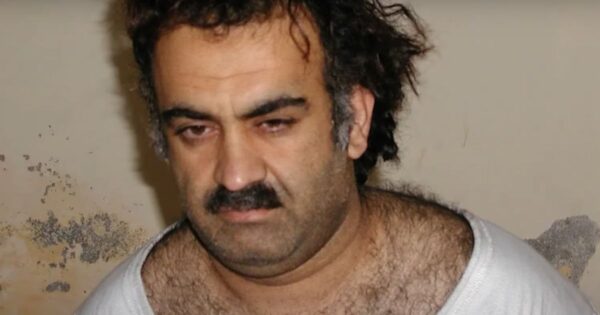
KSM, the Sept. 11 mastermind, is shown shortly after his capture during a raid in Pakistan on March 1, 2003.AP
Reported by:

Cherry Meigh Timbol
News Content Editor
Published August 29, 2026
More than two decades after the September 11 terrorist attacks, the U.S. government’s effort to prosecute the alleged architect of the plot has suffered one of its most significant legal setbacks. A military judge has ruled that Khalid Sheikh Mohammed’s FBI confessions cannot be used at trial, finding they were irreparably tainted by years of torture while in CIA custody.
The decision threatens to reshape one of America’s most consequential terrorism cases and could further delay a trial that has already been stalled for nearly 25 years.

Khalid Sheikh Mohammed is pictured in 2022..
Confessions ruled involuntary
Air Force Lt. Col. Michael Schrama, the military judge overseeing the Guantanamo Bay military commission, ruled that statements Mohammed made to FBI agents in 2007 were not voluntarily given. Although the interviews occurred after he was transferred from CIA black sites to Guantanamo Bay, the court concluded prosecutors failed to prove there had been a genuine break from the coercive treatment he previously endured.
According to reports, Schrama determined the FBI interrogations remained influenced by the “unbroken continuation” of Mohammed’s earlier abuse, making the confessions inadmissible as evidence. The full ruling is still undergoing a national security review before public release.
“The prosecution failed to establish… that Mohammed’s statements to the FBI were voluntary,” the judge concluded.

The Twin Towers are seen after they were struck by planes flown by Al Qaida terrorists, as viewed from the 37th floor of the southernmost building of Waterside Plaza on the East River in New York City on Sept. 11, 2001.Getty Images
A major setback for prosecutors
For years, federal prosecutors considered Mohammed’s FBI interviews among the strongest evidence in their case against the alleged 9/11 mastermind. Without those statements, the government must rely more heavily on classified intelligence, physical evidence, and witness testimony.
Mohammed, who was captured in Pakistan in 2003, spent years in secret CIA detention facilities where he was subjected to enhanced interrogation techniques, including repeated waterboarding, before being transferred to Guantanamo Bay in 2006. His defense has long argued that every subsequent confession was contaminated by that treatment.
The ruling marks the strongest judicial endorsement yet of that argument.
Trial still scheduled for 2028
Just days before suppressing the confession, Judge Schrama scheduled Mohammed and three co-defendants to stand trial beginning June 5, 2028. The date came after the court rejected prosecutors’ request for an earlier trial, citing unresolved pretrial disputes and the extraordinary complexity of the case.
However, legal experts expect the latest ruling to trigger an appeal by the prosecution—a move that could postpone proceedings yet again.

Victims’ families have long feared that Mohammed and his alleged fellow 9/11 plotters could die behind bars at Guantánamo Bay before being found guilty in a court of law.
Families face another painful delay
For relatives of the nearly 3,000 people killed on September 11, the decision is another devastating reminder of how elusive justice has become.
The military commission has endured repeated postponements over classified evidence, torture allegations, procedural challenges, and failed plea negotiations. Many victims’ families worry the accused could spend the rest of their lives in custody without ever reaching a verdict.
Despite the ruling, Mohammed still faces multiple terrorism and murder charges and remains eligible for the death penalty if convicted. The decision affects only the admissibility of his FBI confessions—not the charges themselves.
🧩 Bottom Line:
The court’s ruling does not exonerate Khalid Sheikh Mohammed, nor does it erase the horror of the September 11 attacks. Instead, it underscores a painful reality: America’s pursuit of justice has become inseparable from the legacy of its own post-9/11 interrogation policies. For prosecutors, it is a significant legal defeat. For victims’ families, it is another heartbreaking delay. And for the nation, it raises the enduring question of whether justice can ever be fully achieved when evidence is overshadowed by the methods used to obtain it.
SOURCES: THE GATEWAY PUNDIT – Judge Throws Out 9/11 Mastermind Khalid Sheikh Mohammed’s Confession Days Before 25th Anniversary of September 11 Terror Attacks
THE NEW YORK POST – Judge axes Khalid Sheikh Mohammed’s confession in long-delayed 9/11 terror case — in major blow to feds