Published April 26, 2026
WASHINGTON, D.C. — Chaos erupted Saturday night at the prestigious White House Correspondents’ Dinner after an armed suspect allegedly attempted to breach security and opened fire near the event, sending shockwaves through the nation’s political and media elite.
Authorities have identified the suspect as Cole Tomas Allen, a 31-year-old man from Torrance, California. Law enforcement officials say Allen was taken into custody after a rapid response from Secret Service agents prevented what could have been a far more devastating attack.
Shots Fired Near High-Profile Event
The incident unfolded at the Washington Hilton, where top government officials, journalists, and dignitaries had gathered. Witnesses reported hearing multiple gunshots as the suspect charged toward a security checkpoint.
According to officials, Allen was armed with multiple weapons, including a shotgun and handgun, and attempted to push past security before opening fire.
At least one Secret Service agent was struck, but was protected by a bulletproof vest and is expected to recover. No fatalities were reported.
President Donald Trump, along with the First Lady and other top officials, was immediately evacuated from the scene as agents secured the area.
Suspect Taken Down, Motive Still Unclear
Authorities say Allen was subdued at the scene and taken into custody. Early indications suggest he may have acted alone, though investigators are still working to determine a motive.
Officials believe the attack may have been aimed at members of the Trump administration, possibly including the president himself.
Investigators are now examining the suspect’s electronic devices and background, as he has reportedly not been cooperating with authorities.
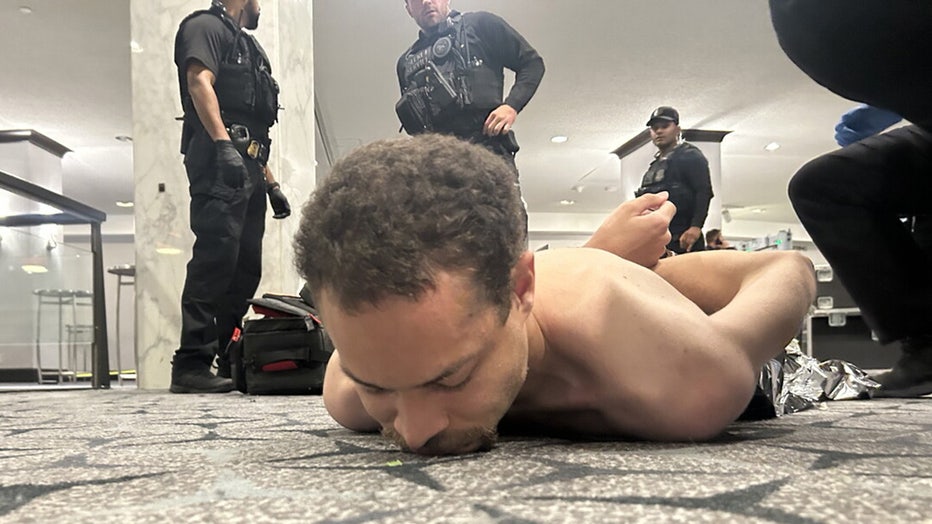
President Donald Trump released an image showing the man accused of opening fire at the White House Correspondents’ Association dinner, on Saturday, April 25, 2026. (Via Truth Social)
A Troubling Profile Emerges
In a twist that has left many stunned, Allen is described as highly educated, with a background in engineering and computer science. He reportedly worked as a teacher and independent game developer and had previously been recognized for academic achievements.
Friends and acquaintances have described him as intelligent and seemingly stable — raising serious questions about what may have driven the violent outburst.
Security Questions Raised
The attack is already sparking renewed concerns about security at high-profile political events. Reports indicate the suspect was able to get dangerously close to the venue before being stopped.
The White House Correspondents’ Dinner, long considered a symbol of the intersection between media and government, now faces scrutiny over whether existing protocols are sufficient in today’s threat environment.
🔍 Critical View:
🛡️ Security Failure
The fact that Cole Tomas Allen was able to get close enough to a major event like the White House Correspondents’ Dinner is deeply concerning. This is not just any gathering — it includes top political figures, media leaders, and high-level security presence, especially with someone like Donald Trump in attendance. Events like this are supposed to have multiple layers of protection: checkpoints, screening, surveillance, and rapid response teams.
So when an armed individual still manages to approach and fire shots, it raises hard questions. Was there a gap in perimeter control? Were security checks rushed or incomplete? Or did the system rely too much on reacting instead of preventing? People expect these events to be locked down tightly, and this situation suggests that even top-tier security can have weak spots.
⚠️ Rising Political Tension
This incident didn’t come out of nowhere. It reflects a larger issue — the growing tension in political discussions across the country. What used to be disagreements over policy has, for many, turned into deep personal anger. Conversations are more heated, and patience for opposing views seems to be shrinking.
When people feel strongly enough, some may cross the line from speech into action. That’s where things become dangerous. Violence or threats tied to political frustration affect everyone, regardless of where they stand. It creates an environment where fear replaces open discussion, and that’s not healthy for any society.
🔍 Missed Warning Signs
Another key concern is whether this could have been prevented earlier. In many past incidents, warning signs were only recognized after the fact — online posts, unusual behavior, or warning reports that didn’t get enough attention.
Now people are asking: did Cole Tomas Allen show any signs beforehand? Was there any digital trail, communication, or behavior that could have raised a red flag? If so, why wasn’t it acted on?
There’s a growing expectation that authorities should not only respond quickly, but also detect threats early. Prevention is always better than reaction, especially when lives are at risk.
🏛️ Trust in Safety Systems
When a security breach happens at such a high-profile event, it doesn’t just stay there — it affects how people view safety overall. If something like this can happen in one of the most protected environments in the country, it naturally makes people wonder about everyday situations.
Public confidence depends on consistency. People want to believe that security systems are strong, organized, and reliable. When those systems appear to fail, even once, it can shake that trust. Rebuilding that confidence requires clear answers, transparency, and visible improvements — not just reassurances.
👥 On the Ground:
🚔 Immediate Response
When gunfire erupted near the White House Correspondents’ Dinner, the shift was instant. What started as a formal, tightly scheduled evening quickly turned into a full emergency situation. Secret Service agents and law enforcement didn’t hesitate — they moved with speed and precision, locking down access points and zeroing in on the threat.
Donald Trump and other high-profile attendees were quickly surrounded and escorted out through secured routes. This kind of rapid extraction shows that emergency planning was in place and practiced. On the ground, seconds matter — and in this case, those seconds likely prevented injuries from turning into fatalities.
😨 Panic and Confusion
For people inside the venue, the experience was far from controlled. Many attendees didn’t immediately understand what was happening. Some thought the sounds were dropped objects or noise from outside — until security began shouting commands.
Guests were told to get down, move away from open areas, or stay behind cover. In a crowded event filled with journalists, staff, and guests, even a few moments of uncertainty can cause panic. People were looking to security for direction, and those early seconds of confusion show how quickly calm environments can break down.
👁️ What Witnesses Noticed
Witnesses later described Cole Tomas Allen as focused and determined as he approached the security area. But in real time, that kind of behavior can easily go unnoticed, especially in a busy environment where people are arriving, talking, and moving around.
This highlights a key issue on the ground: threats don’t always look obvious until it’s too late. Even trained personnel can struggle to separate a real threat from normal crowd behavior in the moment. That’s why early detection — before someone reaches the perimeter — is so important.
🛑 Security Presence vs Reality
There was already a visible and heavy security presence at the event. Armed personnel, checkpoints, and restricted access zones were all in place. But this incident shows that visibility doesn’t always equal effectiveness.
From a ground-level perspective, the challenge isn’t just having security — it’s how that security operates under pressure. A determined individual only needs one opening, one moment of distraction, or one weak point to get through. This situation raises concerns about whether current screening methods and perimeter controls are strong enough for modern threats.
🧍♂️ Everyday People Caught in It
While the focus is often on political figures, the majority of people present were everyday professionals — reporters, photographers, hotel staff, and support crews. These individuals rely entirely on security systems to keep them safe.
When shots are fired, they don’t have protective teams or armored exits. They depend on quick instructions and trust that the system will guide them out safely. Incidents like this highlight how vulnerable regular people can be, even in places that are supposed to be highly secure.
🚑 Aftermath on the Scene
Once the suspect was contained, the scene didn’t immediately return to normal. Emergency personnel moved in to assess injuries, secure evidence, and sweep the area for any additional threats. The mood remained tense, with many unsure if the danger had fully passed.
Events like this leave a lasting impact on those who experience them. Even if physical injuries are limited, the psychological effect — fear, shock, and uncertainty — can stay with people long after the incident ends.
🇺🇸 Ground-Level Reality Check
For those on the ground and those watching from afar, this incident serves as a wake-up call. If something like this can happen at a high-profile, heavily guarded event, it challenges assumptions about safety in other public spaces.
The takeaway is straightforward: fast response is critical, but it’s not enough. People want to see stronger prevention — stopping threats before they even reach the scene. Because once it gets to the point of gunfire, the situation has already gone too far.
🎯 The Final Word:
What happened at the White House Correspondents’ Dinner is more than just a single incident — it’s a warning sign that even the most secure settings are not immune to failure. While the fast action of security teams helped prevent a tragedy, many people are left asking the same basic question: how did someone like Cole Tomas Allen get that close in the first place, especially with high-profile figures like Donald Trump nearby?
For everyday people, the takeaway is simple and practical. Safety should not depend on reacting quickly after something goes wrong — it should be built on stopping threats before they even reach the scene. That means stronger screening, better coordination between agencies, and taking warning signs seriously before they turn into action. It also means creating an environment where disagreements don’t escalate into dangerous situations.
At the end of the day, people aren’t looking for complicated answers — they want to feel secure. They want to trust that major events are truly protected and that the systems in place are strong, reliable, and focused on prevention. Because once a situation reaches the point of gunfire, it’s already too late to say the system worked the way it should have.