Reported by:

Cherry Meigh Timbol
News Content Editor
Published September 29, 2026
Israeli forces continued carrying out strikes and shelling across southern Lebanon on September 27 despite a U.S.-brokered framework intended to halt the fighting and eventually facilitate an Israeli withdrawal from parts of Lebanese territory.
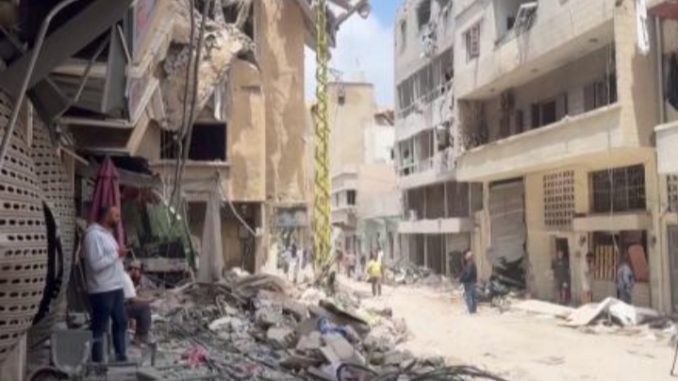
Al Jazeera reported that an Israeli Apache helicopter struck a commercial centre near Mayfadoun, while attacks and destruction were also reported in several other areas of southern Lebanon.
The renewed attacks come amid an increasingly fragile ceasefire arrangement and ongoing disagreements over Israeli military positions, Hezbollah’s weapons and the role of the Lebanese army.
Strikes reported across southern Lebanon
According to Lebanon’s National News Agency, Israeli attacks on September 27 affected areas across the districts of Tyre, Nabatieh, Marjayoun and Bint Jbeil.
Reported targets included Mansouri, Wadi Zibqin, Nabatieh al-Fawqa, Kfar Tibnit, Mayfadoun, Kafr Rumman, Mazraat al-Shomeriya, Al-Qusayr, Beit Yahoun, Safarin and Hadatha.
Several homes were reportedly demolished in Mansouri, while artillery and machine-gun fire were reported in other locations. In Mayfadoun, a strike reportedly destroyed a house.
Israel said the attacks followed what it described as a Hezbollah explosive-laden drone launched toward Israeli forces operating in its declared security zone. Hezbollah had not commented on that specific Israeli claim at the time of the reports.
A ceasefire that has struggled to stop the fighting
The current framework emerged from U.S.-mediated efforts to reduce the fighting between Israel and Hezbollah.
The agreement linked an Israeli withdrawal from occupied Lebanese territory to the deployment of the Lebanese army and the disarmament of Hezbollah.
However, implementation has remained contentious.
Israeli forces have continued operations in southern Lebanon while Lebanon has pressed for an Israeli withdrawal. Israel, meanwhile, has said Hezbollah’s military infrastructure must be dismantled.
Israel says Hezbollah remains a threat
Israel has continued to argue that its military operations are aimed at preventing Hezbollah from rebuilding its military capabilities near the Israeli border.
Earlier this month, Israel said it had destroyed what it described as an underground Hezbollah command and weapons network beneath the Ali al-Taher ridge in southern Lebanon.
The Israeli military said the underground complex included weapons storage, command facilities and living areas.
Israel’s stated position is that continued military action is necessary to prevent Hezbollah from restoring its capabilities in areas close to Israeli territory.
Lebanon says attacks undermine the ceasefire
Lebanese officials have repeatedly criticized the continued Israeli military operations.
Lebanese authorities have described Israeli strikes as a dangerous escalation, particularly after attacks killed civilians and damaged civilian facilities.
Israel has said that its strikes target Hezbollah infrastructure and weapons-related activity rather than civilian institutions.
The competing claims have made it difficult to establish a stable interpretation of the ceasefire’s implementation.
Civilian impact continues
The latest attacks come after several weeks of deadly strikes in southern Lebanon.
Earlier in September, Israeli strikes on Kfar Rumman reportedly killed civilians, including children, according to Lebanon’s Health Ministry. Israel said it had targeted people transferring weapons in the area.
Lebanese authorities have reported thousands of deaths from Israeli strikes since the escalation of fighting. Such casualty figures are provided by Lebanese authorities and are difficult to independently verify during an active conflict.
The continuing attacks have also affected communities attempting to return to areas they had previously left.
Talks remain under pressure
The military escalation is occurring alongside diplomatic efforts to implement the ceasefire framework.
The central dispute remains the sequence of steps: Israel has demanded action against Hezbollah’s military capabilities, while Lebanon has sought an Israeli withdrawal and an end to attacks.
The result is a fragile arrangement in which diplomatic negotiations continue while military activity persists on the ground.
🧩 Bottom Line:
Israeli strikes and shelling continued across southern Lebanon on September 27 despite the U.S.-brokered ceasefire framework. Israel says its operations are aimed at Hezbollah and preventing attacks against its forces, while Lebanese officials and Hezbollah accuse Israel of violating the ceasefire.
With Israeli forces still positioned in parts of southern Lebanon and disagreements over Hezbollah’s disarmament unresolved, the ceasefire remains fragile and the risk of renewed escalation continues.
SOURCES: AL JAZEERA – Israeli strikes continue in southern Lebanon despite ceasefire
TOLO NEWS – Israeli Airstrikes Continue in Southern Lebanon Despite Ceasefire
ABADOLU AJANSI – Israeli airstrikes continue to hit southern Lebanon despite framework deal