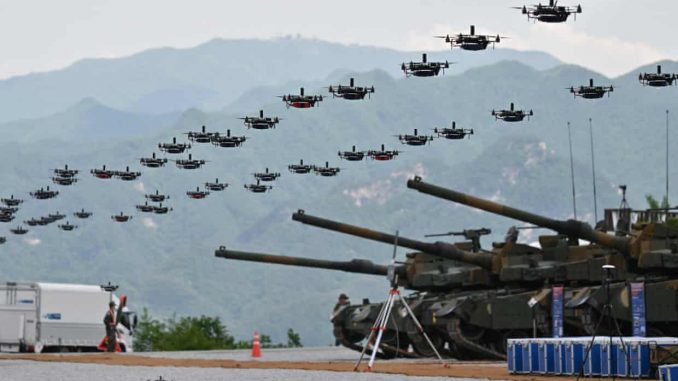
South Korean military drones fly in formation during a military drill in May 2023. Half a million military personnel are to be trained in how to operate drones. Photograph: Yelim Lee/AFP/Getty Images
Published June 26, 2026
WASHINGTON / SEOUL — South Korea is moving to dramatically reshape its military posture for the age of drone warfare, announcing plans to train 500,000 “drone warriors” and massively expand its unmanned aerial capabilities in response to growing threats from North Korea and lessons drawn from modern conflicts such as Ukraine.
The sweeping initiative, revealed by South Korea’s Defence Ministry, calls for drones to become a standard tool for frontline troops, effectively treating unmanned systems as essential battlefield equipment alongside traditional weapons. Officials said the goal is to embed drone operations across all branches of the armed forces — army, navy, air force, and marines — rather than limiting them to specialized units.
The announcement immediately sparked debate among defense analysts, with critics warning that the ambitious scale of the program may outpace South Korea’s current industrial and operational capacity.
A MASSIVE SHIFT IN MILITARY DOCTRINE
Under the plan, South Korea intends to:
- Train half a million military personnel in drone operations
- Deploy tens of thousands of unmanned systems across combat units
- Produce around 110,000 drones by 2029
- Introduce roughly 11,000 drones by 2026 alone
- Expand both offensive drone fleets and counter-drone systems, including lasers and microwave weapons
Defense officials described the shift as a response to the rapidly evolving nature of warfare, where small, inexpensive drones have played decisive roles in conflicts in Ukraine and the Middle East.
A ministry official said drones should be used like a “second personal weapon,” reflecting a vision in which every soldier is both a traditional combatant and a drone operator.
 South Korea’s short-range surface-to-air missile system Chunma is seen during an anti-drone drill in Yangju, South Korea, in this handout picture provided by the South Korean Defence Ministry on December 29, 2022.
COUNTERING NORTH KOREA’S DRONE AND MISSILE PUSH
The program is heavily shaped by rising tensions on the Korean Peninsula.
North Korea has expanded its missile and drone programs in recent years, while also deepening military cooperation with Russia, which South Korean officials say has helped Pyongyang gain battlefield experience in modern drone warfare.
Seoul’s leadership views the buildup as essential to maintaining deterrence, particularly given North Korea’s continued development of long-range strike systems and its growing emphasis on asymmetric capabilities.
The South Korean plan also includes strict requirements to rely on domestically produced components, reducing dependence on Chinese-made technology due to security concerns.
CRITICS WARN OF A “HOLLOW FORCE”
Despite the scale of the announcement, some defense analysts are questioning whether the program is more symbolic than operationally effective.
A separate analysis highlighted concerns that South Korea’s envisioned “500,000 drone warriors” could become a “hollow force” if training, integration, and industrial capacity fail to keep pace with the rapid expansion of doctrine.
Critics argue that while drones have become central to modern warfare, effective deployment requires not just manpower training, but also:
- resilient command-and-control systems
- advanced counter-drone defenses
- secure supply chains for components
- and realistic battlefield integration
Without these, analysts warn, large-scale drone forces risk becoming more theoretical than combat-ready.
 A South Korean soldier with 20mm vulcan cannon takes part in an anti-drone drill in Yangju, South Korea, in this handout picture provided by the South Korean Defence Ministry on December 29, 2022.
A RESPONSE TO THE FUTURE OF WAR
South Korea’s initiative reflects a broader global trend in military planning, where armed forces are rapidly adapting to lessons from Ukraine’s battlefield innovations — particularly the use of inexpensive drones for reconnaissance, targeting, and strike missions.
Military planners say the aim is to ensure that South Korea does not fall behind in what some analysts now call the “drone arms race” on the modern battlefield.
However, the scale and speed of Seoul’s transformation also raise questions about execution.
RISING STAKES ON THE KOREAN PENINSULA
With tensions between Seoul and Pyongyang remaining high, the drone expansion signals a long-term shift in how South Korea intends to deter and respond to threats.
Whether the program becomes a decisive leap in military capability — or an overstretched experiment — will depend on how quickly doctrine, training, and industrial capacity can align with the ambitious vision now being set in motion.
🧩 Reading Between the Lines: South Korea’s Drone Gamble and the Reality Behind the Numbers
More Than a Manpower Announcement
South Korea’s plan to train 500,000 drone operators signals less about immediate battlefield deployment and more about a long-term restructuring of how the military prepares for modern conflict. The scale of the program reflects urgency, but also an attempt to rapidly align doctrine with the realities of drone-heavy warfare seen in recent global conflicts.
A Shift Toward Distributed Warfare
The emphasis on widespread training suggests a move away from elite, centralized drone units toward a model where unmanned systems are integrated at nearly every level of the armed forces. This reflects a belief that future wars will require mass participation in drone operations rather than specialized control structures.
Industrial Capacity Becomes the Bottleneck
Behind the ambitious targets lies a practical constraint: whether South Korea’s defense industry can actually supply, maintain, and upgrade the systems required for such a large operator base. The success of the program may depend less on training numbers and more on production capacity, software integration, and supply chain resilience.
Doctrine Is Still Catching Up to Technology
The scale of the announcement highlights a broader issue seen in many modern militaries — rapid adoption of drone warfare concepts before fully developed operational doctrines are in place. The risk is that training can outpace real-world integration, leaving gaps between theory and battlefield effectiveness.
Deterrence as the Real Objective
Beyond capability building, the announcement also functions as a signal to North Korea and regional actors. The message is not just about readiness, but about deterrence — projecting the idea that South Korea can rapidly scale asymmetric warfare capabilities if conflict breaks out.
🔗 The Stakes: Why This Story Matters
South Korea’s plan to train 500,000 drone operators represents one of the most ambitious military modernization efforts in the region, but it also raises fundamental questions about whether scale alone can translate into real combat effectiveness. The outcome of this program could shape how modern militaries worldwide approach drone warfare and force structure design.
Deterrence vs. Practical Capability
At the heart of the issue is whether the initiative strengthens deterrence or risks overstating readiness. While the numbers signal resolve, the true measure of effectiveness will depend on training quality, system integration, and how well drone units can operate under real battlefield conditions.
Risk of Overextension
Rapid expansion of military programs often creates gaps between ambition and execution. If infrastructure, logistics, and command systems do not scale at the same pace as operator training, the result could be a force that appears large on paper but struggles in coordinated operations.
Regional Security Implications
Given ongoing tensions with North Korea, any perceived weakness or delay in capability development could carry strategic consequences. At the same time, an aggressive build-up may further heighten regional tensions and contribute to an accelerating arms competition centered on unmanned systems.
The Future of Warfare Question
More broadly, the program reflects a global turning point in military thinking: whether drone warfare will be defined by mass participation and distributed control, or by smaller, highly specialized systems. South Korea’s experiment will likely serve as a test case for which model proves more effective.
The Bigger Picture
Ultimately, the stakes go beyond South Korea’s defense posture. The success or failure of this initiative could influence how other nations structure their armed forces in the drone era, making it a reference point for the future evolution of modern warfare.
🏁 The Final Word:
South Korea’s decision to train 500,000 drone operators underscores how rapidly military thinking is evolving in response to modern conflicts and emerging technologies. While the initiative reflects Seoul’s determination to strengthen deterrence and prepare for future threats, its long-term success will depend on more than ambitious recruitment targets. Training quality, industrial capacity, technological integration, and operational doctrine will ultimately determine whether the program becomes a transformative military capability or a difficult-to-sustain experiment. As drone warfare continues to reshape battlefields around the world, South Korea’s approach may offer an early glimpse into the future of armed conflict.
SOURCES: REUTERS – South Korea says to train 500,000 ‘drone warriors’ to counter North Korea
MISSILE DEFENSE ADVOCACY – South Korea’s 500,000 Drone Warriors Will Be a Hollow Force
INTERNAZIONALE – South Korea says to train 500,000 ‘drone warriors’ to counter North Korea