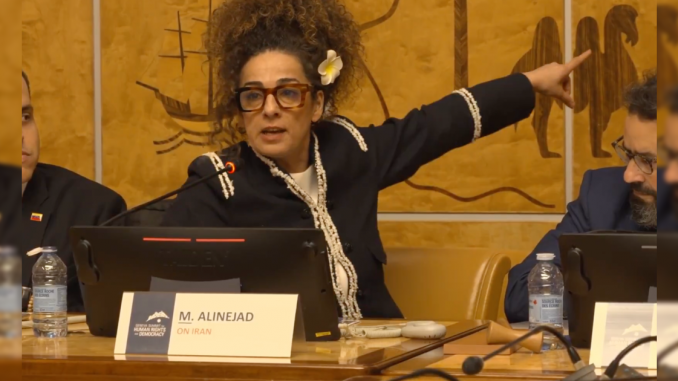
Masih Alinejad/Image: Video screenshot via @AlinejadMasihX
Published February 20, 2025
Iranian-American journalist and women’s rights activist Masih Alinejad delivered a blistering critique of the United Nations Human Rights Council and the broader UN system this week after drawing attention to what she described as an inexplicable and troubling development: the Islamic Republic of Iran being granted an advisory role within UN human-rights bodies.
Alinejad, who now lives in exile and works as a journalist and advocate for Iranians’ rights, accused the United Nations of moral hypocrisy for permitting Tehran — whose government she says is responsible for killing and maiming protesters and suppressing basic freedoms — to sit in advisory capacities on human rights matters.
A Scathing Condemnation at the UN
Speaking publicly on social media and in video clips from United Nations gatherings, Alinejad said she was “confronting a disturbing reality” at the United Nations: that the same regime accused of massacring protesters, shooting demonstrators in the eyes, and suppressing basic freedoms is now positioned to influence discussions at the Human Rights Council.
Her comments reflect deep frustration among many human rights defenders and critics of Tehran who argue that Iran’s human-rights record — including its crackdown on dissent and extensive violations documented by independent monitors — should disqualify the government from advisory or influential roles in UN human-rights mechanisms. Alinejad dismissed such appointments as emblematic of the UN’s failure to uphold its founding principles.
Background: Why the Criticism?
The pushback comes amid broader controversy over Iran’s involvement in international bodies at the United Nations. Critics, including diplomats from several Western countries, have objected when Iranian representatives have been placed in leadership or advisory positions within UN committees and forums — arguing that Tehran’s documented human-rights abuses clash with the Council’s mandate to protect and promote universal rights.
Alinejad’s own history amplifies her message. She is a prominent critic of the Islamic Republic and its treatment of women and dissidents. Her campaigns — such as the My Stealthy Freedom movement against Iran’s compulsory hijab laws — have made her a target of threats and plots by Iranian agents abroad, according to U.S. court filings and media coverage.
Earlier this year, Alinejad also addressed the UN Security Council on the situation in Iran, forcefully condemning the regime’s crackdown and describing Tehran’s actions as akin to extremist violence.
A Symbolic and Moral Outcry
Whether in the halls of the United Nations or on social media, Alinejad’s message has been consistent: she believes the international community — and especially institutions like the UN — must do more than offer symbolic condemnations. Instead, she argues, they should act in ways that meaningfully support Iranian protesters and hold their government accountable.
Her outspoken stance has resonated with many human-rights advocates who see deep contradictions in a system that can permit states accused of serious violations to influence human-rights discourse. But it also raises complex questions about how international organizations balance universality of membership with principled leadership in human rights.
 Implications
1️⃣ Institutional Credibility Crisis
If Iran is granted an advisory role within bodies tied to the United Nations Human Rights Council, critics argue it undermines the credibility of the entire system.
From this perspective:
-
A regime accused of suppressing dissent influencing human rights discussions creates moral contradiction.
-
It weakens public trust in global institutions.
-
It reinforces the idea that the UN rewards membership status over moral accountability.
The broader implication: international institutions may be seen as structurally flawed rather than principled.
2️⃣ Sovereignty vs. Global Governance
This development strengthens arguments that:
-
Nations should not rely heavily on multinational bodies for moral leadership.
-
Sovereign states should prioritize their own values and standards rather than defer to international consensus.
-
Global institutions can be captured or manipulated by authoritarian governments.
It fuels skepticism toward centralized global authority.
3️⃣ Signal to Authoritarian Regimes
Allowing Iran influence in human-rights discussions could be interpreted as:
-
A signal that international condemnation has limited consequences.
-
Evidence that reputational costs are temporary.
-
Proof that strategic alliances and bloc voting inside the UN can outweigh documented abuses.
This may embolden other governments facing similar accusations.
4️⃣ U.S. Policy Implications
For American policymakers, it could:
-
Increase calls to reassess U.S. funding to the United Nations.
-
Strengthen arguments for conditional funding tied to institutional reform.
-
Reinforce pressure to confront Iran more aggressively in diplomatic and sanctions frameworks.
This also aligns with ongoing debates about U.S. leverage inside international bodies.
5️⃣ Political Narrative Impact
Domestically, this story becomes a symbol of:
-
Perceived elite disconnect between global institutions and everyday citizens.
-
Frustration that human-rights rhetoric is selectively enforced.
-
Concern that bureaucratic processes override moral clarity.
It may energize voters who already distrust international organizations.
6️⃣ Strategic Consequence
Long-term, if institutions like the UN appear inconsistent:
-
Democratic nations may form alternative coalitions outside UN structures.
-
Bilateral alliances could gain priority over multilateral diplomacy.
-
Parallel systems of accountability may emerge.
 Overall Takeaway:
The controversy surrounding Masih Alinejad and her condemnation of the United Nations Human Rights Council ultimately centers on legitimacy and moral authority.
When a government widely criticized for repressing dissent is granted influence in a body tasked with defending human rights, it raises serious questions about standards, accountability, and institutional consistency.
From this perspective, the issue goes beyond Iran. It reflects a deeper concern that global institutions may prioritize procedural inclusion over principled leadership. If human rights mechanisms appear compromised, public confidence weakens — and nations may feel compelled to rely more heavily on sovereign decision-making and bilateral alliances rather than multilateral frameworks.
In the end, the debate sparked by Alinejad’s remarks is not just about one appointment. It is about whether international institutions can maintain credibility when their actions seem to contradict their mission.