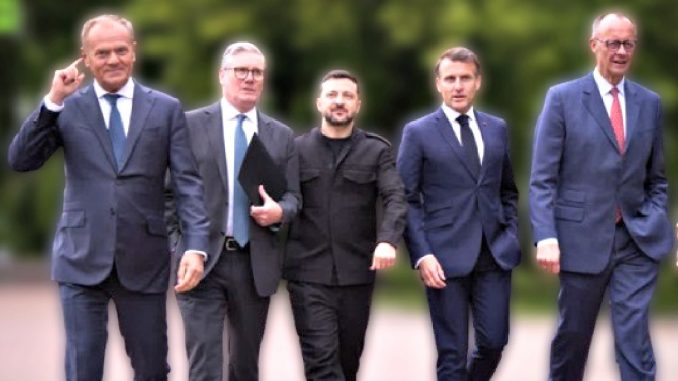
Paper Tigers must now foot the bill: Poland’s Tusk, UK’s Starmer, Ukraine’s Zelensky, France’s Macron, Germany’s Merz
Published April 18, 2026
A senior Pentagon official has issued a blunt warning: Ukraine’s long-term military support can no longer depend on the United States, signaling a major shift in how the war effort will be sustained moving forward.
The message is clear—Europe must take the lead.
A Strategic Pivot Underway
According to defense officials, continued aid to Ukraine “must not rely on significant U.S. contributions,” with allies being urged to step up funding, weapons production, and logistical support.
The shift comes as U.S. military assistance has sharply declined. Data from the Kiel Support Tracker shows American aid dropped by 99% in 2025, even as European nations increased their contributions to fill the gap.
At the same time, Washington has signaled it is still open to selling weapons to Ukraine—but increasingly expects others to pay for them.
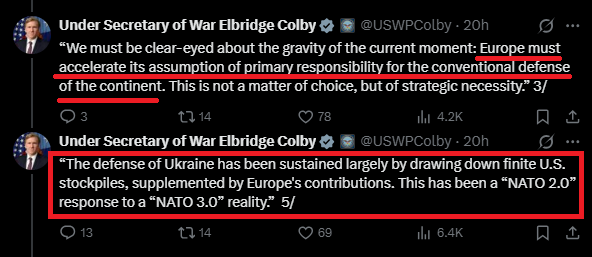
Today, an X thread by Pentagon’s top policy official laid out this new reality in minute detail, warning that from now on, military support for Ukraine cannot depend on the US, urging European allies to take the lead.
Strained Resources and Competing Priorities
Behind the policy shift is a growing reality: U.S. resources are stretched.
Ongoing military operations in the Middle East—particularly the escalating conflict involving Iran—have placed heavy demand on American weapons stockpiles.
Officials have even considered redirecting key systems, including air defense missiles, away from Ukraine to meet urgent needs elsewhere.
This highlights a broader issue: the U.S. is now balancing multiple global conflicts, and Ukraine is no longer the sole priority.
Europe Under Pressure
The shift places increasing responsibility on European nations, many of which have already expanded their financial and military support.
European aid has risen significantly:
- Financial and humanitarian support up by 59%
- Military aid up by 67% compared to previous years
But the question remains whether Europe can fully replace the scale and speed of U.S. support—especially in high-end systems like missile defense.
A Long-Standing Debate Comes to the Surface
The idea that Europe should carry more of the burden is not new. For years, U.S. officials have argued that allies must invest more in their own defense.
Now, that expectation is becoming policy.
Even within NATO frameworks, mechanisms like the Prioritised Ukraine Requirements List (PURL) are increasingly structured around allied funding rather than direct U.S. supply.
This represents a shift from direct assistance to indirect support, where the U.S. plays a secondary role.
What This Means for Ukraine
For Ukraine, the implications are significant.
The country remains heavily dependent on external military aid to sustain its defense. Any reduction or delay—especially in critical systems like air defense—can have immediate battlefield consequences.
At the same time, the transition to a Europe-led support model introduces uncertainty:
- Will funding remain consistent?
- Can production keep pace with demand?
- How quickly can systems be delivered?
These questions remain unresolved.
🔍 Critical View: Pentagon’s Ukraine Shift Exposes the Limits of Endless Commitments
The Pentagon’s warning that Ukraine can no longer rely on sustained U.S. military support isn’t just a policy adjustment—it’s a reality check.
For years, the strategy leaned heavily on American resources, with the assumption that funding, weapons, and logistical backing would continue at scale. That assumption is now breaking down.
And it raises a fundamental question: Was this approach ever sustainable to begin with?
The Cost of Open-Ended Support
Military aid on this scale was never just about helping an ally—it came with long-term consequences:
- Strain on weapons stockpiles
- Financial pressure on taxpayers
- Reduced readiness for other global threats
Now, with rising tensions in other regions, those trade-offs are becoming harder to ignore.
When resources are finite, priorities must be clear. Supporting multiple conflicts indefinitely without clear limits is not strategy—it’s overextension.
Europe’s Role—Delayed but Necessary
The call for Europe to take the lead reflects a long-standing imbalance.
For years, the United States carried the largest share of defense support, while many European nations moved more slowly to scale up their own capabilities.
Now that expectation has changed:
- Europe is being asked to fund more
- Produce more weapons
- Take greater responsibility for regional security
This shift may be overdue—but it also highlights how dependent the system had become on a single contributor.
A Strategy Without an Endgame
One of the most pressing issues remains unanswered:
What is the long-term objective?
Providing aid without a clearly defined outcome creates a cycle where:
- Support continues
- Costs increase
- Resolution remains uncertain
Without a defined end state, policies drift. And when they drift, they eventually collide with political, financial, and military limits—as they are now.
Readiness vs. Commitment
The reported strain on U.S. military resources is not a minor detail—it’s a warning sign.
Redirecting weapons or delaying shipments to meet other global demands suggests that:
- Stockpiles are under pressure
- Strategic flexibility is narrowing
- Priorities are competing in real time
A nation cannot maintain strong global positioning if its own readiness is compromised.
The Risk of Sudden Shifts
For Ukraine, the timing of this shift is critical.
A transition from U.S.-led support to a more distributed model introduces uncertainty:
- Will allies maintain consistent levels of aid?
- Can supply chains keep pace with battlefield needs?
- How quickly can gaps be filled?
Abrupt changes in support structures can have real consequences—not just politically, but on the ground.
The Bigger Lesson
This moment reflects a broader issue in modern foreign policy:
commitments are often made faster than they can be sustained.
Short-term decisions, driven by urgency, can evolve into long-term obligations without clear limits or exit strategies.
Eventually, those obligations meet reality.
👥 On the Ground: Ukraine War Support Shift Leaves Allies, Troops, and Citizens Facing Uncertainty
April 2026 — Washington / Europe / Kyiv
On paper, the Pentagon’s message is strategic: Ukraine can no longer depend primarily on U.S. military support.
On the ground, it feels more like a turning point—and not a smooth one.
Across allied capitals, military planners, defense contractors, and policymakers are now adjusting to a new reality: the burden is shifting, and quickly.
In Europe: Pressure to Deliver, Fast
European governments are being pushed to accelerate:
- Weapons production
- Defense spending
- Logistics coordination
There is movement—but also strain.
Defense industries are working to ramp up output, yet timelines remain a concern. Scaling production of advanced systems is not immediate, and delays could create gaps in supply.
Officials understand what’s at stake. But behind closed doors, there’s growing awareness that matching previous levels of U.S. support is a steep challenge.
In Ukraine: Timing Is Everything
For Ukraine’s military, consistency matters as much as volume.
Shifts in supply—even temporary ones—can affect:
- Air defense coverage
- Ammunition availability
- Operational planning
Uncertainty complicates decisions. Commanders rely on predictable support to plan ahead. When that predictability weakens, so does strategic confidence.
Even a short disruption can have ripple effects on the battlefield.
In Washington: Competing Demands
The shift reflects a broader reality inside the U.S. defense system.
Resources are being pulled in multiple directions:
- Ongoing commitments in Europe
- Rising tensions in the Middle East
- Long-term focus on other global threats
Military stockpiles are not unlimited. Decisions about where to send critical systems are becoming more difficult—and more consequential.
Officials are now weighing not just what can be sent, but what must be held back.
Among the Public: Questions About Priorities
Beyond government circles, there is growing attention to the bigger picture.
In the U.S., citizens are increasingly aware of:
- The financial cost of extended foreign support
- The strain on military readiness
- The absence of a clearly defined endpoint
In Europe, the conversation is shifting toward responsibility:
- How much should each country contribute?
- How quickly can commitments turn into action?
These are no longer abstract debates—they are shaping policy in real time.
A System Adjusting Mid-Conflict
What makes this moment particularly complex is timing.
The support structure for Ukraine is not changing after the conflict—it’s changing during it.
That creates friction:
- Agreements must be renegotiated
- Supply chains restructured
- Expectations reset
Transitions like this are rarely seamless, especially under pressure.
🎯 The Final Word:
In the end, this shift underscores a simple but often overlooked reality: commitments must match capacity. Supporting allies is important, but doing so without clear limits, shared responsibility, and a defined objective leads to strain that eventually forces abrupt change. Asking others to step up is not abandonment—it’s recognition that long-term stability requires balance, not dependency. The real test now is whether this transition is handled with clarity and discipline, or whether it exposes deeper gaps in planning that should have been addressed from the start.