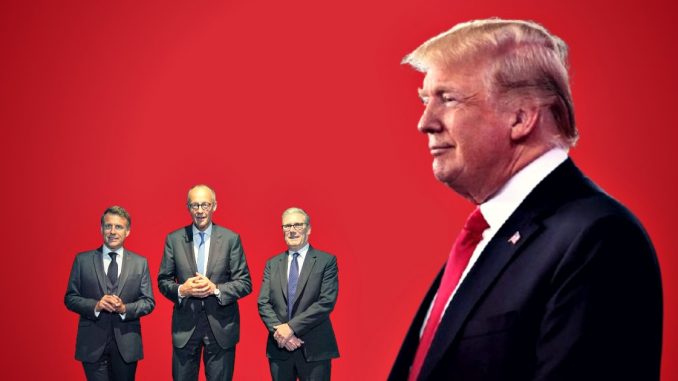
Geopolitical midgets Macron, Merz, and Starmer are again getting trolled by Trump
Published April 18, 2026
President Donald Trump sparked fresh diplomatic controversy after appearing to downplay the role of NATO allies in managing escalating tensions around the Strait of Hormuz, with critics seizing on what they described as a reference to “paper tiger” participation in the crisis response.
According to political readouts and commentary circulating after his remarks, Trump questioned the effectiveness of European involvement in coordinated maritime security efforts, suggesting that key allies were reacting too slowly and contributing little to enforcement operations in the region.
While the White House did not release a formal transcript using the phrase directly, Trump allies and critics alike pointed to his broader criticism of NATO burden-sharing as the basis for the characterization, with some describing his tone as effectively “discarding” or sidelining allied participation in active operational planning.
The phrase “paper tigers” began trending online shortly after, reflecting a growing political debate over whether Western allies are providing meaningful deterrence or merely symbolic support during the crisis.
Context: Longstanding NATO Frustrations Resurface
Trump has repeatedly criticized NATO countries over defense spending and military readiness, arguing that the United States carries a disproportionate share of global security responsibilities.
In the context of the Strait of Hormuz tensions, those frustrations resurfaced as European governments convened emergency talks in Paris to coordinate a diplomatic and maritime response to Iran’s partial reopening of the waterway.
Supporters of Trump’s position argue that NATO responses often rely on U.S. naval and intelligence capabilities while European participation is limited or delayed. Critics, however, say such rhetoric risks undermining alliance unity at a sensitive geopolitical moment.
Europe Responds Separately in Paris
Despite Trump’s remarks, European leaders moved forward with independent coordination efforts, holding emergency discussions in Paris focused on maritime security, oil route stability, and contingency planning should tensions escalate again.
Officials emphasized continued cooperation with the United States, even as political disagreements over burden-sharing and response strategy became more visible.
🧩 Reading Between the Lines: What the Strait of Hormuz Drama Really Signals
The latest headlines around the Strait of Hormuz, Iran’s announcement of a “completely open” waterway, and the parallel diplomatic scramble in Europe are being presented as separate developments. In reality, they point to a single underlying theme: who actually controls global pressure points when tensions rise — and who is reacting after the fact.
1. “Open Strait” — or Controlled Access?
Iran’s declaration that the Strait of Hormuz is “open” is being widely framed as a de-escalation. But the fine print matters.
The Strait is not simply “open” in the normal commercial sense. Reports and official statements suggest shipping remains subject to:
- Iranian security oversight
- Designated routing requirements
- Conditions tied to ceasefire compliance
That distinction is critical. In practice, it looks less like a full reopening and more like a managed release of pressure under Iranian terms.
The takeaway: access is being adjusted, not fully surrendered.
2. Markets React Faster Than Governments
Oil prices dropped quickly on the announcement, and equity markets surged. That reaction reflects something familiar: financial systems respond instantly to perceived stability, even when operational risks remain unresolved.
Shipping insurers and logistics firms, however, are not moving at the same speed. Elevated risk premiums and cautious routing decisions suggest that private-sector actors are treating the situation as fragile rather than resolved.
There is a recurring pattern here:
markets price optimism → governments and operators price risk.
3. Europe’s Emergency Meeting in Paris — Coordination or Catch-Up?
The Paris meeting highlights another recurring geopolitical dynamic: reactive diplomacy.
European leaders convened to discuss maritime security, energy routes, and regional stability. But the timing is important — the meeting followed the announcement, not the escalation cycle that led to it.
That raises a broader question being debated in policy circles:
Are allied institutions shaping events, or responding after key strategic moves are already made elsewhere?
The emphasis on coordination signals awareness of limited direct leverage over the core chokepoint itself.
4. Trump and the Question of Allied Weight
Against this backdrop, Trump’s criticism of NATO participation has become part of the larger conversation.
His argument, consistent with previous positions, centers on a simple claim: burden-sharing and responsiveness are not evenly distributed among allies during high-pressure crises.
The phrase circulating in commentary — describing some allied responses as ineffective or symbolic — reflects a broader skepticism about whether multilateral structures can move fast enough in real-time security situations.
Supporters interpret this as a focus on operational efficiency and deterrence strength. Critics see it as rhetoric that strains alliance cohesion during sensitive negotiations.
Either way, it reinforces a long-running debate:
coordination vs. capability.
5. The Strait of Hormuz as a Power Signal
Beyond the political language, the Strait itself remains the central strategic lever.
Control over this narrow maritime corridor means influence over:
- Global energy supply flow
- Shipping insurance stability
- Regional military positioning
- Price volatility in global markets
Even partial control or conditional access can produce outsized global effects. That is why every announcement around it triggers immediate international reaction.
🔗 The Stakes: What’s Really on the Line Behind the Strait of Hormuz Crisis
The latest developments around the Strait of Hormuz, Iran’s shifting posture, and the rushed diplomatic activity in Europe are being discussed as separate news items. But when viewed together, they point to something much larger: control over global energy flow, credibility of deterrence, and the balance of geopolitical influence in real time.
1. Energy Security Is the Core Issue
At the center of the situation is not just diplomacy — it is energy.
The Strait of Hormuz remains one of the most important maritime chokepoints in the world, carrying a significant share of global oil shipments. Even partial disruption or conditional access can:
- Push oil prices sharply higher
- Disrupt global shipping and insurance markets
- Ripple into inflation and consumer costs worldwide
This is why even announcements of “reopening” or “ceasefire-linked access” move markets immediately. The system is highly sensitive because there is no easy alternative route at scale.
2. Control vs. Access Is the Real Power Question
The key distinction being overlooked in much of the coverage is the difference between:
- A waterway being “open” in name
- And a waterway being freely, independently accessible
When access is conditional, monitored, or subject to approval by a regional power, the strategic balance does not disappear — it shifts.
That means the core issue is not simply whether ships can pass, but who sets the rules of passage during moments of tension.
3. Deterrence Is Being Tested, Not Assumed
Crises like this are rarely about a single announcement. They are about signaling.
Each move — whether it is a ceasefire condition, a naval posture, or diplomatic coordination — is read as part of a broader test:
- How quickly do major powers respond?
- How unified is the response?
- Who ultimately influences outcomes on the ground and at sea?
When responses appear fragmented or delayed, it strengthens the perception that deterrence is negotiable rather than fixed.
4. Alliances Under Pressure
European emergency meetings in Paris highlight a familiar pattern: coordination efforts intensify when situations escalate quickly.
But the underlying challenge remains structural:
- Decision-making across multiple governments takes time
- Military coordination depends on shared capabilities and readiness
- Political consensus often lags behind operational developments
This creates a gap between diplomatic response and real-world speed of events, especially in maritime crises.
5. The Role of Leadership Messaging
Public statements from major leaders during these moments matter because they shape expectations.
When allied coordination is questioned or described in dismissive terms in political discourse, it reflects a deeper debate about:
- Responsibility for global security enforcement
- Effectiveness of multilateral defense structures
- Willingness to act decisively during fast-moving crises
Supporters of stronger unilateral action argue this gap in responsiveness is exactly why clearer, faster decision-making is needed. Critics argue it risks weakening long-standing alliances.
🏁 The Final Word:
In the end, the Strait of Hormuz situation underscores a simple but uncomfortable reality: global stability often hinges on narrow chokepoints where economic dependence, military presence, and political signaling collide. While diplomatic meetings and public declarations suggest progress, the underlying facts remain unchanged—access can be conditioned, deterrence is constantly tested, and markets react faster than governments can coordinate. The real takeaway is that energy security and strategic control are still deeply tied to hard power and swift decision-making, and any perceived hesitation or fragmentation in response only strengthens uncertainty in an already volatile system.
SOURCES: THE GATEWAY PUNDIT – Euro-Globalists Meet in Paris To ‘Discuss’ the Strait of Hormuz, But Iran Has Already Opened the Waterway, and Trump Discards the Participation of the ‘Paper Tigers’
THE NEW YORK POST – Strait of Hormuz ‘completely open’ as Trump celebrates tumbling oil prices, rips into NATO as ‘Paper Tiger’