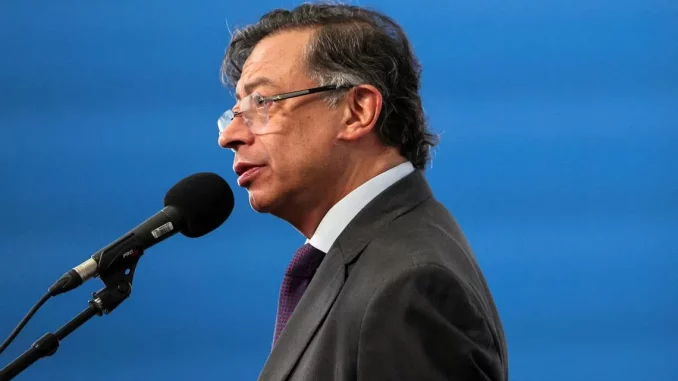
Colombia’s President Gustavo Petro speaks to the press as he arrives at the summit \”In defence of democracy\” in Barcelona, Spain, April 18, 2026. REUTERS/Nacho Doce
Published April 19, 2026
🧩 Reading Between the Lines:
When you zoom out, what Gustavo Petro is saying isn’t just a reaction — it reflects a deeper shift happening across Latin America. The language may sound dramatic, but the underlying message is about influence, control, and how far outside powers should be allowed to go.
1. The Word “Rebellion” — Why It Matters More Than It Sounds
In everyday conversation, “rebellion” might sound like exaggeration. In politics, it’s calculated.
Using that term does a few things at once:
- It rallies support at home by appealing to national pride
- It signals alignment with other governments that feel pressured
- It puts the U.S. on notice without direct confrontation
In simple terms: it raises the stakes without actually taking action.
But here’s the other side — strong language like this can also normalize tension. Once leaders start framing disagreements as existential conflicts, it becomes harder to walk things back later.
2. Sanctions: Tool for Accountability or Political Weapon?
At the center of this issue is how the U.S. uses sanctions.
Supporters of sanctions say they’re one of the few non-military ways to:
- Pressure corrupt officials
- Disrupt drug trafficking networks
- Respond to human rights concerns
Critics, including Petro, argue they:
- Hurt entire economies, not just leaders
- Push countries into deeper crisis
- Can be used selectively depending on politics
In plain language:
Sanctions are like cutting off someone’s access to the financial system. It’s powerful — but it doesn’t always hit only the intended target.
So the real debate isn’t whether sanctions work — it’s whether they’re used fairly and effectively.
3. Sovereignty vs. Standards — Where’s the Line?
Petro’s argument leans heavily on sovereignty: the idea that each country should control its own path without outside interference.
That’s easy to agree with in principle.
But here’s where it gets complicated:
What happens when internal issues — like drug trafficking, corruption, or migration — spill across borders?
In everyday terms:
If a neighbor’s house is causing problems for the whole street, does the street stay silent, or step in?
The U.S. tends to argue that some issues don’t stay contained within one country — and that justifies involvement. Petro is pushing back on that idea.
4. The Regional Strategy — Building a Bloc
This isn’t just about Colombia. Petro’s comments hint at something bigger: a potential alignment of countries with similar views.
Think of it like forming a group chat — strength in numbers. If multiple countries push back at once, it becomes harder for any one of them to be isolated or pressured.
But there’s a practical challenge:
Latin America is not unified. Different countries have:
- Different political systems
- Different economic needs
- Different relationships with the U.S.
So while the idea of a united front sounds strong, pulling it off is much harder in reality.
5. The Economic Reality No One Can Ignore
Here’s the part that often gets overlooked in speeches:
The U.S. is still one of the largest economic partners for many countries in the region, including Colombia.
That means:
- Trade flows both ways
- Jobs depend on exports
- Investments are tied to stability
In simple terms:
You can criticize a business partner — but cutting ties comes at a cost.
This is why even with tough rhetoric, leaders like Petro still maintain working relationships with figures like Donald Trump.
6. Domestic Politics — Speaking to the Home Audience
Statements like this aren’t just aimed at Washington — they’re also meant for voters at home.
Strong messaging can:
- Reinforce leadership image
- Shift focus away from internal challenges
- Unite supporters around a common external issue
In everyday terms:
It’s easier to rally people against an outside force than to fix complex internal problems overnight.
That doesn’t mean the concerns aren’t real — but timing and tone often serve political purposes too.
7. Risk of Escalation — How Words Turn Into Action
Right now, this is mostly rhetoric. But rhetoric shapes behavior.
If tensions keep rising, possible outcomes include:
- Reduced cooperation on crime and security
- Trade friction or economic slowdowns
- More countries choosing sides
And once cooperation drops, problems like drug trafficking and illegal migration can become harder to manage — not easier.
8. The Quiet Reality Behind the Headlines
Despite all the strong statements, there’s an underlying truth:
Both sides still need each other.
- The U.S. needs regional partners for stability and security
- Latin American countries rely on trade, investment, and access to global markets
So while public messaging may sound confrontational, behind the scenes there’s often ongoing negotiation.
In plain terms:
The argument is loud, but the relationship isn’t going away.
🔗 The Stakes:
At first glance, this might look like another political disagreement. But when you dig deeper, what Gustavo Petro is signaling touches on several high-impact areas that can shape everyday life — not just in Colombia, but across the region.
1. Security: What Happens If Cooperation Breaks Down?
For years, countries in Latin America have worked closely with the U.S. on security — especially on drug enforcement and organized crime.
That cooperation includes:
- Intelligence sharing
- Joint operations
- Funding and training
If that relationship weakens, those systems don’t just pause — they weaken.
In simple terms:
Criminal groups look for gaps. When governments aren’t aligned, those gaps get bigger.
And these aren’t small groups — they’re highly organized networks that move drugs, weapons, and people across borders. Less coordination can mean:
- More drugs reaching international markets
- Stronger cartels
- Increased violence in affected areas
This isn’t theoretical — history shows that when enforcement loosens, these networks expand quickly.
2. Drug Trade: A Problem That Doesn’t Stay Local
Colombia has long been a major focal point in the global drug trade.
Efforts to reduce production and trafficking rely heavily on cooperation with the U.S. If tensions rise:
- Anti-drug programs may lose funding
- Joint operations may slow down
- Enforcement may become less effective
In everyday terms:
If pressure drops, supply often rises.
That doesn’t just affect one country — it affects international markets, crime rates, and public health in multiple regions.
3. Accountability: The Risk of “No Consequences”
One of the biggest concerns behind U.S. policy is maintaining accountability.
Sanctions and international pressure are meant to act as guardrails — discouraging:
- Corruption
- Abuse of power
- Criminal involvement at high levels
If those tools are reduced or ignored, the fear is that some leaders may feel less constrained.
Put simply:
Rules only work if there are consequences for breaking them.
Critics of Petro’s position worry that framing all outside pressure as “interference” could remove those guardrails entirely.
4. Economic Ripple Effects: It Hits Ordinary People First
Big political shifts often show up first in the economy.
If relations between Colombia and the U.S. cool down:
- Trade agreements could be strained
- Foreign investment could slow
- Currency stability could be affected
In plain language:
When uncertainty rises, businesses hesitate.
That hesitation can lead to:
- Fewer job opportunities
- Slower economic growth
- Higher cost of living
Even if political leaders intend to push for independence, the short-term impact can be felt most by everyday workers and families.
5. Migration Pressure: A Growing Side Effect
Economic and security instability often lead to increased migration.
If conditions worsen:
- More people may leave in search of work or safety
- Border pressures can increase
- Regional systems can become strained
In simple terms:
When life becomes harder at home, people look for options elsewhere.
This creates challenges not just for one country, but for multiple governments trying to manage migration flows.
6. Power Vacuum: If One Steps Back, Another Steps In
A key concern in this situation is what happens if U.S. influence declines.
Global politics doesn’t leave empty space for long. Other countries — including China and Russia — have been expanding their presence in Latin America through:
- Infrastructure investments
- Trade agreements
- Strategic partnerships
In everyday terms:
If one major player pulls back, others move in.
The concern from a U.S.-aligned perspective is that these new partnerships may come with:
- Different standards on governance
- Less emphasis on transparency
- Long-term economic dependencies
7. Political Contagion: How Ideas Spread
Political messaging doesn’t stay within borders.
If Petro’s stance gains traction, other leaders might adopt similar positions — especially those already skeptical of U.S. influence.
This could lead to:
- A shift in regional alliances
- Less coordinated policy-making
- Increased ideological divisions
Think of it like a trend:
Once one influential figure says something loudly enough, others may follow.
8. Domestic Pressure vs. Global Reality
It’s also important to understand the internal angle.
Statements like these can strengthen a leader’s position at home by:
- Appealing to national pride
- Framing issues as external pressure
- Redirecting focus from domestic challenges
But governing requires more than messaging.
In plain terms:
It’s easier to make strong statements than to manage the consequences that follow.
Even leaders who take a tough public stance — including interactions with figures like Donald Trump — often continue behind-the-scenes cooperation because the practical needs don’t go away.
9. Escalation Risk: From Words to Policy
Right now, this is largely rhetoric — but rhetoric sets direction.
If tensions increase, it could lead to:
- Reduced aid or funding
- Trade restrictions
- Diplomatic pushback
And once policies shift, they can create long-term effects that are hard to undo.
In simple terms:
Words start the process — policies make it real.
🏁 The Final Word:
At the end of the day, what Gustavo Petro is pushing highlights a real tension — countries want independence, but actions don’t happen in a vacuum. When issues like crime, corruption, and economic instability cross borders, other nations will respond, whether it’s welcomed or not. Strong words about “rebellion” may sound bold, but they also risk weakening cooperation that keeps people safer and economies stable. Even leaders who criticize the U.S. still rely on working relationships with figures like Donald Trump, because the reality is simple: stability comes from cooperation, not isolation. The real challenge isn’t choosing between independence or partnership — it’s making sure leadership decisions don’t sacrifice long-term security and accountability for short-term political messaging.
SOURCES: THE GATEWAY PUNDIT – Colombia’s Leftist Petro Warns: US Policy Against Latin American Socialist Countries May Lead to a ‘Rebellion Against Washington’
THE STRAITS TIMES – Colombia’s Petro warns of Latin American ‘rebellion’ if US doesn’t rethink policy
REUTERS – Colombia’s Petro warns of Latin American ‘rebellion’ if US doesn’t rethink policy