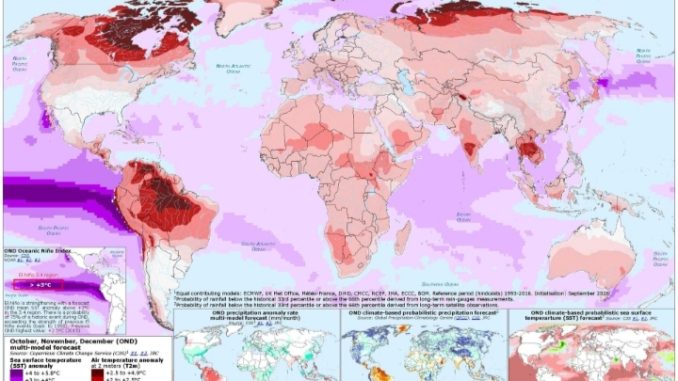
The World Meteorological Organization warns that an exceptionally strong El Niño could intensify heat, drought and flooding in different parts of the world. Its outlook projects Pacific sea-surface temperatures could reach 3.8°C above average during November 2026–January 2027.

by Diana Zapata •
News Writer /Editorial Specialist
Published November 1, 2026
The World Meteorological Organization (WMO) is warning that a potentially historic El Niño event could intensify toward the end of 2026 and continue into early 2027. However, the forecast also raises important questions about how much of the expected temperature increase and changing weather patterns can be attributed to a naturally occurring ocean cycle rather than broader climate trends.
According to the WMO’s October 8 report, sea-surface temperatures in the central and eastern tropical Pacific could reach approximately 3.7°C above the reference average during October–December. The organization says the event could become one of the strongest recorded since 1950.
El Niño is a naturally occurring climate pattern that develops when ocean temperatures in the tropical Pacific become unusually warm. It occurs periodically, generally every two to seven years, and influences rainfall and temperature patterns across different regions.
This distinction is important when interpreting current forecasts. El Niño is not a new phenomenon, nor is its occurrence evidence by itself that human activity has caused a particular weather event.
Natural variability remains an important factor
Historical records show that powerful El Niño events have occurred long before current climate debates. The 1997–1998 and 2015–2016 events, for example, produced significant changes in global temperatures and regional weather conditions.
The current forecast therefore deserves examination within the broader history of ocean-atmosphere cycles.
NOAA acknowledges that El Niño and La Niña are naturally occurring phenomena that have existed for thousands of years. It also recognizes that scientists have limited confidence in predicting exactly how global warming may affect their frequency and intensity.
Forecasts are not the same as confirmed outcomes
Another important consideration is the distinction between projections and actual observations.
Although forecasting models indicate a strong likelihood of an unusually powerful El Niño, the severity of its consequences will vary by location. A strong event does not automatically mean every country will experience record-breaking temperatures, drought or flooding.
The WMO itself acknowledges that regional impacts depend on other oceanic and atmospheric conditions.
Consequently, predictions about future weather conditions should not be presented as though every projected outcome is already established.
Questions surrounding the 1.5°C temperature benchmark
Recent reports have also highlighted global temperatures exceeding the 1.5°C benchmark associated with the Paris Agreement.
Copernicus reported that September 2026 was approximately 1.63°C above its estimated pre-industrial reference level.
However, a monthly temperature reading above 1.5°C is not equivalent to the long-term global warming threshold established under the Paris Agreement.
That distinction deserves greater attention in public reporting. Short-term temperature fluctuations, including those associated with El Niño, should not automatically be interpreted as evidence that a long-term threshold has been permanently crossed.
The importance of examining both sides
The latest El Niño forecasts provide a legitimate reason for governments to prepare for possible droughts, flooding and temperature fluctuations. However, preparation should be based on measurable risks rather than exaggerated predictions or political messaging.
Scientific reporting should also distinguish natural climate cycles from longer-term changes, acknowledge uncertainties in forecasting, and examine historical records before drawing broader conclusions.
Rather than accepting every warning without question, readers should be encouraged to examine the underlying measurements, forecasting methods and historical comparisons.
The central issue is not whether El Niño exists or whether ocean temperatures are changing. It is whether the conclusions being drawn from these observations are supported by sufficient evidence.
SOURCES: WMO – Sea-surface temperatures reflect strengthening El Niño
NOAA – ENSO Diagnostic Discussion
NOAA – El Niño and La Niña Frequently Asked Questions
Copernicus – About the data and methods