Published May 25, 2026
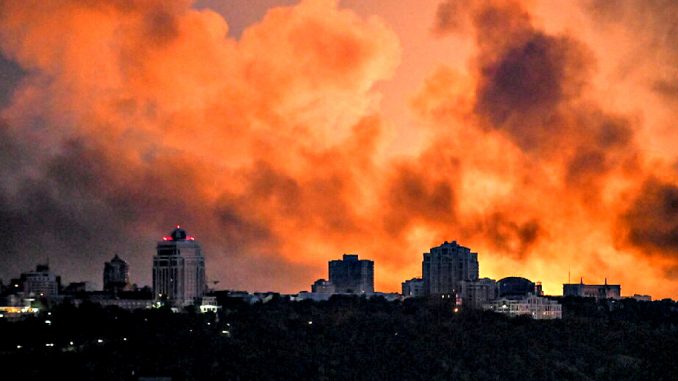
Russia launched one of its largest missile and drone assaults on Ukraine’s capital in months, pounding Kyiv overnight with waves of strikes that Ukrainian officials say included the feared hypersonic Oreshnik ballistic missile. Explosions echoed across the city as civilians rushed into subway stations and underground shelters while air defense systems attempted to intercept incoming projectiles.
According to Ukrainian authorities, at least four people were killed and dozens more injured after residential buildings, infrastructure, and cultural sites were hit in Kyiv and surrounding areas. Reports described fires breaking out across multiple districts as debris from intercepted missiles rained down onto apartment complexes and streets.
Ukraine’s Air Force reportedly warned shortly before the attack that Russia could launch an Oreshnik hypersonic missile, a weapon Moscow has promoted as nearly impossible to intercept. Ukrainian President Volodymyr Zelenskyy later claimed the missile was indeed used during the assault, describing the strike campaign as an act of terror against civilians.
The Kremlin’s Defense Ministry later acknowledged using advanced missile systems, including hypersonic weapons, claiming the attacks were retaliation for alleged Ukrainian strikes inside Russian territory. Moscow insisted the operation targeted military and strategic infrastructure, though footage emerging from Kyiv showed severe damage to civilian areas.
Western leaders quickly condemned the strikes, with European officials accusing Russia of escalating the war through the deployment of nuclear-capable missile technology. Analysts noted that the Oreshnik missile has now reportedly been used multiple times during the conflict, raising fears of a dangerous new phase in the war.
The overnight bombardment also reportedly involved hundreds of drones and dozens of missiles, overwhelming Ukrainian air defenses in what some observers called one of the most coordinated aerial assaults since the start of the full-scale invasion in 2022. Emergency crews continued rescue operations throughout the day as smoke rose from damaged structures across the capital.
Despite repeated Western military aid packages, the latest attack renewed concerns about Ukraine’s ability to defend against increasingly sophisticated Russian hypersonic weapons. Military experts have warned that current air defense systems face major challenges intercepting high-speed ballistic missiles like the Oreshnik.
🚨🇺🇦🇷🇺 | Kiev bajo fuego ruso esta noche. pic.twitter.com/jrBkb0hPn0
— Mundo en Conflicto 🌎 (@MundoEConflicto) May 24, 2026
The reported strike came after Russian President Vladimir Putin ordered the Defense Ministry to “submit proposals” for a response to a Ukrainian drone attack on a teacher training college dormitory in the Lugansk People’s Republic, which left 21 people, mostly teenage girls, dead and 42 injured.
The US Embassy in Kiev had earlier warned American citizens of a “potentially significant air attack” that could occur within 24 hours, advising them to be prepared to take shelter immediately in the event of an air alert.
🧩 Reading Between the Lines:
The scale of the attack appears designed to show that Moscow still has the ability to overwhelm Ukraine’s defenses despite years of Western-backed military support. The reported use of the Oreshnik hypersonic missile may also be intended to demonstrate that Russia possesses weapons capable of challenging even advanced air defense systems.
Questions About Endless Spending
As military aid continues flowing into Ukraine, many people across the United States and Europe are increasingly asking how long governments can continue funding the conflict. Rising living costs, inflation, and economic uncertainty have made foreign spending a growing political issue for taxpayers focused on problems at home.
Fear of a Wider Conflict
Each new escalation increases concern that the war could eventually pull larger powers into direct confrontation. Advanced missile systems, cross-border strikes, and deeper foreign involvement raise the risk of mistakes or miscalculations between countries with nuclear capabilities.
The Future of Warfare
The attack also highlights how modern wars are changing. Large numbers of drones combined with high-speed missiles can overwhelm expensive defense systems. Military experts believe future conflicts may rely more on technology, missile production, and electronic warfare than traditional battlefield tactics.
Civilians Still Paying the Price
While governments debate strategy and military aid, ordinary people continue living through the consequences. Families in Kyiv once again spent the night in shelters as explosions struck residential areas. Long wars often leave behind damaged infrastructure, economic hardship, trauma, and generations shaped by instability.
🔗 The Stakes:
The latest missile barrage on Kyiv is about more than one night of attacks. What happens next in Ukraine could affect global security, energy prices, military spending, and the balance of power between major nations for years to come.
Can the West Sustain Support?
One of the biggest questions is whether Western countries can continue sending billions in weapons, aid, and financial support without political backlash at home. Many voters are increasingly focused on inflation, housing costs, border security, and economic pressures inside their own countries. Leaders supporting Ukraine may face tougher questions from citizens asking how long the financial commitment will continue.
Russia Testing Limits
Russia’s use of advanced missiles may also be testing how far Western nations are willing to go in response. Moscow appears determined to prove it can endure sanctions and continue fighting despite international pressure. If Russia believes its strategy is working, the conflict could drag on much longer than many expected.
Global Security Risks
The danger is no longer limited to Ukraine alone. Increased military involvement from outside countries raises the possibility of accidental escalation between nuclear powers. Even small incidents — such as strikes near borders, drone interceptions, or military miscalculations — could create international crises very quickly.
Energy and Economic Pressure
Wars involving major energy producers often affect the global economy. Continued instability in the region could influence fuel prices, trade routes, food supplies, and inflation worldwide. Families far from the battlefield may still feel the effects through higher transportation, heating, and grocery costs.
The Race for Military Technology
The conflict is becoming a real-world test of modern weapons systems. Hypersonic missiles, drones, electronic warfare, and air defense systems are now central to military planning around the world. Countries watching the war closely may increase defense spending and accelerate weapons development programs in response.
What Victory Even Means
Another growing issue is the lack of a clear definition of success. Ukraine wants to defend its sovereignty and territory, while Russia shows no sign of backing down. Meanwhile, outside nations continue investing resources into a conflict where the end goal remains uncertain. Without a realistic path toward negotiations or resolution, the risk of a prolonged war continues to grow.
🏁 The Final Word:
The massive strike on Kyiv shows that the war is entering a more dangerous and unpredictable stage. Advanced missiles, constant escalation, and growing international involvement are increasing the risks far beyond Ukraine’s borders. While leaders continue debating military aid and strategy, ordinary people around the world are watching rising costs, global instability, and fears of wider conflict grow with each new attack. Many are beginning to question whether endless escalation will lead to peace — or simply deepen a war with no clear end in sight.
SOURCES: THE GATEWAY PUNDIT – Massive Russian Missile Strike Rocks Kiev – Hypersonic Oreshniks Used for the Third Time in the War (VIDEOS)
REUTERS – Russia hits Ukraine with Oreshnik missile in one of war’s biggest attacks on Kyiv
RUSSIAN TIMES – Oreshnik strike reported near Kiev (VIDEOS)