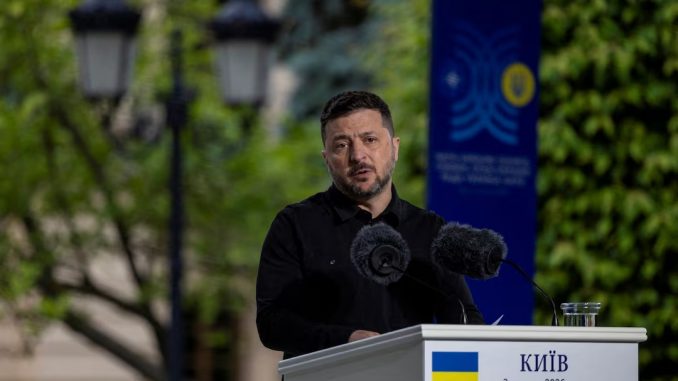
Ukrainian President Volodymyr Zelenskiy speaks during a joint press conference with NATO Secretary General Mark Rutte after talks, amid Russia’s attack on Ukraine, in Kyiv, Ukraine, June 3, 2026. REUTERS/Thomas Peter/File Photo
Published June 25, 2026
KYIV, Ukraine — June 25, 2026 — Ukraine has significantly intensified its long-range strike campaign against targets inside Russia and Russian-occupied Crimea, with President Volodymyr Zelenskyy announcing that Ukrainian forces will conduct preemptive attacks against facilities used to support Moscow’s war effort.
In an evening address, Zelenskyy said he had instructed Ukraine’s military and intelligence services to carry out preemptive strikes on infrastructure that Russia uses to sustain its invasion, signaling a further expansion of Kyiv’s strategy of taking the war beyond the front lines and deep into Russian territory.
The announcement came as Ukrainian drones launched a series of overnight attacks targeting critical Russian energy and communications infrastructure.
According to Ukrainian officials, strikes hit the Orenburg Gas Processing Plant—one of Russia’s largest natural gas processing facilities—as well as satellite communications centers near Moscow and in Russia’s Vladimir region. Ukrainian authorities said the targets were selected because of their importance to Russia’s military and industrial capabilities.
The latest attacks are part of a broader Ukrainian effort to disrupt Russia’s energy sector, military logistics, and command-and-control networks. Kyiv argues that such strikes are necessary to weaken Moscow’s ability to continue the war and to increase pressure on the Kremlin to engage in meaningful negotiations.
Crimea has emerged as a central focus of Ukraine’s deep-strike strategy. Ukrainian forces recently targeted power infrastructure in Sevastopol, the largest city in Russian-controlled Crimea, causing widespread outages and disrupting services across parts of the peninsula. Additional strikes have reportedly targeted railway links, oil facilities, electrical substations, and military assets in an effort to isolate
Crimea from Russian supply networks.
Russian authorities have responded by strengthening air defenses around key strategic locations, including Moscow and the Kerch Bridge, which serves as a critical logistical connection between Russia and Crimea. Satellite imagery and official statements indicate that Moscow is increasingly concerned about the growing range and effectiveness of Ukrainian drone operations.
The intensified drone campaign comes as Russia continues missile and drone attacks against Ukrainian cities. Earlier this week, a Russian strike on Kryvyi Rih killed three civilians and injured dozens more, according to Ukrainian officials. Kyiv has repeatedly called on Western allies to provide additional air-defense systems to counter ongoing Russian bombardments.
Military analysts say Ukraine’s strategy reflects a growing emphasis on long-range warfare as battlefield conditions remain largely static along much of the front. By targeting energy facilities, fuel supplies, transportation routes, and communications infrastructure, Kyiv hopes to increase the economic and military costs of the war for Russia while reducing Moscow’s ability to sustain offensive operations.
Despite the escalation in long-range attacks, prospects for a negotiated settlement remain limited. Both sides continue to exchange large-scale drone and missile strikes, while diplomatic efforts have failed to produce a ceasefire or meaningful progress toward ending the conflict.
 Public / Political Reactions:
🇺🇦 Ukrainian Government and President Volodymyr Zelenskyy
Ukrainian officials defended the expanded drone campaign as a necessary response to Russia’s continued invasion and attacks on Ukrainian cities.
- President Volodymyr Zelenskyy announced that Ukraine would conduct preemptive strikes against facilities used to support Russia’s war effort.
- Ukrainian officials argue that energy facilities, logistics hubs, communications centers, and military infrastructure are legitimate targets because they directly support Russian military operations.
- Kyiv maintains that increasing pressure on Russian territory is necessary to raise the costs of the war for Moscow and improve Ukraine’s position in any future negotiations.
➡️ Position: Ukraine views the strikes as a lawful and necessary strategy to weaken Russia’s war machine and force Moscow to reconsider its military campaign.
🇷🇺 Kremlin and Russian Officials
Russian authorities strongly condemned the attacks and accused Ukraine of escalating the conflict.
- Kremlin spokesman Dmitry Peskov has repeatedly characterized Ukrainian strikes on Russian territory and allied infrastructure as aggressive actions that threaten regional stability.
- Russian officials accuse Kyiv of targeting critical civilian and energy infrastructure inside Russia.
- Moscow has responded by strengthening air defenses around key locations, including Moscow and the Kerch Bridge connecting Russia to Crimea.
➡️ Position: Russia portrays the strikes as dangerous escalation and argues they justify stronger defensive and military responses.
🇪🇺 European Leaders and NATO Supporters
Many European officials continue backing Ukraine’s right to defend itself against Russian aggression.
- Former NATO Secretary General Anders Fogh Rasmussen recently described Ukraine as one of Europe’s most battle-hardened military forces and emphasized its importance to European security.
- Supporters of Ukraine argue that Russia’s continued attacks on Ukrainian cities make military pressure on Russian war infrastructure understandable.
- Several European governments continue advocating military aid, air-defense support, and economic assistance for Kyiv.
➡️ Position: Most pro-Ukraine European leaders view the strikes as part of Ukraine’s broader self-defense strategy against the Russian invasion.
🇺🇸 Western Security Analysts
Military analysts are divided on the long-term effectiveness of the strategy.
- Some experts believe attacks on refineries, gas facilities, and communications centers can disrupt Russia’s military logistics and fuel supplies.
- Others caution that deep strikes could prompt Russia to intensify missile and drone attacks on Ukrainian cities.
- Analysts note that neither side appears close to achieving a decisive military breakthrough despite the escalating drone war.
➡️ Position: Experts see potential military benefits but warn of the risk of further escalation.
🌍 International Observers and Diplomats
Diplomatic observers expressed concern that the conflict is becoming increasingly difficult to contain.
- International mediators continue calling for renewed negotiations and confidence-building measures.
- Humanitarian organizations warn that continued escalation will likely result in additional civilian casualties on both sides.
- Many diplomats fear that expanding attacks deeper into Russian territory could further complicate already stalled peace efforts.
➡️ Position: Diplomats remain concerned that escalating strikes and retaliation cycles are reducing the chances of a near-term peace agreement.
🗣️ Broader Public Reaction
Public opinion remains sharply divided along national and political lines.
- Many Ukrainians view the strikes as justified retaliation after years of Russian missile attacks, occupation, and infrastructure destruction.
- Russian citizens in affected regions have expressed growing concerns about security as drone attacks reach deeper into the country.
- International audiences continue debating whether deep strikes will help bring an end to the war or prolong the conflict further.
➡️ Position: Supporters see the strikes as necessary pressure on Russia, while critics worry they may contribute to a wider and more prolonged conflict.
 Resulting Effects
Ukraine’s decision to expand deep-strike operations against Russian military, energy, and communications infrastructure marks a significant escalation in the war, increasing pressure on Moscow while raising concerns about retaliation and the broader trajectory of the conflict.
1. Increased Pressure on Russia’s War Infrastructure
The strikes are targeting facilities that Ukraine says directly support Russia’s military operations.
⛽ Energy plants, fuel processing facilities, and logistics hubs have become key targets.
📡 Communications and satellite infrastructure have also been targeted to disrupt military coordination.
🚛 Supply chains supporting Russian forces could face additional strain if attacks continue.
➡️ Result: Expanded drone campaign → increased pressure on Russia’s military and industrial support networks.
2. Growing Security Concerns Inside Russia
The attacks demonstrate Ukraine’s growing ability to reach targets far from the battlefield.
🏙️ Regions previously considered relatively safe are experiencing increased drone threats.
🛡️ Russian authorities are being forced to strengthen air-defense systems around strategic sites.
🌉 Critical infrastructure, including transportation and energy facilities, faces heightened security risks.
➡️ Result: Deep strikes inside Russia → increased domestic security concerns and defensive measures.
3. Escalation of the Drone War
Both sides are relying more heavily on long-range drones as the conflict evolves.
🚁 Ukraine continues developing increasingly capable long-range strike systems.
💥 Russia is expected to maintain or expand retaliatory missile and drone attacks.
⚔️ The conflict is becoming increasingly defined by long-range precision strikes rather than major territorial advances.
➡️ Result: Expanded drone operations → intensification of long-range warfare on both sides.
4. Additional Strain on Peace Efforts
The escalation comes as diplomatic negotiations remain largely stalled.
🤝 Prospects for a ceasefire remain limited.
📉 Mutual distrust between Kyiv and Moscow continues to deepen.
🗣️ Each side accuses the other of undermining conditions necessary for meaningful negotiations.
➡️ Result: Increased military pressure → reduced likelihood of near-term diplomatic breakthroughs.
5. Potential Economic Impact on Russia
Repeated attacks on strategic facilities could carry economic consequences.
⛽ Damage to energy infrastructure may affect production and distribution networks.
💰 Increased security and repair costs could place additional burdens on Russian resources.
🏭 Industrial operations may face temporary disruptions if key facilities are successfully targeted.
➡️ Result: Infrastructure attacks → growing economic and operational costs for Russia.
6. Heightened Risk of Retaliation Against Ukraine
Military analysts warn that Russia may respond with additional strikes.
🚀 Ukrainian cities and infrastructure could face intensified missile and drone attacks.
⚡ Energy facilities remain particularly vulnerable targets.
🚨 Civilian populations may continue to bear the consequences of escalating attacks by both sides.
➡️ Result: Ukrainian deep strikes → increased risk of Russian retaliation and further escalation.
7. Shift in the Strategic Balance of the Conflict
The growing reach of Ukrainian drones is altering battlefield calculations.
🎯 Ukraine is increasingly able to threaten targets hundreds or even thousands of kilometers from the front lines.
📍 Russia must now devote more resources to protecting infrastructure deep inside its territory.
⚖️ The ability to strike strategic targets may provide Ukraine with additional leverage in future military and diplomatic negotiations.
➡️ Result: Expanded strike capabilities → changing strategic dynamics across the wider conflict.
 Future Outlook
The coming weeks are expected to be critical as Ukraine expands its deep-strike campaign and Russia weighs its response. With both sides increasingly targeting strategic infrastructure beyond the front lines, the conflict appears to be entering a new phase characterized by long-range warfare, economic pressure, and continued military escalation.
1. Ukraine Likely to Expand Long-Range Strike Operations
Kyiv has signaled that attacks on Russian war-supporting infrastructure will continue.
🚁 Ukrainian drone capabilities are expected to improve further through continued innovation and domestic production.
🎯 Additional energy facilities, logistics hubs, communications centers, and military sites could become targets.
📡 Ukraine is likely to prioritize assets that directly support Russian military operations.
➡️ Outlook: Expanded strike strategy → continued attacks on strategic targets inside Russia and occupied territories.
2. Russia Expected to Strengthen Air Defenses and Retaliate
Moscow is likely to increase efforts to protect critical infrastructure.
🛡️ Additional air-defense systems may be deployed around major cities, military facilities, and energy sites.
🚀 Russia could intensify missile and drone attacks against Ukrainian infrastructure in response.
⚔️ Military planners may adjust operations to counter Ukraine’s growing long-range capabilities.
➡️ Outlook: Persistent Ukrainian strikes → stronger Russian defenses and potential retaliatory operations.
3. Crimea Will Remain a Key Battleground
Russian-controlled Crimea is expected to remain one of Ukraine’s primary targets.
🌉 The Kerch Bridge and associated logistics routes will continue to hold strategic importance.
⚡ Energy infrastructure and military installations on the peninsula may face further attacks.
🚢 Russian efforts to secure Crimea could require additional military and security resources.
➡️ Outlook: Strategic importance of Crimea → continued military pressure on the peninsula.
4. Drone Warfare Will Play an Even Larger Role
The conflict is increasingly becoming a contest of drone technology and adaptation.
🚁 Both sides are investing heavily in long-range drones and counter-drone systems.
📈 Drone production is expected to remain a top military priority.
🔧 Rapid technological innovation will continue shaping battlefield tactics and defenses.
➡️ Outlook: Expanding drone capabilities → greater emphasis on long-range precision warfare.
5. Economic Pressure on Russia May Increase
Ukraine’s targeting strategy seeks to raise the cost of sustaining the war.
⛽ Energy facilities and transportation networks could remain vulnerable.
💰 Russia may face growing expenditures on repairs, security, and infrastructure protection.
🏭 Repeated disruptions could affect industrial and logistical operations in targeted regions.
➡️ Outlook: Continued infrastructure attacks → increased economic and operational pressures.
6. Peace Negotiations Remain Unlikely in the Near Term
Despite international calls for diplomacy, meaningful negotiations appear distant.
🤝 Both sides continue to hold fundamentally different positions on territory and security issues.
📉 Escalating attacks are likely to deepen mistrust between Moscow and Kyiv.
🗺️ Military developments may continue to shape any future diplomatic opportunities.
➡️ Outlook: Ongoing escalation → limited prospects for a ceasefire or negotiated settlement.
7. The War May Become Increasingly Attritional
Military analysts believe the conflict could remain prolonged.
⚔️ Neither side currently appears close to achieving a decisive breakthrough.
🏭 Industrial capacity, economic resilience, and weapons production will remain critical factors.
🌍 International support and geopolitical developments will continue influencing the war’s trajectory.
➡️ Outlook: Prolonged conflict → continued war of attrition with no immediate end in sight.
 Bottom Line
Ukraine’s expanding deep-strike campaign represents one of the most significant shifts in the war’s dynamics since Russia’s full-scale invasion began. By targeting energy infrastructure, communications networks, logistics hubs, and military facilities deep inside Russia and occupied Crimea, Kyiv is seeking to raise the costs of the war for Moscow while reducing Russia’s ability to sustain military operations.
At the same time, the strategy carries substantial risks. Russia is expected to strengthen its defenses and may respond with additional missile and drone attacks against Ukrainian cities and critical infrastructure. As both sides continue to expand their use of long-range strike capabilities, the conflict is becoming increasingly defined by drone warfare and attacks on strategic assets far from the front lines.
With peace negotiations stalled and neither side showing signs of backing down, the war appears poised to remain a prolonged and costly struggle. The success or failure of Ukraine’s deep-strike strategy could play a major role in shaping the military balance, economic pressure, and diplomatic leverage of both sides in the months ahead.
SOURCES: REUTERS – Ukraine to conduct preemptive attacks on facilities Russia uses for war, Zelenskiy says
AP NEWS – Ukraine’s latest long-range strikes on Russia hit a major natural gas plant and satellite centers