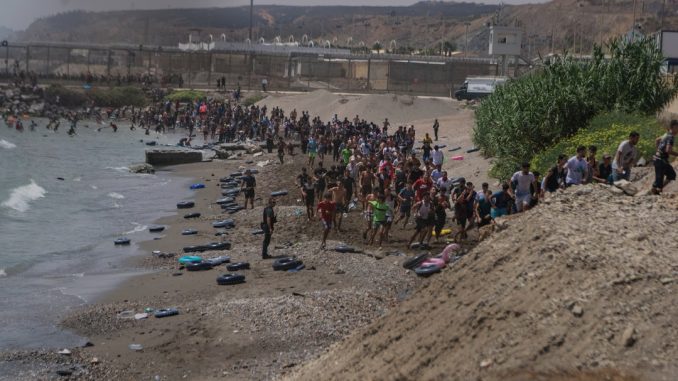
Migrants cross from Morocco to Spanish enclave of Ceuta, June 20, 2026
Published July 31 , 2026
Spain has deployed military forces to its North African enclave of Ceuta after one of the largest illegal migration surges in recent years overwhelmed border security, triggering a humanitarian and political crisis.
 Migrants try to cross from Morocco into the Spanish enclave of Ceuta, Friday, July 31, 2026. (AP Photo/Antonio Sempere)
Credit: AP Photo/Antonio Sempere
According to Spanish officials, thousands of migrants crossed into Ceuta from neighboring Morocco over a matter of days, with estimates indicating that tens of thousands may have entered during the peak of the crisis. Local authorities warned that reception centers have exceeded capacity, leaving many migrants sheltering in public areas while emergency services struggle to respond.
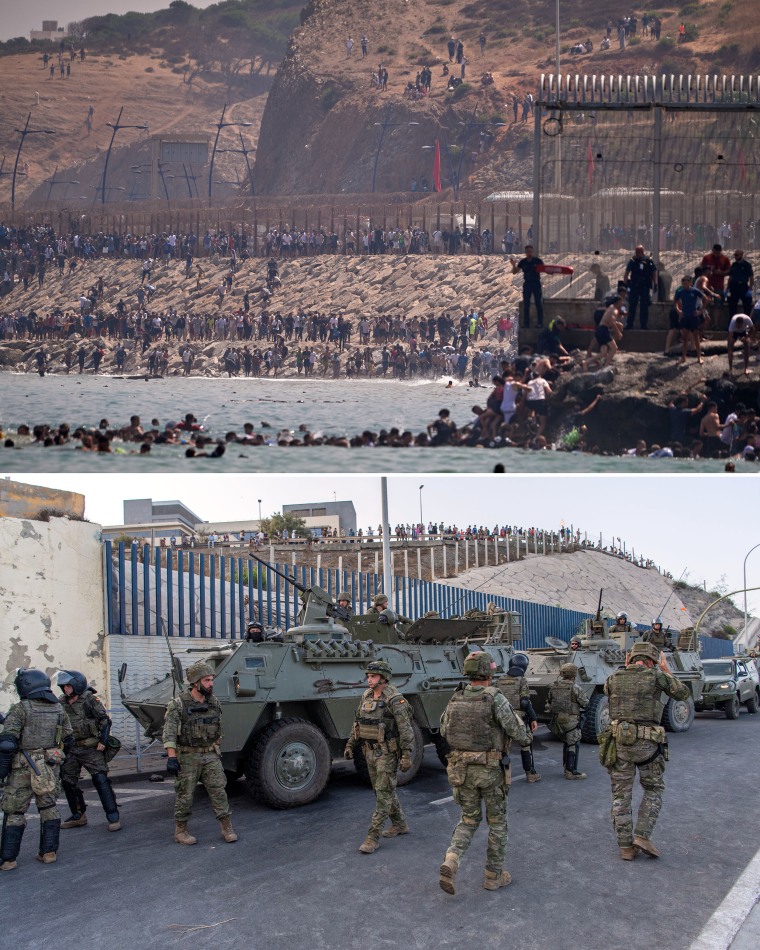
The mass crossings reportedly occurred by both land and sea, with many migrants swimming around border barriers or entering through coastal areas. Spanish authorities confirmed multiple fatalities during the dangerous crossings, prompting an emergency deployment of military personnel to reinforce police and Civil Guard units.
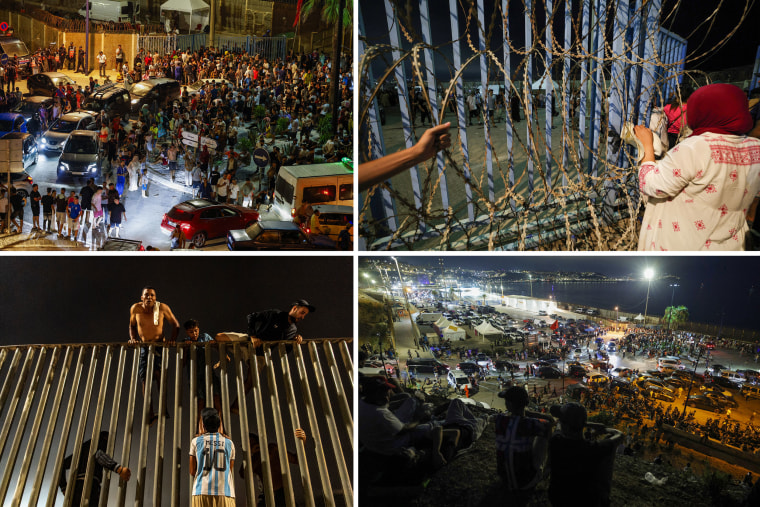
Ceuta President Juan Jesús Vivas called for extraordinary assistance from Madrid, warning that the autonomous city faced an unprecedented emergency that threatened public services and local security. Spain’s central government has since increased security operations while coordinating with Moroccan authorities to manage the situation and accelerate migrant returns where legally permitted.
 Migrants cross from Morocco into the Spanish enclave of Ceuta on July 30, 2026. [Antonio Sempere/AP]
The sudden influx has reignited debate across Spain and Europe over illegal immigration, border enforcement, and asylum policies. Some officials argue that recent legal developments concerning migrant processing may have encouraged additional crossings, although the precise cause of the surge remains under investigation.

Ceuta occupies a strategically important position as one of the European Union’s only land borders with Africa. The enclave has repeatedly experienced migration crises, most notably in 2021, but officials say the current wave is among the most significant in recent memory.
👥 Public / Political Reactions:
🇪🇸 Spain
Spanish authorities have responded by reinforcing security in Ceuta and deploying military personnel to help manage the migrant surge.
- Prime Minister Pedro Sánchez’s government has pledged to restore order and strengthen border security.
- Officials have coordinated with Moroccan authorities to facilitate the return of migrants who do not qualify for international protection under existing agreements.
- Spain has also requested additional support and cooperation from the European Union to address the growing migration pressure.
➡️ Position: Spain considers the Ceuta migrant surge a national security and humanitarian emergency requiring stronger border enforcement and international cooperation.
🇲🇦 Morocco
Moroccan authorities have increased coordination with Spain following the mass crossings.
- Security forces have stepped up patrols along the border to discourage additional illegal crossings.
- Morocco continues to work with Spain on migration management and repatriation efforts.
- Officials have not publicly accepted responsibility for the surge but remain engaged in bilateral discussions.
➡️ Position: Morocco supports continued cooperation with Spain while emphasizing joint responsibility for migration management.
🇪🇺 European Union
European leaders have expressed concern over the renewed migration crisis at one of the EU’s external borders.
- EU officials reaffirmed support for Spain in protecting the Union’s external frontier.
- Discussions have intensified over strengthening border security, migration policies, and burden-sharing among member states.
- Some governments are calling for tougher measures against illegal migration while maintaining humanitarian obligations.
➡️ Position: The European Union supports Spain’s response while seeking long-term solutions that balance border security with international humanitarian commitments.
🌍 Humanitarian Organizations
Aid agencies have urged authorities to prioritize the safety and welfare of migrants.
- Organizations expressed concern over overcrowded reception facilities and the welfare of children and vulnerable individuals.
- Humanitarian groups called for safe processing procedures and access to emergency medical care.
- Several organizations also urged both Spain and Morocco to uphold international refugee and human rights obligations.
➡️ Position: Humanitarian groups support orderly border management but insist that migrants’ rights and safety remain protected.
🇮🇹 Italy and Other European Governments
Several European governments have cited the Ceuta crisis as further evidence of growing migration pressure across the Mediterranean.
- Italian officials renewed calls for stronger external border protection.
- Some governments advocated faster deportation procedures for migrants without legal asylum claims.
- Others emphasized the need for broader cooperation with North African nations to reduce illegal migration.
➡️ Position: Many European governments favor stricter border controls while continuing cooperation with transit countries.
👥 Public Response
Public reaction has been sharply divided.
- Many Spanish residents have expressed concern about border security, public safety, and the strain on local resources.
- Others have emphasized the humanitarian needs of migrants fleeing poverty, instability, or conflict.
- The crisis has fueled renewed debate across Europe over immigration policies and asylum systems.
➡️ Position: Public opinion remains divided between calls for stronger immigration enforcement and demands for greater humanitarian assistance.
🏛️ Broader Political Impact
The Ceuta crisis is expected to influence migration policy debates across Europe.
- Spain may seek additional EU funding and resources for border management.
- The incident could accelerate discussions on reforming the EU’s asylum and migration framework.
- Analysts say future Spain-Morocco cooperation will be critical in preventing similar large-scale migration surges.
➡️ Position: The migrant surge has become a significant political issue that could shape European border and immigration policy for years to come.
⚠️ Resulting Effects:
The surge of illegal migrants into Spain’s North African enclave of Ceuta has placed significant pressure on border security, humanitarian services, and European migration policy. As Spanish authorities deploy military personnel and coordinate with Morocco, the crisis is expected to have both immediate and long-term consequences.
1. Border Security Has Been Significantly Reinforced
Spain has responded by increasing its security presence along the Ceuta border.
🛡️ Military personnel have been deployed to assist police and Civil Guard units.
🚔 Border patrols have been expanded on both land and coastal areas.
🤝 Spain is coordinating closely with Moroccan authorities to prevent additional illegal crossings.
➡️ Result: Large-scale migrant surge → stronger border security and military deployment.
2. Humanitarian Services Are Under Growing Pressure
The sudden influx has strained Ceuta’s limited resources.
🏥 Reception centers have exceeded capacity.
🚑 Emergency medical and humanitarian assistance has been expanded.
👨👩👧👦 Authorities continue providing shelter, food, and basic services while processing new arrivals.
➡️ Result: Overwhelmed facilities → increased humanitarian and emergency response.
3. Spain Faces Increasing Political Pressure
The crisis has intensified domestic debate over immigration policy.
🏛️ National and regional leaders are calling for stronger migration controls.
⚖️ Officials continue reviewing asylum procedures and deportation policies.
🇪🇺 Spain has urged greater European Union support in managing external borders.
➡️ Result: Border crisis → heightened political and policy debate.
4. European Migration Policy Could Be Revisited
The Ceuta emergency has renewed discussion across the European Union.
🇪🇺 Member states are debating stronger external border protection.
📋 Policymakers are reviewing asylum and migration frameworks.
🤝 Additional cooperation with North African partners is expected to become a priority.
➡️ Result: Migration surge → renewed EU discussions on border and asylum policy.
5. Spain–Morocco Cooperation Has Intensified
Both governments are working together to manage the crisis.
🤝 Security coordination has increased along the shared border.
🚨 Authorities are seeking to discourage further illegal crossings.
📡 Bilateral cooperation remains essential to restoring stability in Ceuta.
➡️ Result: Shared migration challenge → stronger Spain–Morocco coordination.
6. Security Challenges Are Expected to Continue
Authorities warn that additional migration attempts remain possible.
⚠️ Smuggling networks may continue exploiting vulnerable migrants.
🚔 Security forces are expected to maintain heightened patrols.
📍 Ceuta will likely remain under increased surveillance until the situation stabilizes.
➡️ Result: Ongoing migration pressure → sustained security operations.
7. Long-Term Impact on European Migration Policy
The Ceuta crisis may influence future migration strategy across Europe.
🌍 EU leaders are expected to pursue stronger cooperation on external border management.
📈 Investment in border infrastructure and surveillance could increase.
🕊️ Long-term stability will depend on continued cooperation between Spain, Morocco, and the European Union while balancing security with humanitarian responsibilities.
➡️ Result: Ceuta crisis → potential reforms to European migration and border management policies.
🔮 Future Outlook:
Spain is expected to maintain heightened security operations in Ceuta while working with Morocco and the European Union to prevent further illegal migration. Although the immediate situation may stabilize, officials warn that migration pressure is likely to continue, making long-term cooperation and policy reforms essential.
1. Spain Will Maintain Enhanced Border Security
Spanish authorities are expected to keep additional security forces deployed in Ceuta.
🛡️ Military and Civil Guard personnel will likely continue reinforcing border operations.
🚔 Coastal and land surveillance is expected to remain at elevated levels.
📡 Authorities will continue monitoring for additional mass crossing attempts.
➡️ Outlook: Continued migration pressure → sustained border security operations.
2. Spain and Morocco Will Expand Cooperation
Bilateral coordination is expected to remain central to managing migration flows.
🤝 Both governments are likely to strengthen border coordination and intelligence sharing.
🚨 Joint efforts may focus on preventing human smuggling and illegal crossings.
📋 Existing repatriation agreements could be used more frequently.
➡️ Outlook: Closer cooperation → improved management of future migration surges.
3. The European Union May Pursue Migration Reforms
The Ceuta crisis is expected to influence discussions across the EU.
🇪🇺 Member states may seek stronger protection of the Union’s external borders.
📖 Policymakers could revisit asylum procedures and burden-sharing mechanisms.
💶 Additional funding for border security and migration management may be considered.
➡️ Outlook: Renewed migration pressure → possible EU policy and funding reforms.
4. Humanitarian Assistance Will Remain a Priority
Authorities and aid organizations are expected to continue supporting migrants already in Ceuta.
🚚 Emergency food, shelter, and medical assistance will likely continue.
🏥 Reception facilities may receive additional resources if arrivals remain high.
👨👩👧👦 Special attention is expected for children and other vulnerable migrants.
➡️ Outlook: Ongoing humanitarian needs → continued emergency assistance and support.
5. Illegal Migration Attempts Could Continue
Officials caution that the factors driving migration have not disappeared.
⚠️ Economic hardship, instability, and conflict in parts of Africa may continue pushing migrants toward Europe.
🌊 Smuggling networks could attempt to organize additional crossings.
🚨 Authorities remain prepared for future migration surges.
➡️ Outlook: Persistent migration drivers → continued risk of new border crossings.
6. Political Debate Across Europe Will Intensify
Migration is expected to remain a major political issue.
🏛️ Governments may face increasing pressure to strengthen immigration enforcement.
⚖️ Public debate is likely to continue over balancing border security with humanitarian responsibilities.
🌍 The Ceuta crisis may influence migration policies in several European countries.
➡️ Outlook: Ongoing border challenges → intensified political and policy discussions.
7. Long-Term Stability Will Depend on International Cooperation
Managing migration will require sustained collaboration beyond emergency responses.
🤝 Spain, Morocco, and the European Union are expected to continue working together on long-term solutions.
📈 Investments in border infrastructure, surveillance, and migration management could increase.
🕊️ Lasting progress will depend on addressing both border security and the underlying causes driving illegal migration.
➡️ Outlook: Continued international cooperation will be essential to reducing future migration crises while maintaining security and humanitarian obligations.
🧩 Bottom Line:
The illegal migrant surge into Spain’s North African enclave of Ceuta has become one of the country’s most serious border crises in recent years, prompting emergency military deployments, intensified cooperation with Morocco, and renewed debate across Europe over immigration and border security.
🛡️ For Spain, restoring control of the border remains the immediate priority, with authorities working to prevent additional illegal crossings while ensuring public safety and maintaining order in Ceuta.
👥 For the migrants, the crisis highlights the dangerous journeys many undertake in search of safety or better economic opportunities, while also underscoring the humanitarian challenges facing frontline communities.
🇪🇺 For the European Union, the Ceuta emergency has renewed calls for stronger external border protection, reforms to migration and asylum policies, and closer cooperation with neighboring countries to address illegal migration.
🌍 For the international community, the situation illustrates the growing complexity of global migration, where humanitarian concerns, national security, and international cooperation must be balanced to achieve sustainable solutions.
➡️ Bottom Line: The coming weeks will be critical in determining whether Spain, Morocco, and the European Union can contain the current crisis and prevent future mass migration surges. While emergency security measures may restore short-term stability, lasting progress will depend on stronger international cooperation, effective migration management, and addressing the underlying factors driving illegal migration.
SOURCES: REUTERS — Leader of Spain’s Ceuta warns of emergency as 1,500 migrants arrive in one week
AP NEWS – What to know about the Spanish enclave of Ceuta as migrant arrivals from Morocco spike
AL JAZEERA – At least 18 die as thousands cross from Morocco into enclave of Ceuta