by Diana Zapata • News Writer /Editorial Specialist
Published August 13, 2026
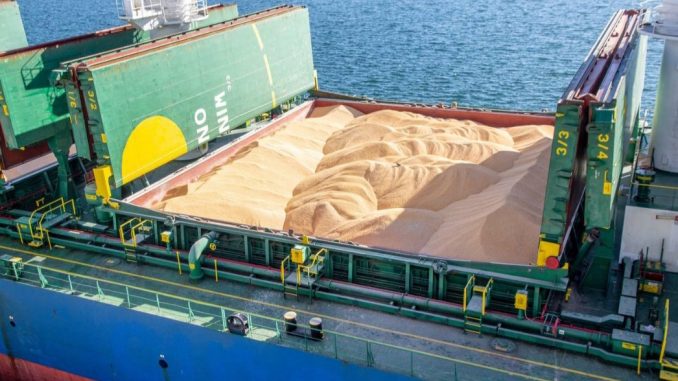
Golden wheat grains representing Ukraine’s vital agricultural harvest, symbolizing the country’s role as a major global grain supplier and the growing threat to food exports caused by the war and disruptions in Black Sea shipping
by Diana Zapata • News Writer /Editorial Specialist
Published August 13, 2026
The war in Ukraine is increasingly becoming a battle over something that reaches far beyond the borders of either country: food.
The latest fighting around Black Sea ports should not be dismissed as another chapter in a long-running military conflict. Russia’s attacks on Ukrainian export infrastructure and Ukraine’s strikes against Russian grain terminals are putting one of the world’s most important agricultural trade corridors under increasing pressure.
That matters because Ukraine and Russia are not ordinary agricultural producers. According to the Food and Agriculture Organization, the two countries together accounted for about 12% of global agricultural trade by calories in 2019–2021. Their combined market shares included approximately 34% of global wheat trade, 26% of barley, 17% of maize and 75% of sunflower oil.
When that much agricultural production is concentrated in two countries at war, the consequences are inevitably global.
Ukraine Has Grain — But the Problem Is Getting It Out
Ukraine’s farmers are facing an extraordinary situation: the fields are producing, but the traditional route to international buyers is being squeezed.
Reuters reports that Ukraine expects a grain harvest of roughly 60 million tons this year, close to the previous year’s level. Yet farmers are struggling to sell and export that production because Russia’s attacks have disrupted Black Sea shipping. Around 90% of Ukraine’s wheat, corn and sunflower exports normally move through the Black Sea.
Reuters reports that Ukrainian agricultural exports were down roughly 75% year-on-year in early August, while Ukraine’s central bank estimates a potential $2.5 billion decline in hard-currency earnings. Farmers could also face around $3 billion in additional logistics costs as they attempt to move grain through more expensive alternative routes.
That is not simply an agricultural problem.
It is an economic and food-security problem.
Russia Is Also Vulnerable
There is another important part of this story that deserves attention.
Russia is itself one of the world’s largest agricultural exporters and the world’s largest wheat exporter, with much of its grain moving through Black Sea ports such as Novorossiysk.
Reuters reported that two major grain terminals at Novorossiysk halted operations after Ukrainian drone attacks this week.
That means the danger is no longer limited to Ukraine’s ability to export food.
Both sides are now putting pressure on the infrastructure that moves food from the Black Sea to the rest of the world.
This creates a dangerous situation in which military calculations can collide directly with global food markets.
The Black Sea Is Becoming a Food-Security Battlefield
The world has already seen what happens when Black Sea grain shipments are disrupted.
After Russia’s invasion, the blockade of Ukrainian ports brought exports close to a standstill. The subsequent Black Sea Grain Initiative, brokered with the involvement of the United Nations and Türkiye, allowed more than 32 million metric tons of food commodities to reach global markets before Russia withdrew from the agreement in 2023.
That history should serve as a warning.
The world does not need Ukrainian and Russian farms to stop producing food for a crisis to develop.
The supply chain itself only needs to break.
Grain sitting inside Ukraine does not feed consumers in Egypt, Africa, Asia or the Middle East. A Russian harvest sitting inside a damaged or threatened export terminal cannot reach international buyers either.
The battlefield has therefore moved beyond trenches and military bases. Ports, ships, storage facilities and agricultural infrastructure have become strategic targets.
The People Far From the Battlefield Could Pay the Price
The most vulnerable countries are not necessarily the countries fighting the war.
Import-dependent nations in Africa and the Middle East have long relied on Black Sea agricultural supplies. Reuters reported that Russian agricultural officials have warned that continued attacks on Black Sea grain infrastructure could push prices higher and threaten supplies to countries in those regions.
And the timing is particularly concerning.
Reuters reported last week that the world was already facing the prospect of another period of food-price inflation, with wars and weather pressures contributing to the risk.
That means the Black Sea crisis is developing against an already fragile global food environment.
A disruption in one region can therefore become a price problem somewhere thousands of miles away.
This Is Where the West Must Pay Attention
For the United States and its allies, the lesson is uncomfortable.
Supporting Ukraine is not only about military assistance or territorial sovereignty. It is also about protecting the international trade system that allows agricultural commodities to move from producing countries to consumers.
But there is another reality: there are limits to how much military escalation can be absorbed without creating additional risks.
If Russia attacks Ukrainian ports and Ukraine responds by destroying Russian grain terminals, the immediate military objective of each side may make sense from its own perspective.
But the global consequence could be much harder to control.
The world could eventually find itself with fewer reliable export routes, higher shipping insurance costs, increased transportation expenses and greater volatility in food prices.
The Bigger Question
The most important question is no longer simply who controls a particular piece of Ukrainian territory.
It is this:
How far will the destruction of Black Sea agricultural infrastructure spread before the international community treats food security as a strategic priority?
The answer should not be left until supermarket prices rise or vulnerable countries begin reporting shortages.
There needs to be greater international pressure to protect commercial shipping and agricultural infrastructure, regardless of which side owns the port.
Food should not become another weapon in a war that has already killed and displaced millions.
Our View
Russia’s blockade and attacks on Ukrainian agricultural infrastructure are putting enormous pressure on Ukraine’s farmers. But Ukraine’s attacks on Russian grain facilities demonstrate that the danger is becoming broader: the entire Black Sea agricultural supply chain is increasingly caught in the crossfire.
This is why the conflict deserves attention far beyond Kyiv and Moscow.
Ukraine can harvest 60 million tons of grain and Russia can remain a global wheat powerhouse, but none of that matters if the ships carrying that food cannot safely reach international markets.
The world should not wait for a global food crisis before recognizing what is happening.
The war in Ukraine is no longer only a fight over land. It is increasingly a fight over the infrastructure that feeds the world — and everyone has a stake in how that battle ends