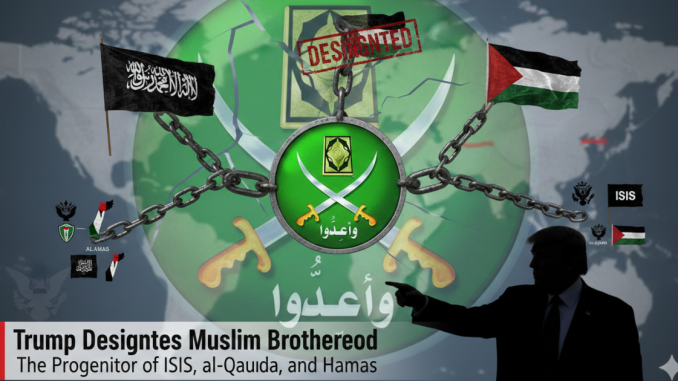
Photo generated by AI using user prompts.
Published February 23, 2025
In a significant shift in U.S. counterterrorism policy, the Biden-era Muslim Brotherhood debate culminated in January 2026 with the United States government formally designating several national chapters of the Muslim Brotherhood as terrorist entities, imposing sanctions under U.S. counterterrorism law.
What the Designation Means
On January 13, 2026, the U.S. Departments of State and Treasury announced that the Lebanese, Egyptian, and Jordanian branches of the Muslim Brotherhood were designated as terrorist entities:
-
The Lebanese Muslim Brotherhood was designated both as a Foreign Terrorist Organization (FTO) and a Specially Designated Global Terrorist (SDGT).
-
The Egyptian and Jordanian Muslim Brotherhood branches were designated as SDGTs for their material support to violent extremist movements.
Under U.S. law, an FTO designation makes providing material support to the group a federal crime, while SDGT status allows the government to freeze any financial assets and block transactions involving the groups and their leaders.
Background: Executive Order and Policy Shift
These actions followed an executive order signed in November 2025 which directed the State and Treasury Departments to review Muslim Brotherhood chapters for terrorism designations. According to that order’s supporters in the Trump administration, it marked a major change in how U.S. counterterrorism policy views the Brotherhood, particularly its historical links to jihadist movements.
Senegal-based counterterrorism figures and commentators within the administration publicly described the Egyptian Brotherhood branch as “the progenitor of all modern jihadists, including al-Qaeda and ISIS,” underscoring the rationale behind the designation.
Why This Matters
The Muslim Brotherhood, founded in Egypt in 1928 by Hassan al-Banna, began as an Islamist socio-religious movement and over decades expanded into a transnational network with varying levels of political and militant activity. While many Brotherhood affiliates have engaged in strictly political or community work, some offshoots and allied organizations — such as Hamas, the Egyptian Islamic Jihad (which eventually merged with al-Qaeda), and others — have been linked to significant violence and terrorism in the Middle East and beyond.
U.S. officials have framed the designation as part of a broader strategy to deter support for extremist violence, particularly in regions where Brotherhood branches have been accused of aiding militant actors or destabilizing local governance. Supporters argue that designations help cut off financing and international networks that could contribute to violent extremism.
Regional and International Reactions
The decision has drawn mixed reactions internationally — with some Middle Eastern governments that have already deemed Brotherhood affiliates as security threats welcoming the move, while others and certain foreign policy analysts caution it could complicate diplomatic relations or inflame regional tensions.
Critics of the policy have argued that designating ideological or political movements carries risks of alienating Muslim communities and potentially driving recruitment toward more radical extremists rather than deterring them — concerns that echoed earlier debates within U.S. policy circles before the final designations.
Broader Counterterrorism Context
The Brotherhood move comes amid ongoing U.S. counterterrorism operations across the globe, including military and intelligence actions against groups such as ISIS and al-Qaeda affiliates. While the Brotherhood’s structure and goals differ from those groups, the Trump administration has highlighted historical linkages between some Islamist extremist ideologies and modern jihadist violence in defending its policy shift.
 Implications of the Muslim Brotherhood Designation: A National Security–First Perspective:
The decision by the Trump administration to designate branches of the Muslim Brotherhood as terrorist entities marks a major recalibration of U.S. counterterrorism doctrine. By linking the Brotherhood’s ideological roots to modern jihadist organizations such as ISIS and al-Qaeda, the administration signals that it sees the threat not merely as operational, but foundational.
Here are the broader implications from a national sovereignty and security–driven standpoint:
1. Redefining the Battlefield: Ideology as Infrastructure
For decades, U.S. counterterrorism policy has focused primarily on armed groups carrying out attacks. This move shifts attention upstream — toward ideological incubators that critics argue provide intellectual and organizational soil for violent extremism.
By targeting what officials describe as the ideological progenitor of groups like ISIS and al-Qaeda, the administration is effectively stating that:
-
Extremism begins long before violence.
-
Networks, funding pipelines, and ideological ecosystems matter.
-
Preventative designation can be as important as reactive military action.
This reflects a broader philosophy: security policy should not wait for a group to detonate bombs before taking action.
2. Financial Warfare as a Strategic Tool
Designation as a Foreign Terrorist Organization (FTO) or Specially Designated Global Terrorist (SDGT) entity allows the U.S. government to:
-
Freeze assets
-
Block financial transactions
-
Criminalize material support
-
Restrict travel and visas
This approach prioritizes economic pressure over prolonged military engagement. The strategy is clear: disrupt networks financially before they become kinetic threats.
It represents an expansion of post-9/11 counterterror finance doctrine — treating financial systems as battlegrounds rather than neutral infrastructure.
3. Stronger Alignment With Certain Middle Eastern Allies
Several Middle Eastern governments — including Egypt and others — have long treated Brotherhood branches as security threats. By aligning U.S. policy with those positions, Washington strengthens bilateral ties with governments that view political Islam as destabilizing.
This has two effects:
-
Reinforces strategic partnerships in the region.
-
Signals that U.S. foreign policy will prioritize regime stability and counter-extremism over ideological neutrality.
4. Immigration and Domestic Policy Ripple Effects
The designation could influence:
-
Visa vetting procedures
-
Refugee screening standards
-
Charitable organization oversight
-
Campus and NGO funding scrutiny
If ideological affiliation becomes grounds for enhanced screening, domestic policy could increasingly mirror foreign counterterror classifications.
Supporters argue this protects national security. Critics warn about civil liberties implications — a debate likely to intensify.
5. Messaging to Global Islamist Movements
By formally linking the Brotherhood to modern jihadist violence, the U.S. government is making a rhetorical shift:
It is no longer distinguishing sharply between “political Islam” and violent jihadism when ideological lineage is present.
This sends a message that ideological ambiguity will not shield organizations from designation if they are viewed as contributing to extremist ecosystems.
6. Risk of Diplomatic Friction
Not all U.S. allies share this view of the Brotherhood. Some countries allow Brotherhood-affiliated political parties to operate legally. The designation could:
-
Complicate diplomatic engagements
-
Create tension within NATO and EU relationships
-
Force partner governments to clarify their own positions
However, from a security-first lens, clarity may be seen as preferable to ambiguity.
7. Long-Term Strategic Doctrine Shift
If this designation becomes institutionalized rather than administration-specific, it signals a deeper doctrine:
-
The U.S. may increasingly treat ideological movements as national security threats.
-
Counterterror policy may broaden from targeting violence to targeting enabling networks.
-
Preemptive legal tools may replace reactive military responses.
This represents a move toward a doctrine of early containment rather than late-stage retaliation.
 Overall Takeaway: