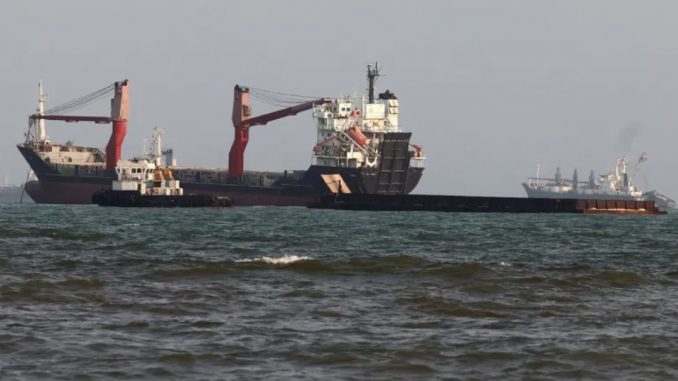
Vessels in the Strait of Hormuz, off the port city of Bandar Abbas [Atta Kenare/AFP]
by Diana Zapata • News Writer /Editorial Specialist
Published August 13, 2026
TEHRAN, Iran — Iran is pushing back forcefully against President Donald Trump’s claim that the United States has “total control” of the Strait of Hormuz, accusing Washington of badly miscalculating Tehran’s ability to maintain control over the strategic waterway.
Iranian Foreign Minister Abbas Araghchi warned Thursday that the United States could be making an “even bigger miscalculation” over the strait, arguing that previous American intelligence assessments had underestimated Iran’s capabilities and resilience.
The warning came only hours after Trump declared that the United States had secured control of the critical maritime passage and indicated that Washington intended to keep it.
Iranian officials, however, maintain that the situation on the ground tells a different story.
A senior Iranian official said the Strait of Hormuz remains under Iran’s control and management, directly challenging Trump’s assertion and describing the American claim as propaganda.
Iran’s ‘Miscalculation’ Argument
At the heart of Tehran’s response is the claim that Washington misunderstood Iran’s ability to withstand military pressure.
Araghchi has argued that U.S. intelligence failures contributed to earlier miscalculations about Iran, including assessments of how quickly military pressure would force Tehran to change course.
Now, Iran is warning that Washington could be repeating the same mistake with Hormuz.
The message from Tehran is straightforward: military superiority does not automatically translate into political or operational control of the waterway.
The Strait of Hormuz is a narrow but crucial passage connecting the Persian Gulf with the Gulf of Oman and Arabian Sea. Its importance gives Iran a powerful strategic position, even as American naval forces operate in the region.
Trump Claims ‘Total Control’
Trump’s position is dramatically different.
The president said the United States has “total control” over the Strait of Hormuz and suggested Washington intends to maintain that control.
His declaration came as the U.S. continues efforts to protect shipping and pressure Iran following the collapse of earlier arrangements surrounding navigation through the waterway.
Iran has rejected the idea that Washington can unilaterally determine when the strait is open.
The Iranian government has said the waterway will not return to normal operations until its conditions are met.
The Real Test: Ships
The competing claims ultimately come down to what happens to commercial vessels attempting to transit the strait.
Despite Trump’s assertion of American control, maritime traffic remains dramatically disrupted. The Wall Street Journal reported that only a small number of vessels have recently crossed the waterway compared with prewar levels, while threats and high insurance costs continue to discourage shipping companies.
That creates a difficult reality for both sides.
Washington can deploy overwhelming military power to protect shipping, but Iran’s ability to threaten vessels, impose costs and disrupt normal commercial traffic gives Tehran leverage that cannot easily be dismissed.
A High-Stakes Showdown
The dispute over Hormuz has therefore become more than a disagreement over terminology.
For Trump, demonstrating American control would reinforce the credibility of the U.S. military campaign and Washington’s negotiating position.
For Iran, demonstrating that it can continue restricting or influencing traffic would show that American military superiority has not translated into complete control of the waterway.
The two sides are now presenting fundamentally opposing versions of reality.
Trump says America controls Hormuz. Iran says Washington has miscalculated.
What happens to commercial shipping in the coming days may provide the clearest indication of which side can actually impose its will on one of the world’s most strategically important waterways.
💬 Overall Takeaway:
Iran’s message is essentially a warning that the United States may be underestimating Tehran’s ability to disrupt or influence the Strait of Hormuz. While President Trump says the U.S. has “total control,” Iran argues that military superiority does not automatically translate into complete control of the waterway.
The real question is not simply who has the stronger military, but whether the U.S. can actually keep commercial shipping moving safely and consistently. If Iran can continue creating uncertainty around the strait, it retains an important bargaining tool despite America’s superior military capabilities.
Iran is challenging Trump’s claim of total control and warning that Washington may have misjudged the difficulty of forcing the Strait of Hormuz back to normal operations.
SOURCES: FOX NEWS – Iran says US miscalculated over Strait of Hormuz despite Trump’s claim of ‘total control’
TASNIM NEWS AGENCY – Araqchi Warns US of ‘Bigger Miscalculation’ over Strait of Hormuz
THE WALL STREET JOURNAL – Trump Says Hormuz Is Under U.S. Control. Few Ships Are Listening.