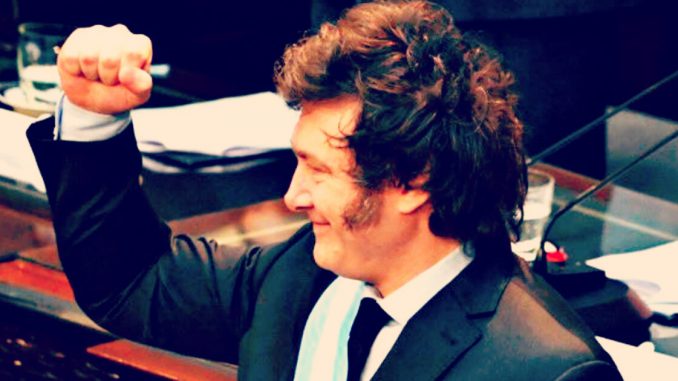
Milei is taking on the Globalists and shielding Argentina from the WHO’s nefarious plans.
Published March 19, 2025
Argentina under President Javier Milei has taken another major step in aligning itself with the growing global backlash against unelected international bureaucracies. After signaling its intention earlier, Buenos Aires confirmed its withdrawal from the World Health Organization, echoing the United States’ own break with the Geneva-based body under President Donald Trump. Argentina’s government said the move was driven by “deep differences” with the WHO, especially over its handling of the COVID-19 era and what officials described as political interference in global health policy.
The decision is about far more than health policy. It is part of Milei’s broader worldview: national sovereignty comes first, supranational institutions should not dictate domestic policy, and countries should not be trapped funding organizations they believe failed in moments of crisis. Argentine officials specifically pointed to the WHO’s pandemic-era conduct and its lack of independence from political pressure as reasons for walking away. That argument closely mirrors the case made by the Trump administration, which accused the WHO of mismanagement, weak accountability, and politicization.
For Milei, the withdrawal also fits neatly into his larger political identity. He has built his reputation on confronting entrenched establishments, slashing bureaucracy, and challenging international consensus where he believes it undermines national self-government. Leaving the WHO allows him to send a message both to Argentine voters and to foreign allies: Argentina will not outsource critical decisions to global agencies that it views as compromised or ineffective. Reuters reported that Argentina and U.S. officials later reaffirmed their withdrawals together, underscoring how closely aligned the two governments had become on this issue.
Critics, of course, argue that leaving the WHO could weaken Argentina’s access to international coordination on disease surveillance, vaccines, and health emergencies. Supporters counter that international cooperation does not require blind obedience to one centralized institution, especially one whose credibility took a beating during the pandemic. In their view, governments can still cooperate bilaterally or through alternative arrangements without submitting to the policy framework of an organization they no longer trust. That is the core divide: whether the WHO is a neutral health body worth reforming from within, or a failed bureaucracy too compromised to deserve continued membership and funding.
 Public / Political Reactions
1. Milei’s government framed it as a sovereignty victory
Foreign Minister Pablo Quirno said Argentina’s withdrawal became effective on March 17, 2026, one year after formal notification, and stressed that the country would still pursue health cooperation through bilateral and regional agreements while preserving control over its own health policies. That tells you the government wants this seen not as isolation, but as a reclaiming of national decision-making.
2. The original political messaging was sharply anti-WHO
When the exit was first announced in February 2025, presidential spokesman Manuel Adorni said the decision came from “deep differences” with the WHO, especially over its COVID-era management and what the government described as outside political influence. Milei himself has been one of the region’s loudest critics of lockdown-era global health policy, so supporters are likely reading this as him doing exactly what he promised.
3. Supporters will likely celebrate it as a rejection of global bureaucracy
Among Milei backers and sovereignty-focused political allies, this move is being received as a stand against unelected international institutions. The government’s language has consistently leaned on “health sovereignty,” non-interference, and independence from supranational pressure. That gives supporters an easy political message: Argentina answers to Argentines, not Geneva. This is partly an inference from the government’s repeated framing and public statements.
4. Critics are likely to frame it as ideological theater with practical risks
Coverage of the move has highlighted concerns that leaving the WHO could reduce Argentina’s formal access to international coordination during future health emergencies. Even where full opposition quotes were limited in the reporting I found, the clear line of criticism is that Milei is prioritizing ideology and symbolism over institutional cooperation in public health.
5. Internationally, the move reinforces Milei’s alignment with Washington
A big part of the reaction is geopolitical, not just medical. Argentina is being seen as following the U.S. lead, which strengthens Milei’s image as one of the most openly aligned foreign leaders in Trump’s orbit. That makes the withdrawal look like both a policy choice and a political signal about who Argentina sees as its closest model and partner.
6. Public reaction will probably be polarized, just like Milei himself
Given Milei’s broader political climate, this is unlikely to produce a neutral response. His supporters tend to view these kinds of breaks with global institutions as bold and overdue, while opponents tend to see them as disruptive and reckless. I did not find fresh, high-quality polling specifically on public opinion about the WHO exit in the quick search, so that part should be described carefully as political polarization rather than a measured public consensus.
BREAKING NEWS: Argentina Officially WITHDRAWS From The World Health Organization
Thanks to President Javier Milei following President Trump's lead pic.twitter.com/WfdCFNxBhb
— Sergeant News Network (@sgtnewsnetwork) March 18, 2026
 Resulting Effects:
1. Argentina regains full policy independence in public health
The clearest effect is that Buenos Aires no longer has to remain tied to the WHO’s institutional framework when setting health policy. Milei’s government has made “health sovereignty” the centerpiece of the move, arguing that Argentine officials—not foreign bureaucrats—should make final decisions during crises. That gives the administration more room to reject outside pressure and tailor responses to national priorities.
2. The government can pursue cooperation without surrendering control
Argentina has said it will continue working through bilateral agreements and regional forums even after leaving the WHO. That means the practical effect is not necessarily isolation, but a shift away from centralized global management toward more selective partnerships. Supporters of the move will see that as a cleaner model: cooperate where useful, but do not hand authority to institutions that are too distant, too politicized, or too unaccountable.
3. The WHO loses more legitimacy when countries start walking away
A major resulting effect goes beyond Argentina itself. Every formal exit weakens the image of the WHO as a universally trusted authority. Complaints can be ignored; withdrawals cannot. Argentina’s departure adds weight to the argument that frustration with the organization is not just rhetorical but serious enough to trigger real institutional breakups.
4. Milei strengthens his image as a leader willing to confront global institutions
Politically, this move reinforces Milei’s brand at home and abroad. He is showing supporters that he is willing to act, not just criticize. The effect is to deepen his reputation as a president who is serious about cutting ties with international bodies he sees as overreaching or compromised. That kind of clarity tends to energize voters who are tired of seeing national governments defer to outside actors. This is partly an inference based on the government’s stated rationale and the broader political framing around the withdrawal.
5. Argentina may lose some institutional access, but gains freedom from a system many see as discredited
There is a tradeoff. Reporting indicates Argentina will lose direct access to certain WHO technical support programs, funding channels, and decision-making forums. Critics will point to that as a cost. But supporters would answer that access is not worth much if the institution itself has lost credibility, especially after the pandemic years. In that view, stepping away from a flawed system is a necessary correction, even if it comes with short-term adjustments.
6. The bigger effect is the normalization of national sovereignty over global management
This is the longer-term consequence that matters most. Argentina’s exit helps normalize the idea that countries do not have to remain locked into international bodies they no longer trust. It shifts the debate from “Can a nation leave?” to “Why should a nation stay if the institution no longer serves its people well?” That is a serious change in global politics, and it favors governments that want accountability to flow back to voters and elected leaders.
 Future Outlook:
1. Argentina is likely to push a “cooperate without surrender” model
The government has already said it will keep working on health issues through bilateral agreements and regional forums even after the WHO exit took effect on March 17, 2026. That points to the most likely near-term path: Argentina will try to show that countries can still coordinate internationally without placing themselves under a global bureaucracy they no longer trust.
2. Milei will probably use this as a template for future breaks with global institutions
This move fits a larger pattern in Milei’s politics: challenge supranational bodies, emphasize sovereignty, and argue that domestic governments should answer to their own citizens first. The WHO withdrawal is unlikely to remain a one-off headline. It looks more like a proof of concept for how his administration may handle other international institutions it sees as ideological, intrusive, or unaccountable. That is an inference from the government’s stated rationale and Milei’s broader public posture.
3. More governments may feel emboldened to question WHO membership
The bigger story may be what happens beyond Argentina. Once countries see that withdrawal is politically possible and survivable, the taboo weakens. Argentina following the U.S. creates the impression that dissatisfaction with the WHO is no longer limited to one country or one administration. Even governments that do not leave may become more aggressive in demanding reform, limiting cooperation, or resisting future WHO pressure.
4. The WHO will face rising pressure to defend its legitimacy
A future effect here is institutional, not just national. The WHO now has to contend with a credibility problem that complaints alone did not create but formal withdrawals make impossible to ignore. Its own January 24, 2026 statement on the U.S. withdrawal said the issue would be considered by the Executive Board and the World Health Assembly, showing that member exits raise real governance questions inside the organization.
5. The practical test will come during the next international health emergency
Right now, supporters of the withdrawal can argue that Argentina loses little by leaving and gains policy freedom. But the real political test will be the next cross-border outbreak or emergency. If Argentina manages that moment through direct partnerships and regional channels without major disruption, the case for national control will get much stronger. If not, critics will seize on any gaps as proof that global institutions still matter. That projection is an inference, but it follows directly from Argentina’s stated plan to rely on alternative cooperation channels.
6. The long-term direction favors sovereignty over managerial globalism
The broader outlook is that this will not be the last rebellion against transnational management. Public distrust of elite institutions did not begin with health policy, and it will not end there. Argentina’s exit signals a world in which more governments may decide that accountability, legitimacy, and national self-rule matter more than staying inside systems that have lost public confidence. That shift may unfold unevenly, but the trend line is hard to miss. This last point is partly interpretive, based on the pattern reflected in the U.S. and Argentina withdrawals and the politics surrounding them.
 Bottom Line:
Argentina’s exit from the World Health Organization is more than a diplomatic gesture. It is a declaration that national governments are beginning to reclaim authority from institutions that many citizens no longer trust. Javier Milei’s move reflects a hard lesson from the pandemic years: when global bodies overreach, fail, and then refuse meaningful accountability, countries will eventually decide they are better off charting their own course. The old model of automatic deference to international agencies is breaking down. In its place is a tougher, more self-directed approach rooted in sovereignty, transparency, and the belief that elected leaders—not insulated global managers—must answer for the decisions that shape people’s lives.
SOURCES: THE GATEWAY PUNDIT – Javier Milei’s Argentina Follows the US and Officially Leaves the World Health Organization
REUTERS – Argentina to withdraw from WHO after Trump exit, citing ‘deep differences’
AP NEWS – Argentina says it will withdraw from the World Health Organization, echoing Trump
AL JAZEERA – Argentina officially withdraws from World Health Organization, following US