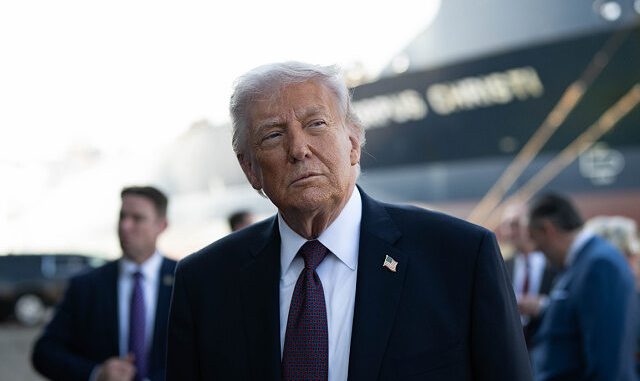
President Donald Trump on Thursday announced a three-week extension of the ceasefire between Israel and Lebanon following his direct participation in historic White House peace talks, voicing optimism the diplomatic push could lead to a lasting agreement as he looks to host both nations’ leaders in Washington in the coming weeks.
Published April 24, 2026
WASHINGTON — President Donald Trump on Thursday announced a three-week extension to the temporary ceasefire between Israel and Lebanon, in what the White House is calling a critical effort to prevent renewed escalation along one of the Middle East’s most volatile front lines.
The extension follows a new round of diplomatic discussions in Washington involving U.S. officials, Israeli representatives, and Lebanese delegates. The talks focused on keeping the ceasefire intact while longer-term security arrangements are negotiated.
The agreement now extends a short-term pause in fighting that was originally set to expire this week.
A pause in fighting—but not a peace deal
Officials stressed that the ceasefire is not a full peace agreement, but a temporary arrangement aimed at reducing immediate violence along the Israel–Lebanon border.
The area has been under sustained tension involving Israeli forces and armed groups operating in southern Lebanon, with Hezbollah remaining a central factor in the security equation. Hezbollah
While the ceasefire has reduced large-scale confrontations, security sources say sporadic incidents, border exchanges, and heightened military readiness have continued in recent weeks, keeping the region on edge.
Why the extension was needed
According to officials familiar with the talks, the extension was pushed through because negotiators were not yet close to resolving key sticking points, including:
- Security arrangements along the border
- Movement and positioning of armed groups in southern Lebanon
- Verification and monitoring mechanisms for compliance
- Long-term guarantees to prevent renewed escalation
The concern among mediators was simple: without an extension, the ceasefire risked collapsing before broader negotiations could stabilize.
Trump: “We’re buying time to prevent something worse”
Speaking from the White House, Trump described the extension as a necessary step to avoid a rapid return to conflict.
He emphasized that while progress has been made, the situation remains highly sensitive and could change quickly without continued diplomatic pressure.
Senior officials involved in the talks described the current phase as “time-buying diplomacy”—using short-term ceasefires to prevent immediate escalation while trying to build a longer framework for stability.
The Israel–Lebanon border: a long-standing flashpoint
The Israel–Lebanon frontier has been one of the most unstable borders in the region for decades, shaped by recurring cycles of conflict involving Israel and Hezbollah-linked forces.
The current situation is particularly delicate because:
- Military operations have increased in frequency in recent years
- Civilian areas near the border have experienced displacement risks
- Both sides remain on high alert despite temporary pauses in fighting
Even during ceasefire periods, officials say the situation remains “active,” meaning tensions can escalate quickly if incidents occur.
Hezbollah remains the key unresolved factor
One of the biggest challenges in the negotiations is that Hezbollah is not directly part of the ceasefire talks but plays a major role on the ground in southern Lebanon.
Israel has consistently argued that long-term stability cannot be achieved without addressing Hezbollah’s military presence in the region, while Lebanese officials face internal political limits on how much control they can exert over the group’s activities.
This gap has repeatedly stalled attempts at a more permanent agreement.
U.S. role: mediator and pressure point
The United States has positioned itself as the primary mediator in the talks, using diplomatic engagement to:
- Prevent immediate escalation
- Encourage structured negotiations
- Coordinate messaging between both sides
Officials say Washington’s role is also to ensure that short-term ceasefires do not simply delay conflict, but instead create conditions for more durable arrangements.
International reaction: relief, but skepticism
International response has been cautiously supportive, with many governments welcoming the extension as a stabilizing step.
However, diplomats and analysts note that:
- The ceasefire remains fragile
- No final political agreement has been reached
- The underlying security dispute is unresolved
In other words, the extension reduces immediate risk—but does not eliminate it.
🔍 Critical View: Why This Ceasefire Is Seen as a Temporary Fix, Not a Solution
From a practical, security-focused perspective, the ceasefire extension between Israel and Lebanon is being treated less like a breakthrough and more like a short-term pause in a long-running and unresolved conflict. The core concern is simple: stopping violence for a few weeks does not necessarily change the conditions that caused it in the first place.
Supporters of a tougher, more security-first approach argue that unless the situation on the ground actually changes, ceasefires tend to act like temporary “timeouts” rather than real progress.
1. The main concern: nothing fundamental has changed
On the ground, one of the biggest concerns is that the underlying drivers of conflict remain in place.
That includes:
- Armed groups still operating in sensitive border areas
- Long-standing distrust between both sides
- Ongoing security incidents even during calm periods
From this perspective, critics say the extension doesn’t solve the problem—it only delays the next escalation.
In simple terms:
If the causes are still there, the conflict can come back at any time.
2. Why enforcement is seen as weak
Another major issue is enforcement.
Ceasefires rely heavily on:
- Both sides following the rules
- Third parties monitoring compliance
- Limited ability to respond quickly to violations
But in real-world conflict zones, enforcement is often inconsistent.
Critics point out:
- Monitoring systems can miss small violations
- Local commanders may act independently
- Responses to breaches are often delayed
So the concern is straightforward: agreements are only as strong as the ability to enforce them—and that is often limited.
3. The “on-the-ground reality” problem
A key issue raised by security observers is the gap between diplomatic agreements and what actually happens locally.
On paper:
- Leaders agree to reduce hostilities
- Ceasefire terms are announced publicly
On the ground:
- Patrols and armed groups still operate nearby
- Tensions remain high in border regions
- Small incidents can quickly escalate
In simple terms: what is signed in meetings does not always match what happens in the field.
4. Armed groups remain outside full control
A major complication is that not all armed actors are fully controlled by national governments.
In southern Lebanon, groups like Hezbollah continue to play a major role in security dynamics. Hezbollah
This creates a structural issue:
- Governments negotiate agreements
- But not every armed group is part of those agreements
- Local decisions can still trigger wider consequences
So even if official leaders agree to calm things down, actors on the ground may still have the ability to escalate tensions.
5. The cycle problem: pause, tension, repeat
One of the biggest concerns from a security standpoint is the repeated cycle seen in the region:
- Conflict escalates
- Ceasefire is negotiated
- Tension temporarily decreases
- Underlying issues remain
- New incidents restart the cycle
Critics argue this pattern creates managed instability rather than real resolution.
In simple terms:
The region gets breaks from conflict, but not a true end to it.
6. Why security planners remain cautious even during ceasefires
Even during active ceasefires, military and intelligence planners typically remain on alert.
They focus on:
- Border activity and troop movements
- Early signs of escalation or retaliation
- Whether past violations continue quietly
- Rapid response readiness if things break down
From their point of view, a ceasefire is not relaxation—it is a lower level of tension, not the end of risk.
👥 On the Ground: Why This Ceasefire Is Still Seen as Fragile Despite the Extension
On the ground in Israel and Lebanon, the extension of the ceasefire is being viewed less like a breakthrough and more like a temporary pressure release in a situation that is still unstable underneath. From a practical security standpoint, the reaction is not excitement—it’s caution.
People closest to the situation, especially those focused on security and military readiness, tend to say the same thing in different ways: things may be quieter, but nothing is actually settled yet.
1. The biggest concern: calm on the surface, tension underneath
Even when a ceasefire is active, the situation along the border doesn’t fully reset.
On the ground, what people watch closely includes:
- Patrol activity and military positioning
- Sudden spikes in alert levels
- Isolated incidents that could escalate quickly
- Civilian movement restrictions in sensitive zones
In simple terms:
the noise may go down, but the pressure doesn’t disappear.
That’s why many see the extension as a delay tool, not a resolution.
2. Trust is still the weakest part of the agreement
A major issue is that both sides are still operating with a “prepare for the worst” mindset.
Even during the ceasefire:
- Military units stay alert
- Intelligence monitoring continues at a high level
- Both sides assume the agreement could break down
From a ground-level perspective, this creates a situation where:
The ceasefire exists, but full confidence in it does not.
In practical terms, trust has not caught up with the agreement.
3. Armed groups remain a key pressure point
One of the most difficult realities is that not all actors involved are fully controlled by national governments.
In southern Lebanon, groups such as Hezbollah continue to influence conditions on the ground. Hezbollah
That creates a real-world complication:
- Governments can agree to reduce tensions
- But armed groups may still operate independently
- Local incidents can escalate without central approval
In simple terms:
even if leadership wants calm, not everyone on the ground follows the same playbook.
4. Why short extensions are seen as “holding actions”
Security-focused observers often describe these kinds of agreements as holding actions—meant to prevent immediate escalation rather than solve the underlying conflict.
The pattern usually looks like:
- Tension builds over time
- Violence flares up
- A ceasefire is arranged
- Calm returns temporarily
- Underlying issues remain unchanged
- Tension slowly builds again
From this viewpoint, the concern is simple:
you are managing the cycle, not ending it.
5. Why military planners don’t fully relax
On the ground, military and intelligence planners rarely treat ceasefires as a signal to stand down.
Instead, they continue focusing on:
- Border movement and unusual activity
- Early signs of coordination breakdown
- Communication gaps between sides
- Potential triggers for renewed escalation
In simple terms:
they plan for stability, but prepare for disruption at the same time.
That’s because past experience in the region has shown how quickly situations can change.
6. Civilian reality: cautious normalcy, not confidence
For people living near affected areas, life doesn’t fully return to normal during ceasefires.
What you often see instead is:
- People cautiously returning to routines
- Businesses reopening but staying alert
- Families still ready to move if needed
- Long-term uncertainty about safety
So while there is relief, there is also a constant awareness that conditions can shift again without much warning.
7. Why the extension matters—but only in the short term
The three-week extension is seen as important because it:
- Reduces immediate risk of renewed fighting
- Creates space for further negotiations
- Prevents sudden escalation in the short term
But from a ground-level security view, it does not change the bigger reality:
- The underlying conflict is still there
- Armed actors remain active
- Enforcement remains limited
In simple terms:
it pauses the pressure, but doesn’t remove it.
🎯 The Final Word:
From a practical, security-focused point of view, the ceasefire extension between Israel and Lebanon is seen as useful because it helps stop immediate fighting and creates space for negotiations. But on the ground, the bigger concern is that the core problems that caused the conflict are still there.
Armed groups are still present and active in key areas, trust between both sides remains very low, and enforcement of any agreement is difficult in a real-world conflict zone. That means even if the situation is quieter for now, there is no strong confidence that it will stay that way once the extension period ends.
In simple terms, many observers see it as a short-term pause that helps prevent immediate escalation, but not a lasting solution that removes the risk of the conflict starting again later.