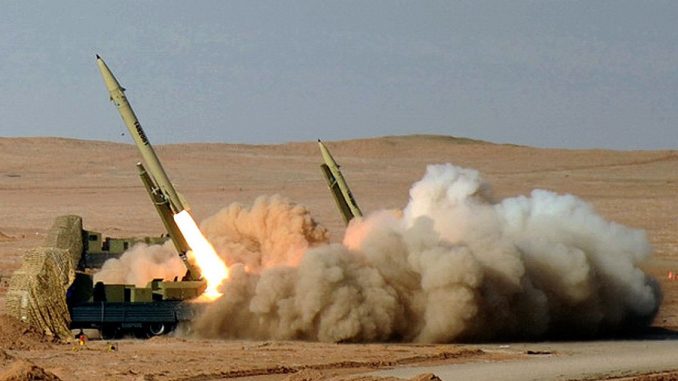
Iran has the largest ballistic missile inventory in the Middle East. Giving it nuclear weapons would endanger the Middle East, the United States, and its allies. Hossein Velayati, CC BY 4.0 https://creativecommons.org/licenses/by/4.0, via Wikimedia Commons
Published April 24, 2026
WASHINGTON — The debate over Iran’s global role is not fading—it is intensifying again, with renewed scrutiny on whether Tehran continues to use state power, allied militias, and covert networks to advance its influence across the Middle East and beyond.
The U.S. government officially designates Iran as a State Sponsor of Terrorism, a classification it has held since 1984. That label carries major consequences: sanctions, diplomatic isolation, and restrictions on financial and military transactions. It is also one of the most politically charged designations in modern foreign policy. Iran United States
Critics’ core argument: “This is not random support—it’s strategy”
Those who support maintaining or even tightening the designation argue that Iran’s behavior is not isolated or accidental, but part of a long-term strategy of regional influence.
They point to what they describe as a network-based model of power, where Iran allegedly:
- Funds and equips armed groups in multiple countries
- Provides training, intelligence, and logistical support to allied militias
- Uses proxy groups to pressure rivals without direct war
Groups frequently cited in these discussions include organizations such as Hezbollah and Hamas, which Iran is widely accused by Western governments of supporting. Hezbollah Hamas
Supporters of the designation argue this structure allows Iran to:
- Extend influence across borders without direct confrontation
- Maintain plausible deniability in international incidents
- Apply pressure on adversaries through indirect conflict
In simple terms, critics say it functions like a “remote-control foreign policy”—where influence is projected through partners instead of official military action.
How the “proxy system” is described on the ground
Security analysts often describe Iran’s approach as layered and decentralized, meaning:
- State funding flows outward
- Regional groups operate semi-independently
- Actions are carried out in ways that are difficult to directly trace back
This structure, they argue, makes it harder for international investigators to prove direct command responsibility for every operation linked to Iran-backed groups.
But critics counter that even if operations are indirect, the financial and strategic support still originates from the state level, making responsibility unavoidable in their view.
Why supporters say the designation still matters
Those who support keeping Iran on the list argue it serves three key purposes:
1. Financial pressure
Sanctions restrict access to global banking systems, limiting funding for military and proxy activity.
2. Diplomatic isolation
The designation discourages allies and companies from engaging with Iran in sensitive sectors.
3. Deterrence message
It signals that support for armed non-state groups will carry long-term consequences.
In their view, removing the designation without major behavioral change would reduce leverage and weaken deterrence.
Iran’s response: “Political labeling, not legal truth”
Iranian officials reject the terrorism designation outright, arguing it is politically motivated and selectively applied.
From Tehran’s perspective, the narrative is:
- Iran supports “resistance movements” against foreign occupation
- Western governments label opposition groups as terrorists for strategic reasons
- Regional instability is driven by external military interventions, not Iranian policy
In other words, Iran frames itself not as a sponsor of terrorism, but as a supporter of regional allies in asymmetric conflicts.
The gray zone: hybrid conflict and indirect warfare
Modern intelligence assessments increasingly describe the situation as hybrid conflict, meaning:
- Influence operations are mixed with political and military tools
- Cyber activity, funding, and local militias may overlap
- Attribution becomes more complex and often disputed
Some security reports have linked Iran to indirect or low-level operations outside the Middle East, though establishing direct state orders is often difficult due to the layered structure of proxy relationships. Islamic Revolutionary Guard Corps
This ambiguity is part of what makes the debate so persistent: intent, responsibility, and execution are often separated across different actors.
Why the issue remains politically sensitive in Washington
Inside the United States, the debate is less about whether Iran is a concern—and more about how to respond.
Hardline positions argue:
- Pressure must remain high or increase
- Proxy networks must be disrupted globally
- Negotiation alone does not change behavior
More diplomatic approaches argue:
- Engagement is necessary to reduce escalation risks
- Overuse of sanctions can reduce long-term leverage
- Regional stability requires communication channels
Despite disagreements, there is broad consensus that Iran remains a central factor in Middle East security planning.
Wider global impact
Beyond Washington, the designation affects:
- Energy markets and oil diplomacy
- Shipping security in key maritime routes
- Military planning among U.S. allies
- Regional conflicts involving multiple proxy actors
In practical terms, Iran’s designation shapes not just bilateral relations—but global security calculations.
🔍 Critical View: Why Many Say This Should Be Treated as a Serious Security Issue
From a critical standpoint, the debate over Iran is not really about political labeling—it’s about how modern conflict actually works in the real world. The concern raised by critics is that some governments don’t always act through direct war or open military moves anymore. Instead, influence can be extended through funding, alliances, and support networks that operate outside traditional battlefields.
In that context, the argument is simple: what matters is not just who gives the orders, but what actions are being enabled.
1. Indirect support still has real consequences
A major point often raised is that modern conflicts are rarely straightforward. Even if a state is not physically present in a conflict, critics argue that:
- Funding still fuels operations
- Weapons still change outcomes on the ground
- Training and logistics still shape how groups behave
So in plain terms, the idea is this:
If support makes something possible, it still matters—even if it’s one step removed.
From this view, indirect involvement is not a technical loophole. It is part of how influence is projected.
2. Proxy groups make responsibility harder to see
Another concern is the use of allied or affiliated groups operating in different regions.
Critics argue this creates a structure where:
- Actions can be carried out by separate organizations
- Official state involvement becomes less visible
- Responsibility is harder to prove in each individual case
In simple language, it creates layers between decision-makers and actions on the ground.
That matters because it complicates how other countries respond—especially when evidence is fragmented or indirect.
3. Why supporters of strong action say “patterns matter”
Rather than focusing on single incidents, critics often focus on long-term patterns over time.
They point to:
- Repeated regional conflicts involving aligned groups
- Consistent financial or logistical support networks
- Ongoing geopolitical tensions tied to those relationships
The argument is that one event can be debated—but repeated behavior forms a pattern that is harder to ignore.
In everyday terms:
If the same type of situation keeps showing up in different places, it starts to look less like coincidence and more like strategy.
4. Why the designation is seen as a pressure tool
The “state sponsor of terrorism” label is not just symbolic—it affects real-world policy.
Supporters say it is important because it:
- Limits access to global banking and finance systems
- Restricts arms trade and military cooperation
- Signals consequences for supporting armed non-state actors
- Encourages allies to adopt similar restrictions
From this perspective, the goal is not punishment for its own sake, but to reduce the ability of networks to operate freely across borders.
5. The disagreement: interpretation vs. impact
Opponents of the designation often argue the issue is politically framed or depends on perspective. But critics counter that regardless of interpretation, the impact on stability is what matters most.
In simple terms:
- One side focuses on intent and definition
- The other focuses on outcomes and effects
And those two perspectives rarely align.
👥 On the Ground: Why Security Officials and Analysts See This as a Long-Term Pattern Problem
On the ground, especially among people who deal with security planning in United States and allied countries, the discussion around Iran is not treated like a headline debate. It is treated like a pattern that has to be monitored over time, because the consequences show up in multiple regions, not just one.
The focus is not on political language—it’s on what keeps happening repeatedly in different forms.
1. People look at repetition, not single events
One of the biggest differences on the ground is how information is interpreted.
Instead of asking:
- “What does this one event mean?”
Security analysts tend to ask:
- “Has this type of activity happened before?”
- “Is it showing up in different places over time?”
- “Is there a consistent connection between these incidents?”
In simple terms, they are not reacting to one incident at a time. They are tracking repeating behavior patterns across regions.
2. The “distance problem” in modern conflict
A key concern is how modern conflicts are structured.
Instead of direct action, there is often a chain:
- State-level support or funding
- Regional allied groups or networks
- Local operations carried out far from the source
On paper, each layer looks separate. On the ground, critics say they function as one system.
The issue this creates is simple:
- Responsibility becomes harder to trace quickly
- Responses take longer to organize
- Different actors can be blamed or denied involvement
In practical terms, it adds delay and confusion during fast-moving situations.
3. Why security planners default to caution
On the ground, planning is not based on best-case assumptions—it is based on risk prevention.
So when analysts see:
- Repeated activity involving linked groups
- Financial or logistical support networks crossing borders
- Ongoing instability tied to the same regional actors
The response is usually not debate—it is preparation.
In simple terms:
They assume the risk is real enough to plan for, even if every detail is not fully provable in real time.
4. Why the designation still shapes real-world policy
The designation of Iran as a state sponsor of terrorism in United States has practical effects beyond politics.
It influences:
- Banking access and financial restrictions
- Military and intelligence cooperation with allies
- Export controls and weapons restrictions
- Diplomatic engagement levels
On the ground, this means decisions are structured around limiting exposure and controlling risk, not just symbolic messaging.
5. The real-world concern: spillover effects
Another issue raised by security observers is that instability rarely stays contained.
When conflicts involve multiple proxy groups or regional networks:
- Violence can spread across borders
- Local disputes can connect to larger regional tensions
- Civil conflicts can become prolonged and harder to resolve
In simple terms, the concern is spillover—one conflict affecting several others over time.
6. Why this becomes a long-term issue instead of a short-term debate
The reason this topic keeps coming back is because it does not resolve quickly.
Even when individual events settle down:
- The networks often remain
- The relationships between groups persist
- The underlying regional tensions do not disappear
So instead of a one-time issue, it becomes something that is tracked continuously over years.
🎯 The Final Word:
From a practical, on-the-ground point of view, the concern is straightforward: when a country like Iran is repeatedly linked—directly or indirectly—to armed groups and regional conflicts over a long period of time, it naturally shapes how other governments plan for security and stability. Even if every incident is debated or viewed differently, what stands out is the overall pattern and its impact across multiple regions. That’s why supporters of a tougher approach argue that this isn’t just about politics or labels, but about reducing risk, limiting instability, and making sure indirect actions don’t quietly fuel bigger problems down the line.