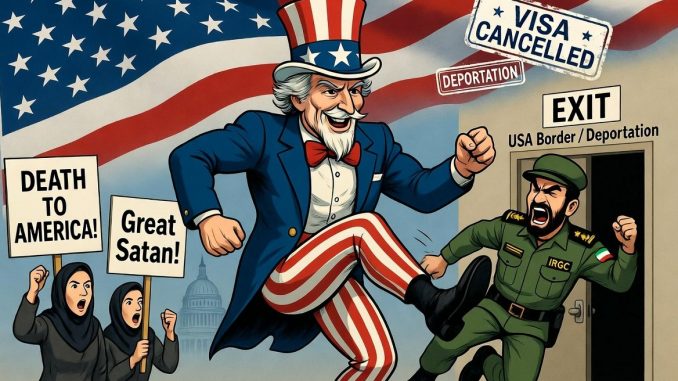
Secretary of State Marco Rubio has been criticized for canceling the residency permits of IRGC family members and deporting them due to their support for the regime.
Published April 11, 2026
A growing controversy is putting a spotlight on a simple but serious question:
Should people who openly support anti-American ideas be allowed to live in the United States?
That question is now front and center after U.S. authorities began revoking visas and green cards from individuals connected to Iran’s powerful military force, the Islamic Revolutionary Guard Corps (IRGC).
WHAT HAPPENED
In recent weeks, immigration officials detained relatives of Qasem Soleimani, the Iranian general who led the IRGC’s elite Quds Force before being killed in a U.S. strike in 2020.
Some of these family members had been living in the United States—particularly in cities like Los Angeles—under legal residency or visas. But that changed quickly.
U.S. officials revoked their immigration status, citing national security concerns. Soon after, arrests followed.
Why?
Because, according to reports from outlets like Reuters and Associated Press, these individuals had allegedly shown support for Iran’s regime and even praised actions that harmed American troops.
THE “DEATH TO AMERICA” PROBLEM
This is where things get even more controversial.
Some individuals tied to Iran’s leadership have been linked to the chant “Death to America”—a slogan that has been used for decades in Iran during protests and official events.
Now, here’s the part that’s raising eyebrows:
- These chants aren’t new
- They’re widely known
- And yet, some of the people connected to that ideology were allowed to live in the U.S.
For many Americans, that feels like a contradiction.
You have people enjoying life in the United States—freedom, safety, economic opportunity—while supporting messages that are openly hostile to it.
WHY THE U.S. IS TAKING ACTION NOW
U.S. law allows the government to deny or cancel visas and green cards if a person:
- Is linked to a terrorist organization
- Supports groups hostile to the U.S.
- Or poses a national security risk
The IRGC itself is officially labeled a terrorist organization by the U.S. government. That designation alone gives authorities broad power to act.
Secretary of State Marco Rubio has backed the tougher approach, making it clear that immigration is a privilege—not a right.
In simple terms:
If you support America’s enemies, you may not be allowed to stay in America.
SUPPORTERS VS. CRITICS
Not everyone agrees on how far this policy should go.
Supporters say:
- It’s common sense
- National security should come first
- The U.S. shouldn’t tolerate anti-American activity from people living inside the country
Critics argue:
- The policy could be too broad
- Family members shouldn’t be punished for political connections
- There’s a risk of targeting people based on beliefs rather than actions
Still, for many, the core issue is simple:
Where do you draw the line?
THE BIGGER PICTURE: U.S.–IRAN TENSIONS
This crackdown isn’t happening in isolation.
The U.S. and Iran have had a long history of conflict—ranging from economic sanctions to military confrontations.
The IRGC plays a major role in Iran’s military strategy and regional influence. It has been involved in operations across the Middle East and is seen by U.S. officials as a major source of instability.
So when individuals connected to that system are found living in the U.S., it raises serious questions for policymakers.
WHY THIS MATTERS TO EVERYDAY PEOPLE
You don’t need to be a politician or expert to understand why this issue matters.
Think of it this way:
- Immigration gives people access to opportunities
- It also comes with responsibilities
- One of those is respecting the country you’re living in
For many Americans, this situation feels like a clear line:
You can’t enjoy the benefits of a country while supporting those who oppose it.
🔍 Critical View: THEY CHANTED AGAINST AMERICA — NOW THEY’RE SHOCKED AMERICA PUSHED BACK
Let’s keep this simple.
If someone lives in your house, enjoys your food, uses your electricity—and at the same time openly supports people who want to harm you—would you let them stay?
That’s exactly the situation the United States is dealing with right now.
Recent actions by the government to remove individuals tied to Iran’s powerful military group, the Islamic Revolutionary Guard Corps (IRGC), have sparked outrage—but for many, the real question is: why were they allowed in the first place?
TOPIC 1: YOU CAN’T HAVE IT BOTH WAYS
This is the biggest issue.
Some individuals connected to Qasem Soleimani—a key figure in Iran’s military operations—were reportedly living comfortably in the United States.
At the same time, there are reports that they supported anti-American ideas, even praising actions that led to American deaths.
In plain terms:
- Living in the U.S. means enjoying freedom and safety
- Supporting groups that oppose the U.S. goes directly against that
You can’t stand on both sides.
TOPIC 2: IMMIGRATION IS A PRIVILEGE, NOT A RIGHT
A lot of people forget this.
Being allowed to live in the United States—through a visa or green card—is not automatic. It’s something granted based on trust.
If that trust is broken, the government has every right to act.
Officials, including Marco Rubio, have made it clear: if someone is linked to hostile groups or supports them, they can lose their legal status.
That’s not punishment—that’s enforcement of the rules.
TOPIC 3: NATIONAL SECURITY COMES FIRST
At the end of the day, every government has one main job: protect its people.
The IRGC isn’t just any organization. It’s labeled by the U.S. as a terrorist group. It has been involved in military operations and conflicts that directly affected American forces.
So the concern is simple:
If someone is connected to that group—even indirectly—should they be living inside the United States?
For many, the answer is obvious.
TOPIC 4: COMMON SENSE VS. POLITICAL ARGUMENTS
Critics say the crackdown is too harsh. They argue that family members shouldn’t be held responsible for political ties.
But supporters see it differently.
They argue this isn’t about politics—it’s about common sense.
If someone shows support for a system that openly opposes America, that should raise red flags.
This isn’t about where someone comes from.
It’s about what they support.
TOPIC 5: A LONG-OVERDUE WAKE-UP CALL
For years, critics have warned that the U.S. has been too loose when it comes to who gets in and who gets to stay.
This situation is being seen by many as a correction—a sign that the government is finally taking national security more seriously.
The message now is clearer:
Access to America comes with expectations.
👥 On the Ground: “WHY ARE THEY EVEN HERE?” — AMERICANS REACT TO IRAN-LINKED VISA CRACKDOWN
On the streets, in small conversations, and across everyday communities, one question keeps coming up:
“If they support people who hate America… why are they allowed to live here?”
That’s the reaction many are having after reports that individuals tied to Iran’s Islamic Revolutionary Guard Corps (IRGC) were living in the United States—and are now being detained or losing their visas.
This isn’t just a political story anymore.
For many, it’s personal. It’s about safety, fairness, and common sense.
TOPIC 1: EVERYDAY PEOPLE SEE A DOUBLE STANDARD
Talk to regular folks, and you’ll hear a similar concern:
They follow the rules.
They work hard.
They respect the country.
So when they hear that some individuals connected to hostile groups were allowed to stay—while possibly supporting anti-American ideas—it doesn’t sit right.
In simple terms:
“We play by the rules. Why don’t they have to?”
TOPIC 2: “YOU CAN’T LOVE THE BENEFITS AND HATE THE COUNTRY”
This is a common reaction on the ground.
People understand that America offers opportunities—jobs, safety, freedom of speech.
But many say there’s a line.
If someone is tied to figures like Qasem Soleimani or groups that oppose the U.S., and at the same time enjoys life in America, it creates frustration.
You’ll hear people say:
“You can’t enjoy everything here while supporting those who go against it.”
TOPIC 3: SAFETY IS THE TOP PRIORITY
For most people, this isn’t about politics—it’s about safety.
The IRGC has been labeled a terrorist organization by the U.S., and many Americans take that seriously.
So the concern becomes:
- Who is being allowed into the country?
- What are their beliefs?
- And could they pose a risk?
People on the ground aren’t asking for complicated policies.
They’re asking for basic protection.
TOPIC 4: TRUST IN THE SYSTEM IS AT STAKE
Another major concern is trust.
People want to believe that immigration systems are strict, fair, and focused on safety.
But stories like this make some feel that the system has been too relaxed.
Now that action is being taken—with officials like Marco Rubio supporting stricter enforcement—some see it as a step in the right direction.
Still, others are asking:
“Why did it take this long?”
TOPIC 5: NOT ABOUT WHERE YOU’RE FROM — IT’S ABOUT WHAT YOU SUPPORT
One thing many people are careful to point out:
This isn’t about nationality.
It’s not about being from Iran or any other country.
It’s about beliefs and actions.
If someone supports groups or ideas that are against the United States, people feel that should matter—no matter where they come from.
🎯 The Final Word:
At the end of the day, many people see this issue in a very simple way. If someone is allowed to live in the United States, they are expected to respect the country and follow its laws. Living in America comes with safety, freedom, and opportunity—but also responsibility. So when reports show that individuals linked to the Islamic Revolutionary Guard Corps were allegedly supporting messages against the U.S. while still benefiting from life here, it naturally raises concern. For many, the government doing something about it is not extreme—it is basic protection. The belief is straightforward: if you support groups or ideas that go against the United States, then you should not be surprised if you are asked to leave.