Published April 19, 2026
MIDWEST U.S. — A violent spring storm system tore across the American heartland, unleashing more than 20 confirmed tornadoes, flattening homes, ripping apart infrastructure, and leaving behind an early damage estimate of around $50 million, according to preliminary assessments.
The outbreak stretched across multiple states, hitting both rural farming communities and suburban neighborhoods in a fast-moving wave that caught many residents off guard despite earlier warnings.
🌪️ A Fast-Moving Storm System With Deadly Ingredients
Meteorologists say the setup was the textbook combination for tornado development:
- Warm, moisture-rich air pushing up from the Gulf
- A strong cold front slicing through the Midwest
- High-altitude wind shear causing storm rotation
When these conditions collided, supercell thunderstorms rapidly developed — the kind capable of producing long-track, damaging tornadoes.
Experts described the system as “highly unstable,” with storms forming, strengthening, and collapsing in rapid cycles across multiple states.
🧭 Where The Worst Damage Hit
The hardest-hit areas included parts of the central and northern Midwest, where multiple tornado touchdowns were confirmed within hours.
In Wisconsin, one of the strongest storms produced an estimated EF3-level tornado, with reports showing:
- Entire homes leveled or heavily damaged
- Farm structures wiped out
- Large trees uprooted and snapped
- Debris fields spread across open farmland
In neighboring states, including parts of Michigan and the Ohio Valley region, additional tornadoes caused scattered structural damage, power outages, and road blockages.
🏚️ Communites hit hard: “It Looked Like A War Zone”
Residents described the aftermath in stark terms.
In several towns:
- Roofs were torn completely off houses
- Vehicles were flipped or damaged by flying debris
- Power lines were knocked down across neighborhoods
- Entire blocks were left without electricity
One resident described waking up to “nothing but noise and wind,” followed by silence and darkness once the storm passed.
Emergency officials say the speed of the outbreak made response efforts challenging, as multiple tornadoes formed in different areas within a short timeframe.
🚨 Emergency Response Matter
State and local agencies quickly activated emergency protocols, including:
- Search-and-rescue teams deployed to damaged zones
- Temporary shelters opened in schools and civic centers
- Utility crews dispatched to restore power lines
- Road crews clearing fallen trees and debris
Despite the widespread destruction, early reports suggest there was no large-scale mass casualty event, though several injuries were confirmed and assessments are ongoing.
Officials cautioned that the situation is still developing as teams continue to survey remote rural areas where damage may not yet be fully reported.
⚡ THE SCALE: More than just one Storm Line
This was not a single tornado — it was a multi-state outbreak event.
In simple terms:
- One storm system triggered repeated tornado formation
- Storms moved quickly, leaving little time for recovery between hits
- Multiple counties were affected within hours
- The damage footprint spans hundreds of miles
Weather analysts say outbreaks like this highlight how quickly conditions can escalate during peak tornado season.
📊 Breaking down the Impact
Here’s what is currently known:
- 20+ tornadoes confirmed
- Estimated $50 million in damage (early figure)
- Multiple EF2–EF3 strength storms
- Widespread power outages and infrastructure damage
- Agricultural losses expected to increase total damage estimates
Officials say final totals could rise significantly once full surveys are completed.
🧠 Why this system was so dangerous
Meteorologists emphasize that the danger wasn’t just strength — it was speed and repetition.
Instead of one isolated tornado, communities faced:
- Repeated storm cells in the same region
- Rapid formation of new tornadoes
- Limited recovery time between impacts
That pattern increases damage severity, especially in rural areas where emergency resources are stretched thin.
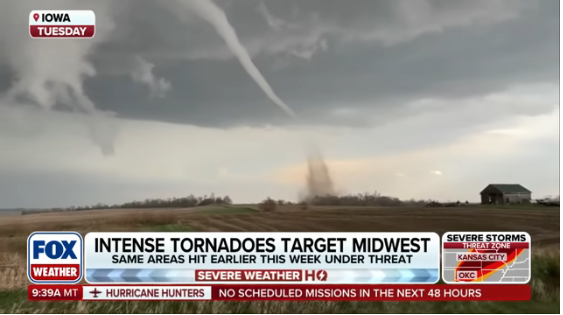
Video posted Saturday showed Fox Weather Storm Trackers watching a tornado in Rockton, Illinois, from the ground:
Additional clips showed a tornado in Iowa, floodwaters in Wisconsin, severe thunderstorms in Michigan, and people in Kansas cleaning up after storms and tornadoes hit their community, per NBC News:
Forecasters said more severe weather may hit parts of the Southern Plains, the Mississippi Valley, and the Great Lakes on Saturday, CBS News reported:
Over 70,000 customers in the Midwest and Great Lakes regions are without power as of Saturday morning, according to the tracking site poweroutage.us. Most of the outages are in Illinois and Missouri.
At least one tornado touched down in Rochester, Minnesota, about 90 miles south of Minneapolis, on Friday. David Vetsch said the storm sounded “like a freight train.” The main part of the tornado hit his 89-year-old father’s house, Vetsch said. While the house took extensive damage, his father was unharmed.
Video footage showed Fox Storm Trackers inside a tornado in Illinois. The clip caught the moments the twister drew near the vehicle and dropped debris onto the roadway and fields while a tornado siren was heard in the background:
As more storms were forecast, the Weather Channel shared safety tips for those who may be in the path of a tornado, stating people should know beforehand where to take shelter. If they are at home, they should go to an interior room without windows and get under something heavy for added protection.
If no shelter is available, the Channel advises people to lie flat in a ditch, ravine, or culvert and use their hands to shield their head until the storm passes.