
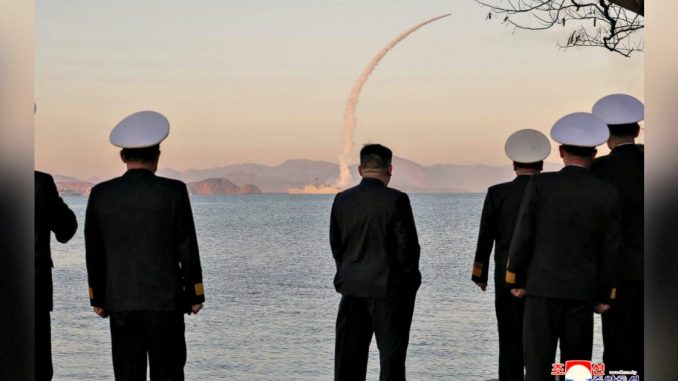
Kim Jong Un supervising missile test earlier in the week – Noth Korea State Agency
Published April 20, 2026
Pyongyang — North Korea has carried out another round of ballistic missile launches, firing multiple projectiles into waters off its east coast in what officials and analysts describe as a continued show of force and a clear signal that its weapons program is moving forward at a steady pace.
Regional militaries, including South Korea and Japan, quickly detected the launches and moved to monitor the situation, while the United States reaffirmed its security commitments in the region. The incident adds to a growing list of tests that have kept the Korean Peninsula on edge in recent months.
What happened: Multiple launches in quick succession
According to defense officials, several short-range ballistic missiles were launched from North Korea’s eastern region and traveled a relatively short distance before landing in the sea.
Key details reported include:
- multiple missiles fired within a short time window
- launches tracked by regional radar systems
- no immediate damage reported
- rapid response from neighboring countries
While the missiles did not strike land, the launches were still viewed as a serious development because they demonstrate operational readiness and consistency.
A steady pattern, not a one-time event
This latest test fits into a broader pattern tied to the policies of Kim Jong Un, who has emphasized strengthening military capabilities, particularly in missile and nuclear systems.
Recent activity has included:
- repeated ballistic missile launches
- testing of cruise and anti-ship missiles
- efforts to develop hypersonic technology
- ongoing work on submarine-based launch systems
In simple terms:
this is not random — it’s part of a long-term plan.
why these launches matter more now
Even though North Korea has conducted missile tests before, the current phase is drawing more attention because of consistency and timing.
Analysts point to several concerns:
- launches are happening more frequently
- technology appears to be improving
- systems are becoming more flexible (land, sea, possibly underwater)
- coordination suggests better operational control
That combination suggests a shift from testing to refinement.
Regional response: Alert but measured
Countries in the region are responding carefully but seriously.
- South Korea has increased surveillance and military readiness
- Japan has issued warnings and condemned the launches
- the United States continues joint defense coordination with allies
So far, responses remain controlled, but the level of attention is high.
What North Korea may be signaling
Missile launches often serve as more than just military exercises.
They can also send messages:
- demonstrating capability to rivals
- reinforcing internal political strength
- gaining leverage ahead of possible negotiations
In plain language:
these launches speak both militarily and politically.
🔍 Critical View: What these repeated missile tests really mean
Looking beyond the headlines, the latest launches tied to Kim Jong Un and the ongoing Korean Peninsula tensions point to something bigger than a single event. This isn’t just testing anymore — it’s a pattern that is becoming part of the normal cycle of tension in the region.
⚠️ From rare events to routine behavior
There was a time when a missile launch from North Korea would immediately trigger global alarm.
Now, the reaction is different:
- launches are reported, but not always followed by major action
- governments issue statements, but responses stay measured
- markets react briefly, then stabilize
In simple terms:
what used to be shocking is now expected.
That shift matters because normalization can lower the sense of urgency, even if the underlying risk is still there — or growing.
🚀 A steady, step-by-step buildup
The pattern suggests careful planning rather than random action.
Each test appears to contribute to:
- improving accuracy and range
- refining launch systems
- testing different platforms (land, sea, possibly submarine-based)
- building confidence in operational capability
This is less about dramatic breakthroughs and more about consistent progress.
Small steps, repeated over time, can lead to major capability gains.
🌍 Pressure without crossing the line
One of the most notable aspects is how controlled these actions are.
- missiles are typically launched into open waters
- tests avoid direct confrontation with other countries
- actions stay just below levels that would trigger a major response
That creates a situation where:
tension increases, but escalation is managed carefully.
From a strategic perspective, this allows pressure to build without forcing an immediate crisis.
🧠 Why this approach is effective
From a practical standpoint, this slow and steady strategy offers several advantages:
- avoids provoking overwhelming retaliation
- allows time to improve technology quietly
- keeps international attention focused
- builds leverage for future negotiations
In plain language:
it’s a way to get stronger without forcing a fight right now.
⚖️ The difficult position for other countries
For countries responding to this situation, there’s no easy answer.
They face a balancing act:
- respond strongly, and risk escalation
- respond lightly, and risk encouraging more tests
- maintain pressure, but avoid triggering conflict
That leads to cautious responses, which can sometimes appear inconsistent or limited.
Every option comes with trade-offs.
🔄 The risk of slow escalation
Even without a major incident, the long-term trend matters.
- repeated launches build technical expertise
- familiarity reduces the shock factor
- gradual improvements strengthen overall capability
This kind of slow escalation can be harder to manage because:
it doesn’t force immediate action — but it changes the situation over time.
👥 On the Ground:
what this missile activity feels like in real terms
On the ground around the Korean Peninsula tensions, the repeated missile launches tied to Kim Jong Un don’t feel like isolated news events anymore. They feel like part of a steady background tension that people in the region have to live with and plan around.
🚨 alerts become routine, not rare
For people in nearby countries like South Korea and Japan, each launch follows a familiar pattern now:
- radar alerts and tracking updates
- emergency notifications in some areas
- quick government statements
- then a return to normal life
In simple terms:
what used to cause panic now causes preparation.
That doesn’t mean it’s harmless — it just means people are getting used to it.
🧠 life continues, but with caution
Even though most missiles land in the sea, the feeling on the ground is still cautious.
People and businesses often:
- pay closer attention to alerts and news updates
- stay aware of evacuation guidance in sensitive areas
- avoid overreacting, but also don’t ignore warnings
- assume more tests could happen at any time
So daily life continues — but with an extra layer of awareness in the background.
🌍 regional security feels “always on”
In countries closest to the situation, military readiness doesn’t really switch off anymore.
You’ll see:
- more consistent defense drills
- stronger surveillance of missile activity
- coordination between allies increasing
- public messaging focused on staying calm but alert
In plain language:
the region is always in a low-level state of watchfulness.
⚖️ People want stability, not headlines
For most civilians, the concern isn’t geopolitical strategy — it’s stability.
They care about:
- whether daily life stays normal
- whether travel and trade remain smooth
- whether tensions could suddenly rise
- whether the situation could spiral unexpectedly
Missile launches don’t always disrupt life directly, but they keep uncertainty in the background.
🔄 Why repetition matters on the ground
When launches happen repeatedly:
- people stop reacting strongly each time
- but they don’t fully relax either
- it creates a “new normal” of tension
In simple terms:
nothing changes dramatically, but nothing fully settles either.
🎯 The Final Word:
At the end of the day, the repeated missile launches tied to Kim Jong Un and the ongoing Korean Peninsula tensions show a steady buildup rather than a one-time event. While life in the region continues and most launches do not directly cause damage, the bigger concern is what this pattern means over time. Each test adds more capability, more confidence, and more uncertainty for neighboring countries. For many observers, the key issue is simple: even if nothing dramatic happens today, the constant testing keeps raising the risk level in the background, making long-term stability harder to take for granted.




