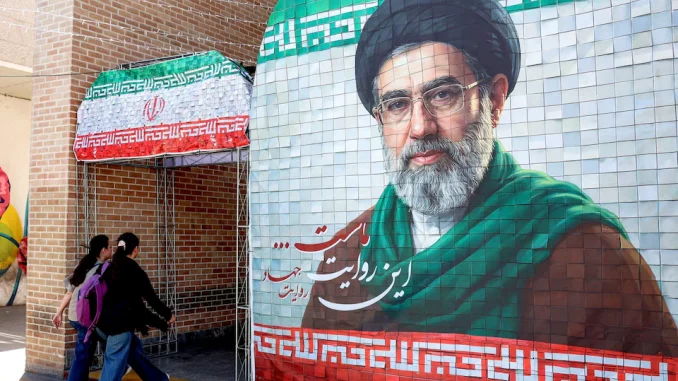
Mojtaba Khamenei became supreme leader after a missile strike, in which he was injured, killed his father Credit: AFP via Getty
Published May 11, 2026
WASHINGTON – Conflicting reports surrounding the health and status of senior Iranian leadership have triggered widespread speculation across international media, raising fresh questions about stability inside Tehran and the reliability of competing narratives emerging from the region.
At the center of the reports are claims involving injuries to Iran’s Supreme Leader and uncertainty over how much direct control remains within the country’s top political and military command structure.
1. Conflicting Reports on Leadership Condition
Different outlets and sources are presenting sharply different accounts of the situation:
- Some reports suggest Iran’s leadership may have suffered serious injuries, limiting public appearances and raising questions about operational control.
- Iranian state-linked statements insist the leadership remains stable and operational, downplaying the severity of any reported injuries.
- Other international coverage notes a lack of consistent public visibility, fueling speculation about internal conditions and decision-making authority.
The result is a fragmented information picture, where no single narrative dominates.
2. Limited Public Visibility Fuels Speculation
A key factor driving uncertainty is the reduced public presence of Iran’s top leadership figures.
In situations like this, analysts say:
- Absence of appearances creates an information vacuum
- Competing political actors and media outlets fill that gap
- Rumors spread faster than official confirmations
In simple terms, when leadership is not clearly visible, uncertainty grows quickly—especially during periods of regional tension.

Khamenei has been involved in decisions to end the war and reopen the Strait of Hormuz.NurPhoto via Getty Images
3. Information Battle Runs Alongside Political Tension
Beyond the physical and political situation, there is also a strong information component unfolding.
Reports are being shaped and repeated through:
- State-controlled media narratives
- Western international news organizations
- Anonymous intelligence-linked assessments
- Social media speculation and commentary
This creates a layered environment where the same situation is described in very different ways depending on the source.
In practical terms: the story is not just about events—it is about who controls the version of events being seen by the public.
4. Leadership Structure Under Scrutiny
The uncertainty has also renewed attention on how decisions are made inside Iran’s political system.
Key questions being raised include:
- Who is making final military and political decisions?
- Is authority centralized or distributed among multiple power centers?
- How quickly can decisions be made during a crisis?
From a strategic standpoint, clarity in leadership is critical during periods of regional instability. Any perceived uncertainty can influence how other countries assess risk and response options.

Mojtaba Khamenei took over in March, after the strikes that killed his father Ali Khamenei.Getty Images
5. Why It Matters Beyond Iran
While the issue is internal, the implications are regional and global.
Iran plays a significant role in:
- Middle East security dynamics
- Energy markets and shipping routes
- Regional alliances and proxy relationships
That means any uncertainty about leadership stability can affect not only domestic policy, but also international calculations involving security and energy markets.
6. The Broader Issue: Competing Narratives
One of the most significant aspects of the situation is not just the reports themselves, but the conflicting interpretations surrounding them.
- Official sources emphasize stability and continuity
- External reports highlight uncertainty and limited visibility
- Analysts attempt to reconcile contradictory information
For the public and policymakers alike, this creates a challenge: determining what is confirmed fact versus what is interpretation or speculation.
🔍 Critical View: Iran Leadership Reports, Information Control, and Why Clarity Matters
When you strip away the headlines and competing claims, the core issue here is not just about one leader or one country—it’s about stability, transparency, and how much uncertainty the world can tolerate during an already tense regional situation.
From this perspective, the most important concern is simple: when leadership status is unclear, everything else becomes harder to trust and harder to plan around.
1. Stability Depends on Clear Leadership
In any country, especially during conflict or tension, people inside and outside the system need to know who is actually in charge.
When leadership appears uncertain or not regularly visible:
- Decision-making becomes harder to track
- Military and political direction becomes less predictable
- Allies and rivals both start guessing instead of reacting to facts
In simple terms: strong countries need clear leadership, especially in unstable times.
2. Conflicting Reports Create Confusion, Not Clarity
When different sources are saying completely different things—some claiming stability, others suggesting serious health issues—it creates a basic problem: nobody knows what is real.
That leads to:
- Speculation replacing facts
- Rumors spreading faster than confirmations
- Policy decisions being made on assumptions instead of verified information
From this view, the real issue is not disagreement, but the lack of a clear, trusted picture.
3. Information Control Becomes Part of the Power Structure
Another key point is that in situations like this, information itself becomes strategic.
- Governments try to control messaging to maintain stability
- Foreign media try to fill gaps with alternative reporting
- Leaks and unofficial sources add more layers of uncertainty
The result is a situation where controlling the narrative can be almost as important as controlling events on the ground.
In simple terms: whoever controls the story often shapes how the world reacts.
4. Why Leadership Visibility Matters in Crisis
On the ground, visibility is not just symbolic—it is practical.
When leaders are seen and active:
- Decisions feel more predictable
- Military and government systems stay coordinated
- Public confidence is stronger
When leaders are not visible or reports are unclear:
- Uncertainty increases
- Rival groups may interpret silence differently
- External countries may adjust their strategies based on worst-case assumptions
That uncertainty can sometimes have real-world consequences beyond the original issue.
5. Regional Impact Is Bigger Than the Internal Story
Even though this is an internal leadership issue, it affects wider regional calculations.
Countries watching the situation are not just asking “what happened,” but:
- Who is really in control?
- How stable is decision-making?
- What happens if leadership changes or weakens?
These are practical questions tied to security, energy, and diplomacy.
6. The Risk of Acting on Unverified Information
One of the biggest risks in this kind of environment is reaction based on incomplete or uncertain information.
If outside actors assume instability that is not confirmed—or ignore instability that is real—it can lead to:
- Misjudged policy decisions
- Overreaction or underreaction in diplomacy
- Increased tension based on misunderstanding
In simple terms: unclear information leads to higher risk of mistakes.
👥 On the Ground: Iran Leadership Reports and What It Means in Real Terms
When you remove the headlines and look at this situation in plain language, the issue is not just about rumors or media reports—it’s about how uncertainty at the top of a government affects everything below it, especially during a tense regional moment.
Here’s what it looks like on the ground.
1. When Leadership Is Unclear, Everything Slows Down
In any country, especially one dealing with pressure or conflict, people look for one thing: clear leadership.
When reports about a leader are mixed or unclear:
- Decisions take longer to confirm
- Government messaging becomes inconsistent
- Military and political branches may hesitate
In simple terms: if people are not sure who is fully in charge, everything becomes more cautious and slower.
2. Conflicting Reports Create Confusion for Everyone Watching
One of the biggest problems here is that different sources are saying different things.
Some say everything is stable. Others suggest there may be serious issues. And official statements try to calm things down.
On the ground, this leads to:
- People guessing instead of knowing
- Analysts interpreting silence in different ways
- Governments reacting based on incomplete information
So instead of clarity, you get confusion—and confusion spreads fast.
3. Information Becomes Part of the Power Game
In situations like this, information is not just reporting—it becomes strategy.
- Governments try to control what is said publicly
- Foreign media highlight different angles of the same story
- Social media fills in the gaps with speculation
That means the story people hear depends heavily on who is talking, not just what is happening.
In simple terms: control of information becomes almost as important as control of events.
4. Why Visibility Matters So Much
On the ground, leadership visibility is not about appearance—it’s about confidence.
When leaders are seen and active:
- Government decisions feel stable
- Military direction is clearer
- Other countries have less room to guess
When leaders are not clearly visible:
- Uncertainty increases
- Opponents may assume weakness
- Allies may become cautious
Even if nothing has changed internally, perception alone can shift how others respond.
5. Other Countries Don’t Wait for Full Answers
A key reality in international politics is that outside countries don’t wait for perfect information.
They react to:
- Possibilities
- Worst-case scenarios
- Early signals of instability
So if leadership clarity is uncertain, other nations may adjust their behavior early—just in case.
That can affect diplomacy, military planning, and energy markets even before anything is confirmed.
6. The Real-World Impact Is About Stability, Not Headlines
For ordinary people, this kind of situation doesn’t show up as political theory. It shows up as:
- Market uncertainty
- Rising risk perception
- Cautious government responses
- Slower decision-making in international relations
In other words, it affects confidence in the system, even before it affects anything concrete.