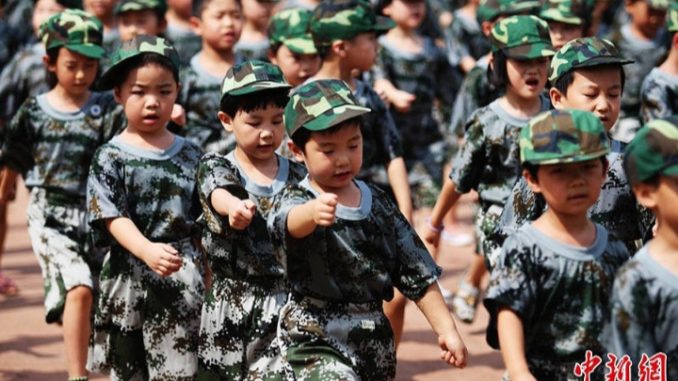
The growing role of the Chinese Communist Party (CCP) in education, information management and national-security policy raises an important question: where does ordinary civic education end and political control begin?
Recent research provides substantial evidence that Beijing has been strengthening ideological education and information controls. A 2026 academic study examining China’s Patriotic Education Law found that patriotic education has become increasingly connected to loyalty to the CCP and ideological conformity under Xi Jinping.
That development matters because schools do more than teach academic subjects. They help shape how younger generations understand history, government, national identity and their country’s relationship with the outside world.
Education as a National-Security Tool
China’s approach increasingly connects education with national security.
The country’s 2024 Patriotic Education Law institutionalized patriotic education across society, including among young people. Researchers have described the framework as part of a broader effort to strengthen ideological control and reinforce the Party’s political authority.
China’s government is also incorporating technology into education. A July 2026 Chinese government plan translated and analyzed by Georgetown’s Center for Security and Emerging Technology describes applications of artificial intelligence ranging from educational planning to classroom surveillance of teachers and students.
These developments do not necessarily mean that every Chinese educational program is military training or that every student is being prepared for military service. The more precise concern is that education, technology, national security and political ideology are increasingly being treated as interconnected parts of state policy.
Information Control Is the Other Side of the Equation
Education is only one part of the broader information environment.
The U.S.-China Economic and Security Review Commission has documented the extensive censorship system maintained by Chinese authorities, including controls designed to regulate internet content and restrict information considered threatening to the CCP’s political authority.
A 2026 UK government country report similarly describes China’s internet censorship system as highly developed, with restrictions affecting foreign websites, news organizations and online platforms. It also reports requirements for Chinese technology companies and websites to remove prohibited content.
This creates a significant imbalance: the government can influence what citizens encounter online while simultaneously strengthening ideological education offline.
The Military Connection
China’s evolving national-defense legislation adds another dimension.
An analysis by Poland’s Centre for Eastern Studies found that amendments to China’s National Defence Mobilisation Law expanded the government’s ability to mobilize civilian resources, including technological and digital capabilities. The analysis also notes that Beijing treats propaganda, information control and disinformation as components of modern warfare.
That does not establish that China’s schools have simply been converted into military institutions. It does, however, demonstrate how Beijing increasingly views information, technology, education and civilian society through a national-security framework.
Why This Matters Beyond China
The implications extend beyond China’s borders.
China’s influence efforts have increasingly included educational exchanges and relationships with foreign schools. A recent Gateway Pundit report, for example, examined Chinese government-linked educational programs involving American schools. That report makes several allegations about the purpose of these programs; those claims should be evaluated against primary documents and independent investigations rather than accepted automatically.
For American schools, universities and policymakers, the practical issue is therefore not whether every Chinese educational exchange represents an influence operation. It is whether institutions have sufficient transparency about funding, partnerships, curriculum development, government involvement and access to students.
Transparency provides a way to distinguish legitimate cultural and educational exchange from programs that may create undisclosed political influence.
Commentary
The most important lesson is that information warfare in the 21st century does not necessarily look like traditional propaganda posters or state-controlled newspapers.
It can involve algorithms, artificial intelligence, school curricula, social-media regulation, digital surveillance, cultural exchanges and control over which information is easily accessible.
China’s system demonstrates how these tools can operate together.
At the same time, discussions about China’s policies should remain evidence-based. Describing every Chinese student, teacher, technology company or international exchange as an extension of the CCP would go beyond the available evidence. The relevant question is which institutions are directly connected to the Chinese state or Party, what authority they possess, how transparent their relationships are, and what the documented objectives of those programs actually are.
That distinction is essential.
The issue is not opposition to Chinese people or Chinese culture. It is the examination of state power and information control—particularly when education, technology and national security become increasingly integrated.