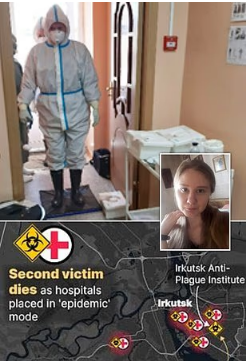
Panic broke out last week when a female laboratory technician died and hundreds of people she came into contact with were placed in quarantine. Darya Shipilova, 28, was said to be working at the Irkutsk Anti-Plague Institute in Siberia when she was exposed to pneumonic plague. She died on October 2.
Reported by:

Cherry Meigh Timbol
News Content Editor
Published October 6, 2026
A growing health scare in Russia’s Siberian region of Irkutsk has taken another turn after media reports claimed that a second person may have died at a hospital placed under heightened infection-control measures.
The reports come days after the death of Darya Shipilova, a laboratory technician who worked at the Irkutsk Anti-Plague Research Institute. Shipilova, who was in her late 20s, was hospitalized with severe pneumonia and died on October 2. Her death triggered quarantine and monitoring measures involving nearly 200 people who had contact with her.
However, there is an important distinction between the alarming reports circulating in Russian and British media and what has been independently confirmed.
As of October 6, Russian authorities have not confirmed a second plague death — and the World Health Organization has been told that there are no confirmed plague cases in Irkutsk.
Second-death claim remains unconfirmed
Reports cited by the Daily Mail and Mirror have raised the possibility that another patient died at a hospital associated with the infection-control response.
The development has fueled speculation that the situation may be more serious than Russian authorities have publicly acknowledged.
But independent reporting has so far not established that a second person died from pneumonic plague.
Reuters reported Tuesday that Russian authorities had told the WHO that no case of plague had been recorded in Irkutsk and that people who had been in contact with the deceased laboratory worker tested negative for dangerous infectious pathogens. Reuters also noted that it remained unclear whether the laboratory worker herself had definitively been ruled out as having plague.
That uncertainty is central to the story.
A death involving severe pneumonia is not, by itself, evidence of pneumonic plague. Confirmation requires laboratory testing for Yersinia pestis, the bacterium that causes plague.
Why the first death triggered such a major response
Shipilova’s death became particularly alarming because she worked at an institute specifically involved in plague research.
Russian media circulated several different accounts of how she might have become infected, including an alleged laboratory accident involving a tube containing Yersinia pestis. Other reports suggested possible exposure away from the laboratory.
Russian authorities have not confirmed either explanation.
Rospotrebnadzor, Russia’s consumer and public-health watchdog, said the woman died from “pneumonia of unknown aetiology” and that testing did not identify microorganisms associated with her professional work.
At the same time, authorities imposed precautionary measures.
Around 189–200 people who had contact with Shipilova were placed under medical observation, while sections of hospitals in the area were subjected to quarantine restrictions. Staff at the anti-plague institute were also reportedly isolated.
Several hospitals and a maternity facility introduced additional restrictions, further contributing to public concern.
Kremlin tells Russians to ignore rumors
The Kremlin has pushed back against reports of an uncontrolled plague outbreak.
Kremlin spokesman Dmitry Peskov urged the public to rely on information from Rospotrebnadzor rather than rumors circulating online.
Russian authorities have repeatedly described the epidemiological situation as stable and said that no confirmed plague infections have been identified among the people who came into contact with Shipilova.
That position received important international support Tuesday when the WHO said Russia had reported no plague cases in Irkutsk.
WHO spokesman Christian Lindmeier said Russian authorities had reported negative test results among contacts of the deceased woman. The WHO continues to assess the general public risk as low based on the information available.
Why pneumonic plague is causing concern
Pneumonic plague is different from the more familiar bubonic form.
The disease is caused by Yersinia pestis. Bubonic plague is normally associated with infected flea bites, while pneumonic plague affects the lungs and can spread between people through infectious respiratory particles.
The World Health Organization describes pneumonic plague as the most severe form of the disease. Symptoms can develop rapidly and include fever, weakness, coughing, difficulty breathing and sometimes bloody sputum.
The disease can be extremely dangerous when treatment is delayed. WHO says untreated pneumonic plague can become fatal rapidly, while appropriate antibiotics can be highly effective when administered early.
This explains why authorities have taken precautionary measures despite the absence of a confirmed outbreak.

She was reportedly working at the Irkutsk Anti-Plague Institute in Siberia when she was exposed to pneumonic plague
COVID-19 adds another layer of confusion
The situation has also produced comparisons with the COVID-19 pandemic, particularly because severe respiratory symptoms can initially resemble other infectious diseases.
Reuters reported that among people connected to the deceased laboratory worker, officials identified two COVID-19 infections and two rhinovirus infections, while no new plague cases were reported.
That finding illustrates one of the major challenges facing investigators: severe pneumonia can have numerous causes, and clinical symptoms alone cannot establish plague.
WHO likewise notes that pneumonic plague can resemble severe pneumonia caused by other pathogens, including influenza and coronaviruses. Laboratory confirmation is therefore essential.
International concern grows
The incident has attracted attention outside Russia.
The United States has said it is monitoring developments, while Secretary of State Marco Rubio said Washington was following the situation closely. President Donald Trump also offered assistance to Russia.
The international focus is not necessarily evidence that an outbreak is underway. Rather, it reflects the unusual combination of a death involving a worker at an anti-plague research facility, emergency quarantine measures and uncertainty surrounding the diagnosis.
The WHO’s current assessment is considerably less alarming: based on information available to the organization, the risk to the general population remains low.
What happens next?
The critical issue is laboratory confirmation.
At present, the available evidence does not establish that Russia is experiencing a pneumonic-plague outbreak.
The reported second death should therefore be treated cautiously. It is a significant development worth monitoring, but there is currently no reliable confirmation that the second person died from plague.
The WHO’s communication with Russian authorities is likely to be particularly important as additional laboratory results become available.
Health officials will also need to continue monitoring people who had close contact with Shipilova and determine whether any unexplained respiratory illnesses emerge.
🧩 Bottom Line:
Russia is facing a serious and unusual public-health scare, but the available evidence as of October 6 does not confirm a pneumonic-plague outbreak.
The death of an anti-plague laboratory worker, extensive precautionary measures and conflicting reports have understandably fueled fears. The latest information from Russia to the WHO, however, says no plague cases have been recorded in Irkutsk, while contacts of the deceased have reportedly tested negative for dangerous infectious pathogens.
The reported second victim remains an unconfirmed claim, and it should not be presented as an established plague death until laboratory or official evidence confirms it.
For now, the story is less about a confirmed return of the Black Death and more about a mysterious pneumonia death, extraordinary precautionary measures and a growing information gap that authorities must resolve with transparent testing and evidence.