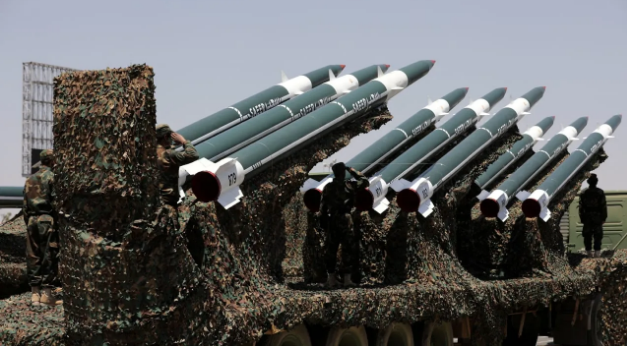
(photo credit: KHALED ABDULLAH/REUTERS)
Reported by:

Cherry Meigh Timbol
News Content Editor
Published October 6, 2026
Iran is moving to expand the range and speed of its missile arsenal after concluding that American forces have been positioned too far from Iranian territory for Tehran’s existing weapons to provide the level of deterrence it wants, according to an Iranian Army spokesman.
The announcement comes as diplomatic efforts between Washington and Tehran remain stalled and the Strait of Hormuz continues to dominate the regional security crisis.
Iranian Army spokesman Mohammad Akraminia said the military had concluded during the recent war that it “absolutely” needed to increase missile range and had already begun moving in that direction. He said U.S. forces are now operating as far as 1,000 kilometers from Iran’s coast.
The statement represents another sign that Iran is using the recent conflict to reassess its military capabilities rather than simply returning to the status quo.
Iran says the war exposed a missile-range gap
According to Akraminia, Iranian missiles used by ground forces against enemy bases in Kuwait and naval missiles used against vessels performed effectively during the conflict.
But Tehran apparently concluded that effectiveness alone was not enough.
Iranian officials say the physical distance of American forces from Iran’s coastline has created a requirement for weapons capable of striking targets farther away. Akraminia said future systems would be upgraded in both speed and range.
The comments were reported after an interview with the Fars news agency and subsequently reported by international media, including Reuters.
Iran’s announcement does not necessarily mean that a new long-range missile has already entered operational service. Rather, the statement indicates that Tehran has decided to pursue additional range as a military-development priority.
Iran already possesses long-range missiles
Iran’s missile program is not starting from scratch.
The country already possesses several ballistic missile systems capable of traveling more than 1,000 kilometers, including variants of the Shahab-3, Sejjil and Khorramshahr families. The Jerusalem Post noted that some Iranian systems have reported ranges reaching roughly 2,000 to 3,000 kilometers.
That makes the latest announcement particularly significant.
Iran is not simply seeking the ability to reach neighboring countries. It is signaling an intention to increase the distance at which it can threaten military forces, bases and naval assets.
The statement also comes after reports earlier this year that Iranian missiles had been used in an attempt to reach the distant U.S.-UK military facility at Diego Garcia in the Indian Ocean. The reported distance was roughly 4,000 kilometers, considerably beyond Iran’s historically stated 2,000-kilometer limit.
Tehran says U.S. forces have moved farther away
The Iranian military’s explanation centers on geography.
Akraminia said American forces have moved to positions as far as 1,000 kilometers from Iran’s coastline. Iranian officials argue that this makes longer-range missiles increasingly necessary.
The claim is part of Tehran’s broader narrative that the recent conflict demonstrated the need to strengthen its ability to strike military targets at greater distances.
Another Iranian commander, Rear Admiral Ali Fadavi, has claimed that U.S. forces were pushed more than 1,000 kilometers away from Iran’s borders because of Iranian military pressure. That claim has not been independently established.
For Tehran, however, the message is clear: distance is becoming a central component of its military strategy.
The Strait of Hormuz remains a major pressure point
The missile announcement comes as Iran continues to link the reopening of the Strait of Hormuz to diplomatic conditions demanded by Tehran.
Iranian Parliament Speaker and chief negotiator Mohammad Baqer Qalibaf has said the waterway will remain closed until seven conditions outlined in an earlier understanding with Washington are fulfilled.
The Strait is one of the world’s most strategically important oil routes.
Its continued closure or disruption has contributed to global energy-market concerns and increased pressure on Washington and its allies to reach an agreement with Tehran.
The missile issue makes the diplomatic situation even more complicated.
Iran wants sanctions relief and security guarantees, while the United States and its allies remain concerned about Tehran’s missile capabilities and broader military posture.
Israel is watching Iran’s missile program closely
Israel has long regarded Iran’s ballistic missile arsenal as one of the country’s most serious conventional threats.
The concern has increased following the missile exchanges during the latest regional conflict.
The Jerusalem Post has previously reported that former Israeli air-defense chief Brig. Gen. Ran Kochav warned that Iran had demonstrated a capability extending beyond the range traditionally associated with its missile program. In March, reports indicated that an Iranian missile had traveled approximately 4,000 kilometers toward Diego Garcia.
If Iran succeeds in systematically increasing missile range, the strategic implications could extend well beyond Israel and the Persian Gulf.
Targets across the Middle East would remain within range, while parts of Europe could potentially become increasingly vulnerable depending on the systems eventually developed.
A new regional arms race?
The announcement raises the possibility of another phase in the Middle East’s missile competition.
Iran has historically relied heavily on missiles because its conventional air force is not comparable to those of the United States or Israel. Longer-range missiles give Tehran a way to threaten military bases and naval forces without needing air superiority.
Israel, meanwhile, has invested heavily in layered missile-defense systems.
The United States also maintains extensive air and missile-defense capabilities across the region.
If Iran begins producing larger numbers of longer-range and faster missiles, Washington and its allies could respond by deploying additional interceptors, sensors and long-range strike systems.
That could create a cycle in which improvements in offensive missiles lead to improvements in missile defenses, which then encourage further offensive development.
What happens next?
The most important indicator will be whether Iran moves from political statements to demonstrable missile-development activity.
That could include new missile tests, production announcements, deployment of new launch systems or evidence of improved guidance, speed and range.
Iran has already said it has begun work in this direction.
The second major factor will be diplomacy.
If Washington and Tehran eventually reach an agreement over the Strait of Hormuz and broader security issues, the pace of military escalation could slow.
If negotiations fail and another confrontation develops, Iran’s newly stated focus on longer-range weapons could become an important part of its response.
🧩 Bottom Line:
SOURCES: ZEROHEDGE – Iran Seeking To Increase Range Of Missiles: ‘Keep Enemy At Greater Distance’
THE JERUSALEM POST – Iran plans to expand missile range to reach ‘enemy located at greater distance’, spokesperson says