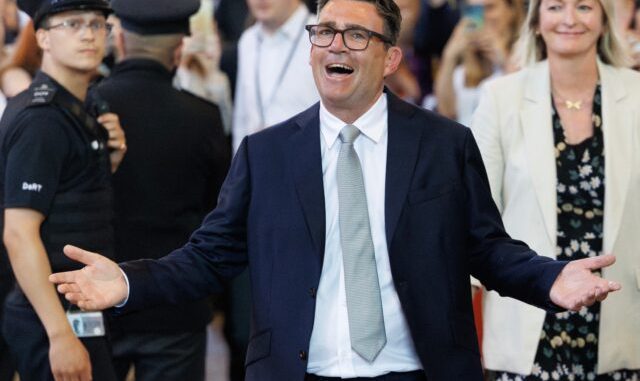
The United Kingdom is set to see its seventh prime minister in the past ten years, and it appears that man will be Andy Burnham, a veteran Labour Party Westminster insider who has sought to cast himself as a “socialist” working-class hero.
Published June 22, 2026
LONDON, United Kingdom — Following the surprise resignation of Keir Starmer, attention has quickly turned to Andy Burnham, who is now widely viewed as the frontrunner to become the next leader of the Labour Party and potentially the next Prime Minister of the United Kingdom.
Burnham, the long-serving Mayor of Greater Manchester, formally announced his intention to seek the Labour leadership shortly after Starmer revealed plans to step down. Several senior Labour figures, including Health Secretary Wes Streeting, have publicly endorsed Burnham, strengthening his position ahead of the party’s upcoming leadership contest.
Who Is Andy Burnham?
Burnham, 56, is one of Labour’s most recognizable political figures. He previously served in several Cabinet positions under former Prime Minister Gordon Brown and has spent nearly a decade leading Greater Manchester as its elected mayor. He is known for advocating stronger regional government, expanded public transportation, and increased public investment in local communities.
His leadership during the COVID-19 pandemic, particularly his campaign for additional support for Northern England, earned him the nickname “King of the North” among supporters and media commentators.
Why Burnham Is Being Called a Socialist
Some commentators, particularly conservative media outlets, describe Burnham as a socialist due to his support for greater government involvement in public services, transportation, housing, and regional economic development. Burnham has also advocated devolving more power away from London and toward local governments. Critics argue these policies represent a shift to the left within Labour, while supporters view them as practical solutions to regional inequality.
Leadership Race Gains Momentum
Burnham’s political comeback accelerated after winning a parliamentary by-election in Makerfield, returning him to Westminster and positioning him to challenge for Labour’s top job. With Starmer’s resignation now official, Labour’s National Executive Committee is expected to begin the formal leadership process in July.
At present, Burnham is the only major candidate to formally declare his intention to run. Political analysts suggest that unless a strong rival emerges, he could secure the leadership relatively quickly and become Britain’s next prime minister without a general election, thanks to Labour’s existing parliamentary majority.
Political Challenges Ahead
If Burnham succeeds Starmer, he will inherit significant challenges, including slowing economic growth, public dissatisfaction with government performance, and growing pressure from Nigel Farage and the rising Reform UK movement. Farage has already called for an immediate general election following Starmer’s resignation, arguing that voters should decide who governs the country.
Financial markets have reacted cautiously but calmly to the transition, with investors waiting for greater clarity regarding Burnham’s fiscal and economic policies. Some analysts believe his more interventionist approach could raise concerns about government spending, while others argue that a stable leadership transition could restore confidence.
 Public / Political Reactions:
🇬🇧 Labour Party Supporters and Allies
Many Labour supporters welcomed Andy Burnham’s decision to seek the party leadership, viewing him as a politician with strong ties to working-class communities and regional voters outside London.
- Supporters argue Burnham has a proven track record as Mayor of Greater Manchester
- Several Labour figures believe he could help rebuild public confidence in the government
- Allies describe him as a strong communicator capable of uniting different factions within Labour
➡️ Position: Burnham is seen by supporters as a credible leader who can renew Labour’s image and strengthen its connection with voters.
🏛️ Senior Labour Figures
Several prominent Labour politicians have publicly backed Burnham’s leadership bid following Keir Starmer’s resignation.
- Health Secretary Wes Streeting endorsed Burnham and declined to enter the leadership contest
- Some Labour MPs favor a quick transition to avoid prolonged political uncertainty
- Others support a competitive race to allow members to debate the party’s future direction
➡️ Position: Party leaders are seeking stability while ensuring Labour remains united during the leadership transition.
🇬🇧 Conservative Critics and Opposition Voices
Conservative commentators and political opponents have raised concerns about Burnham’s policy agenda and leadership ambitions.
- Critics argue Burnham’s economic policies could move Labour further to the left
- Some opponents question whether a new prime minister should take office without a general election
- Conservative voices have warned about increased government spending under a Burnham administration
➡️ Position: Opponents believe voters should have a direct say before a new Labour leader assumes the premiership.
🇬🇧 Reform UK and Nigel Farage
Reform UK leader Nigel Farage has been among the most vocal critics of Labour’s succession process.
- Farage called for an immediate general election following Starmer’s resignation
- Reform UK argues that Labour lacks a fresh electoral mandate for a new prime minister
- Supporters claim the leadership change presents an opportunity for voters to reassess the government’s direction
➡️ Position: Reform UK wants a nationwide election rather than an internal Labour leadership selection.
💷 Business Leaders and Financial Markets
Investors and business groups have reacted cautiously as the leadership contest unfolds.
- Financial markets are closely watching Burnham’s economic proposals
- Some analysts are concerned about higher public spending and government intervention
- Others view a stable transition of power as positive for market confidence
➡️ Position: Businesses are seeking policy clarity and economic stability before fully assessing Burnham’s potential leadership.
👥 Political Analysts and the Public
Political observers note that Burnham enjoys higher personal popularity than many senior Labour politicians.
- Analysts point to his strong performance as Mayor of Greater Manchester
- Supporters see him as more connected to ordinary voters than traditional Westminster politicians
- Polling commentators suggest his regional focus could broaden Labour’s appeal outside major cities
➡️ Position: Burnham enters the leadership race as a strong contender with significant public recognition and political momentum.
 Resulting Effects
The emergence of Andy Burnham as the leading contender to replace Keir Starmer has triggered a major political transition in the United Kingdom, creating uncertainty over the future direction of the Labour government and national policy.
1. Labour Leadership Contest Accelerates
Starmer’s resignation has set off a rapid leadership race within the Labour Party.
🏛️ Labour officials are preparing the formal leadership election process.
🗳️ Burnham has quickly emerged as the frontrunner following endorsements from senior party figures.
👥 Labour members and MPs are now focused on selecting a leader capable of maintaining party unity.
➡️ Result: Starmer’s departure → accelerated leadership battle within Labour.
2. Potential Change in Government Priorities
A Burnham-led government could bring a different approach to domestic policy.
🚆 Greater emphasis on regional development and public transportation.
🏘️ Increased focus on housing, local government powers, and public services.
💷 Possible expansion of public investment programs aimed at reducing regional inequality.
➡️ Result: New leadership → potential shift in Labour’s policy agenda.
3. Growing Calls for a General Election
The leadership transition has intensified debate over democratic legitimacy.
🗳️ Reform UK and other critics are demanding a fresh national election.
📣 Opposition figures argue voters should choose the next prime minister directly.
🏛️ Labour maintains that the governing party has the constitutional right to select a new leader during the current parliamentary term.
➡️ Result: Leadership change → renewed political pressure for an early election.
4. Market and Business Uncertainty
Financial institutions and investors are closely monitoring developments.
📈 Markets are assessing Burnham’s economic and fiscal priorities.
💼 Business groups are seeking clarity regarding taxation, spending, and investment policies.
📊 Analysts are evaluating how a leadership change could affect economic confidence.
➡️ Result: Political transition → short-term uncertainty for investors and businesses.
5. Increased Competition from Reform UK
The leadership contest may reshape the broader political landscape.
📣 Reform UK is using the transition to attract dissatisfied voters.
🗳️ Opposition parties are preparing for potential shifts in public opinion.
⚔️ Labour may face stronger challenges from rivals seeking to capitalize on the government’s instability.
➡️ Result: Labour transition → intensified competition across the political spectrum.
6. Burnham’s National Political Influence Expands
Burnham’s move from local government to national leadership has significantly elevated his political profile.
🌍 His Greater Manchester record is receiving increased national scrutiny.
🏛️ Former local initiatives may become models for future national policies.
👥 Supporters view him as a bridge between regional voters and Westminster politics.
➡️ Result: Burnham’s candidacy → greater influence over the future direction of British politics.
 Future Outlook
The coming weeks are expected to be crucial for both Andy Burnham and the Labour Party as the leadership contest unfolds. The outcome could significantly influence the direction of the British government, economic policy, and the country’s political landscape.
1. Burnham Remains the Favorite to Become Labour Leader
Current political momentum suggests Burnham enters the race as the strongest candidate.
🏛️ Senior Labour figures have already rallied behind his candidacy.
📊 Political analysts view him as one of the party’s most recognizable and experienced leaders.
👥 Additional endorsements could further strengthen his position before voting begins.
➡️ Outlook: Strong party support → increased likelihood of Burnham securing the Labour leadership.
2. Potential Shift Toward Regional Development Policies
A Burnham-led government may place greater emphasis on reducing economic disparities across Britain.
🚆 Investment in transportation and regional infrastructure could become a higher priority.
🏘️ Local governments may receive additional powers and funding.
🌍 Efforts to boost economic growth outside London could become a central policy objective.
➡️ Outlook: Regional-focused leadership → greater emphasis on local development and public investment.
3. Opposition Parties Likely to Intensify Pressure
Political rivals are expected to challenge Labour’s leadership transition.
🗳️ Reform UK is likely to continue demanding a general election.
📣 Conservative figures may question Labour’s mandate to install a new prime minister without a nationwide vote.
⚔️ Opposition parties will seek to capitalize on any divisions within Labour.
➡️ Outlook: Leadership transition → increased political scrutiny and partisan competition.
4. Markets Will Closely Monitor Economic Policies
Investors and businesses will look for signals regarding Burnham’s economic agenda.
💷 Financial markets will focus on spending plans, taxation, and fiscal discipline.
📈 Business leaders may seek assurances that economic stability remains a government priority.
🏦 Government policy announcements could influence investor confidence during the transition period.
➡️ Outlook: Policy clarity → key factor in maintaining market confidence.
5. Labour Unity Will Be Critical
The party’s ability to remain united could determine the success of a future Burnham government.
🤝 Labour leaders will likely work to avoid internal divisions during the contest.
👥 Party members may seek a leadership outcome that balances progressive and moderate viewpoints.
🏛️ A smooth transition could strengthen Labour’s governing position ahead of future elections.
➡️ Outlook: Party cohesion → essential for political stability and effective governance.
6. Britain’s Political Direction Could Change Significantly
A Burnham premiership could mark a new phase in Labour’s approach to governing.
📍 Greater focus on regional representation and local decision-making.
🏘️ Expanded attention to public services, housing, and community investment.
🌍 Britain’s domestic political priorities could evolve under a leader with strong local-government experience.
➡️ Outlook: New leadership at Downing Street → potential reshaping of Britain’s political and economic priorities in the years ahead.
 Bottom Line
Andy Burnham’s bid to replace Keir Starmer has quickly become one of the most closely watched developments in British politics. As the frontrunner for the Labour leadership, Burnham brings significant experience from both national government and his tenure as Mayor of Greater Manchester, where he built a reputation as a strong advocate for regional development and public services. His potential rise to Downing Street could signal a shift toward greater investment outside London and a stronger role for government in addressing economic and social challenges. However, his leadership would also face immediate tests, including maintaining Labour Party unity, reassuring businesses and financial markets, and responding to opposition demands for a general election. The outcome of the leadership contest is likely to shape the future direction of the United Kingdom and determine how Labour approaches governance in the years ahead.
SOURCES: BREITBART NEWS – Self-Described ‘Socialist’ Andy Burnham Looks to Replace Starmer as British Prime Minister
GLOBAL NEWS – Andy Burnham aims to replace Keir Starmer as U.K. PM. Who is he?