A top British Muslim charity has reportedly been accused by the American FBI of having acted as a front to funnel funding and other goods to Hamas terrorists in Palestine.
Published August 10, 2026
A major British Muslim charity is facing a serious investigation after U.S. authorities allegedly accused one of its senior figures of using the organization to raise money, transfer supplies and provide support to Hamas, according to reporting based on a U.S. federal indictment.
The allegations center on Mohammad Yousef Hasna, described as a global director of the Al-Khair Foundation, one of Britain’s largest Muslim charities. According to the indictment cited by The Telegraph and Breitbart, Hasna allegedly used his position to raise funds and provide financing and commodities to Hamas.
British authorities have now launched a probe into the charity following Hasna’s arrest in the United Kingdom on U.S. charges. The allegations have intensified scrutiny of how humanitarian organizations operating in conflict zones ensure that aid does not fall into the hands of terrorist organizations.
Hasna has been accused, not convicted, and the allegations remain subject to the legal process.
U.S. Indictment Places Charity Director at Center of Investigation
According to the U.S. indictment reported by The Telegraph, the FBI allegedly obtained communications between Hasna and individuals described as senior Hamas figures.
Investigators reportedly allege that the communications involved efforts to use the charity’s operations to raise funds and provide material assistance to Hamas.
The allegations are particularly significant because they concern the potential misuse of humanitarian infrastructure.
Rather than openly transferring money to a terrorist organization, prosecutors allege that charitable operations were used to disguise the ultimate destination of funds and goods.
Al-Khair Foundation Under British Investigation
The UK’s Charity Commission announced that it was investigating the Al-Khair Foundation after the allegations became public.
The investigation follows Hasna’s arrest in Britain and the U.S. request for his extradition. The Times of Israel reported that Hasna, a 45-year-old Turkish national, was ordered held pending extradition proceedings in connection with the U.S. case.
The British investigation represents a major development because the allegations involve one of the country’s prominent Muslim charitable organizations.
The Charity Commission will be expected to examine whether the organization itself was involved in wrongdoing, whether individual employees acted improperly and whether appropriate safeguards were in place to prevent funds or humanitarian supplies from being diverted.
Alleged Links to Senior Hamas Figures
One of the most serious aspects of the allegations involves claims that Hasna communicated with senior Hamas officials.
According to the indictment described in the reporting, the FBI allegedly obtained messages between Hasna and individuals at senior levels of Hamas, including Ghazi Hamad.
U.S. prosecutors reportedly allege that those communications concerned fundraising and the movement of goods into Gaza.
If proven in court, such conduct could represent a significant breach of the safeguards normally expected from humanitarian organizations.
Millions of Dollars and Goods Allegedly at Issue
The allegations go beyond financial transfers.
According to the indictment, Hasna allegedly helped procure and transport commodities and materials to Gaza. Investigators reportedly claim that shipments were presented as humanitarian aid while allegedly benefiting Hamas leadership.
The allegations also reportedly include claims that photographs and documents were manipulated to obscure the alleged involvement of Hamas.
That accusation could become a central issue in the investigation because humanitarian organizations rely heavily on public trust and donor confidence.
Humanitarian Aid Under Greater Scrutiny
The allegations come amid an intense international debate over the delivery of humanitarian assistance into Gaza.
Aid organizations have repeatedly emphasized the importance of ensuring that food, medicine and other supplies reach civilians rather than armed groups.
The U.S. allegations involving Hasna could therefore have consequences beyond the individual defendant and the Al-Khair Foundation.
Governments and regulators may face renewed pressure to examine how charitable funds are transferred into conflict zones and what mechanisms exist to prevent diversion.
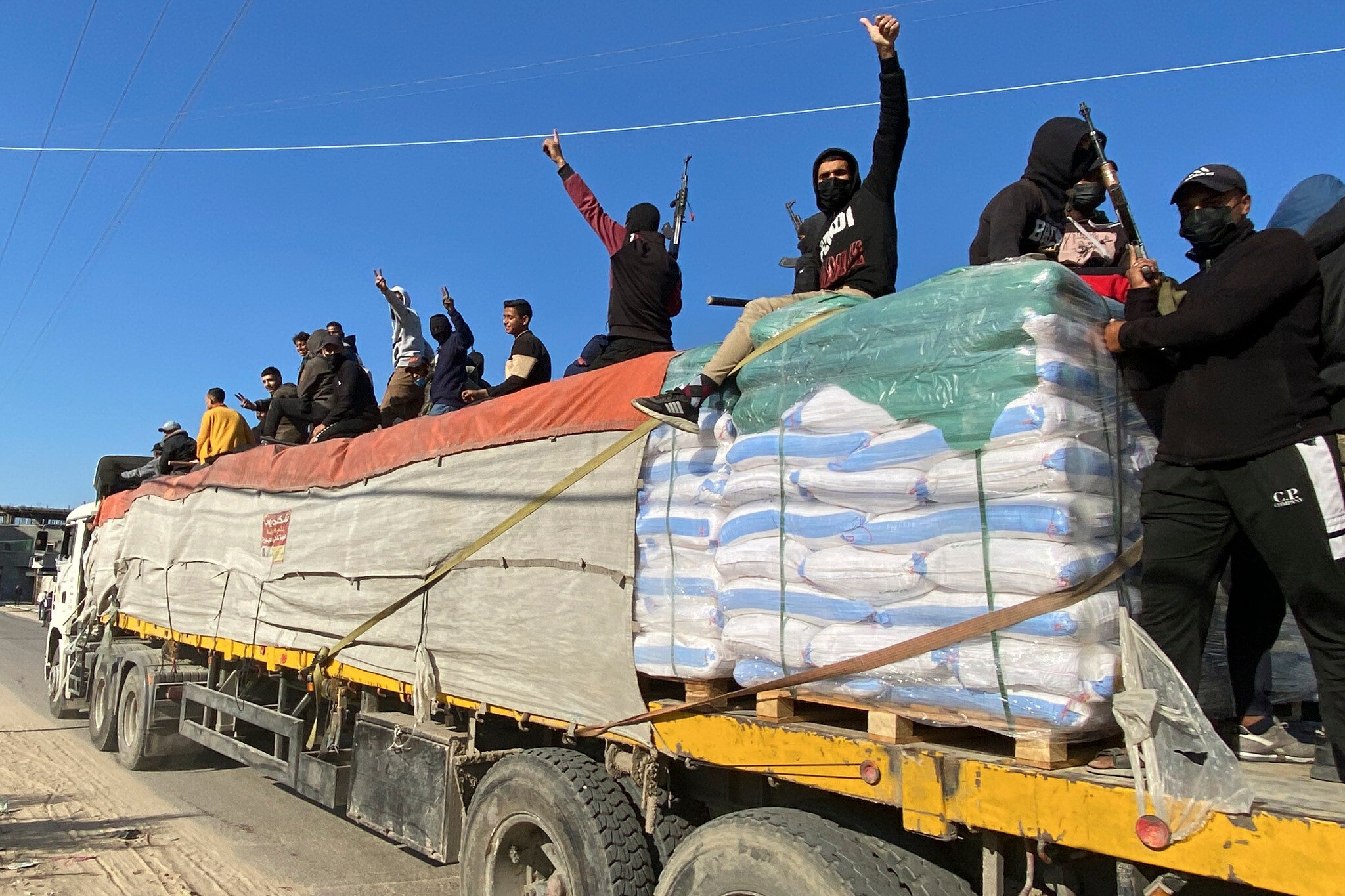
Hamas members ride on top of a humanitarian aid truck in Rafah, Gaza Strip, December 19, 2023. (AP Photo)
Britain Faces Questions Over Charity Oversight
The case could also put Britain’s charity-regulation system under a microscope.
The United Kingdom has thousands of registered charitable organizations, many of which conduct legitimate humanitarian work internationally.
The challenge for regulators is determining whether organizations have sufficient safeguards against money laundering, terrorist financing and the diversion of humanitarian supplies without unnecessarily restricting legitimate aid operations.
The Charity Commission’s investigation could therefore become closely watched by other charities operating in Gaza and the broader Middle East.
A Potential Blow to Donor Confidence
The allegations could also have consequences for charitable fundraising.
British Muslims and other donors who contribute to humanitarian organizations generally expect their money to assist civilians affected by war, poverty and natural disasters.
Any proven misuse of charitable funds could undermine confidence across the sector.
The broader implication is that legitimate humanitarian organizations could face increased scrutiny even when they have no connection to the alleged misconduct.

Mohammad Yousef Hasna, global director of the Al-Khair Foundation, was arrested in London last week and faces extradition to the US
Hamas Funding Allegations Carry Serious Legal Consequences
The case also highlights the serious legal risks associated with providing material support to Hamas.
The United States designates Hamas as a terrorist organization, and individuals accused of knowingly providing financial or material support can face significant federal criminal charges.
The allegations against Hasna will ultimately have to be tested through the U.S. legal process.
Until that occurs, the accusations should not be treated as established facts.
The Gaza Aid Pipeline Faces Greater Scrutiny
The investigation could trigger broader examinations of organizations involved in delivering humanitarian assistance into Gaza.
Regulators may look more closely at:
- Where charitable money originates
- Who controls the funds after they enter Gaza
- Which organizations receive humanitarian shipments
- Whether aid deliveries are independently documented
- Whether employees or contractors have connections to armed groups
- Whether financial transactions can be independently audited
For legitimate charities, stronger transparency requirements could become increasingly important.
 Armed men seen secure trucks loaded with Humanitarian Aid entering Gaza through the Israeli Kerem Shalom Crossing, in Khan Yunis, in the southern Gaza Strip, September 19, 2025. (credit: SAEED MOHAMMED/FLASH90)
International Cooperation Could Expand
The case also demonstrates the growing cooperation between American and British authorities in investigations involving terrorism financing and international charitable organizations.
Hasna’s arrest in Britain following U.S. charges illustrates how investigations can cross borders when alleged financial activity involves multiple jurisdictions.
If the case proceeds toward extradition, U.S. prosecutors could ultimately seek to present evidence gathered from communications, financial records and other investigative sources.
A Major Test for Humanitarian Oversight
The case could become an important test of whether governments can simultaneously protect humanitarian aid and prevent terrorist organizations from exploiting charitable networks.
The distinction is crucial.
Millions of civilians in conflict zones depend on legitimate humanitarian assistance, while governments also have a responsibility to prevent terrorist groups from using aid systems for financial, logistical or military purposes.
Finding that balance could become increasingly difficult as humanitarian operations expand in areas controlled or influenced by armed groups.
What Comes Next?
The immediate focus will be on the British investigation, Hasna’s extradition proceedings and the evidence underlying the U.S. indictment.
British regulators will also have to determine whether any alleged misconduct was limited to individuals or involved broader failures within the charity’s operations.
For U.S. prosecutors, the central question will be whether they can prove the allegations beyond the threshold required in federal court.
For the British charity sector, the case could serve as another warning that international humanitarian operations require extensive financial and operational safeguards.
⚠️ Implications:
1. Greater Scrutiny of British Charities
The allegations could prompt regulators to examine international charities more aggressively for potential terrorist-financing risks.
Implication: Charitable organizations operating overseas could face tighter auditing, reporting and compliance requirements.
2. Increased Oversight of Gaza Aid
Claims that humanitarian shipments were allegedly diverted toward Hamas could intensify scrutiny of aid entering Gaza.
Implication: Governments and donors may demand stronger verification that assistance reaches civilians rather than armed groups.
3. Donor Confidence Could Be Affected
Allegations involving a major charity could create uncertainty among donors who expect their contributions to support humanitarian causes.
Implication: Charities may need greater transparency to reassure donors that funds are being properly controlled.
4. U.S.-U.K. Counterterrorism Cooperation Could Expand
The case demonstrates how investigations into alleged terrorist financing can involve authorities across multiple jurisdictions.
Implication: British and American agencies could increase cooperation on financial intelligence, extradition and charity-related investigations.
5. Legitimate Humanitarian Organizations Could Face Greater Compliance Costs
Stronger safeguards may be necessary to prevent abuse, but additional regulations can also create financial and administrative burdens for legitimate charities.
Implication: Smaller organizations could face increased costs for audits, financial monitoring and international compliance.
6. Terrorist-Financing Investigations Could Focus More on Charitable Networks
The allegations illustrate concerns that legitimate humanitarian structures could potentially be exploited by terrorist organizations.
Implication: Financial investigators may increasingly examine charities, nonprofit organizations and aid networks when tracking alleged terrorist financing.
7. Britain’s Charity Regulation System Could Face Pressure
The investigation could raise questions about whether existing safeguards are sufficient for organizations operating in high-risk conflict zones.
Implication: British regulators could face demands for stronger oversight of charities involved in international aid operations.
8. The Case Could Have Wider Political Consequences
Allegations involving Hamas and a prominent British Muslim charity could intensify debates over terrorism, integration, foreign funding and humanitarian assistance.
Implication: British politicians may face increased pressure to demonstrate that charitable organizations cannot be exploited to support terrorist activity.
9. Hamas Could Face Greater Financial Pressure
If investigators establish that charitable channels were used to transfer resources to Hamas, governments could expand efforts to identify and shut down similar networks.
Implication: Financial disruption could become an increasingly important component of international efforts against Hamas.
10. The Case Highlights the Need to Protect Legitimate Humanitarian Aid
The allegations underscore the importance of separating genuine humanitarian assistance from terrorist financing.
Implication: Stronger transparency and monitoring could help protect civilians while preventing armed groups from exploiting charitable networks.
💬 Overall Takeaway:
The allegations surrounding the Al-Khair Foundation represent a serious test for Britain’s charity sector and international efforts to prevent terrorist financing.
U.S. authorities allege that Mohammad Yousef Hasna used his senior position at the British charity to channel money and goods toward Hamas, while British authorities have opened an investigation into the organization.
Those allegations remain allegations and must be established through the courts.
But if prosecutors ultimately prove that humanitarian infrastructure was deliberately exploited to support Hamas, the consequences could extend well beyond one defendant.
The case could trigger tougher scrutiny of charities, tighter controls over humanitarian shipments and increased international cooperation aimed at ensuring that aid intended for civilians does not become a source of funding or material support for terrorist organizations.
SOURCES: BREITBART – Islamic Charity in Britain Accused of Funnelling Money and Goods to Hamas Leaders: Report
THE TELEGRAPH – British Muslim charity funded Hamas, says FBI
THE TIMES OF ISRAEL – UK probes major Muslim charity after director charged with funneling aid to Hamas