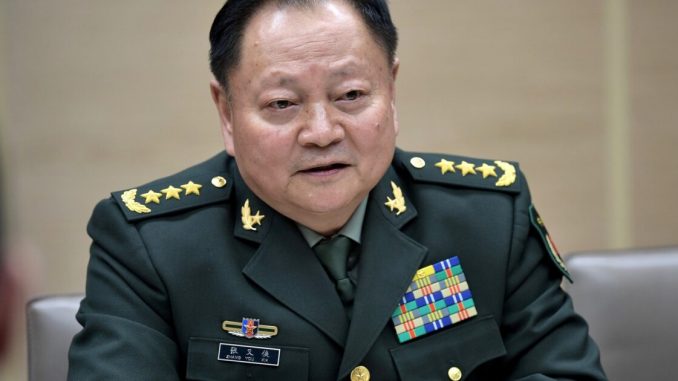
Zhang Youxia, long regarded as the operational leader of the People’s Liberation Army (PLA), was dismissed on Saturday for a “serious violation of discipline.”
Published January 26, 2025
China has reportedly removed one of its most senior military figures in what is shaping up to be one of the most serious internal security scandals in decades, involving allegations of corruption, factionalism, and the unauthorized disclosure of highly sensitive nuclear weapons information to the United States.
President Xi Jinping has ordered an investigation into General Zhang Youxia, vice-chairman of the Central Military Commission (CMC) — the Chinese Communist Party’s highest military decision-making body. Zhang, long regarded as the most powerful uniformed officer in the People’s Liberation Army (PLA), has been accused of “serious violations of discipline and law,” according to a brief statement released by China’s Ministry of National Defense.
As is customary in cases involving senior Communist Party officials, Chinese state media provided no further details, offering only tightly controlled language that masks the true scope of the accusations.
Allegations of Leaked Nuclear Secrets
According to multiple reports cited by Western media, the investigation centers on allegations that Zhang shared classified information related to China’s nuclear weapons program with U.S. officials — a breach that, if confirmed, would represent one of the gravest intelligence failures in the history of the People’s Republic of China.
Sources familiar with internal PLA briefings claim that the accusations were presented during a closed-door meeting of senior military officers. The information allegedly passed to the United States is said to include technical and strategic data tied to China’s nuclear deterrent, an area traditionally guarded by the highest levels of secrecy within the Chinese system.
No official confirmation has been issued by Beijing regarding the specific nature of the leaked material, and U.S. authorities have made no public statements acknowledging receipt of such intelligence.
Corruption, Bribery, and Internal Power Networks
In addition to the alleged nuclear leak, Zhang is reportedly under investigation for a wide range of corruption-related offenses. These include accepting bribes in exchange for military promotions, interfering in procurement decisions, and building personal loyalty networks inside the PLA — actions that directly challenge Xi Jinping’s long-standing efforts to assert absolute Party control over the armed forces.
Investigators are also examining whether Zhang used his authority to protect allies and punish rivals, effectively forming a parallel power structure within the military. Such behavior is viewed as especially dangerous in China’s political system, where the Communist Party insists that the PLA must remain loyal to the Party leadership above all else.
The case reportedly emerged from a broader investigation into Gu Jun, a former senior executive at the China National Nuclear Corporation (CNNC), a state-owned entity closely linked to both civilian and military nuclear programs. Gu is also under investigation for serious violations, and officials believe the two cases may be connected through overlapping networks of influence and information access.
🚨 BREAKING: China’s Top General Accused of Giving Nuclear Secrets to U.S.
Gen. Zhang Youxia, once considered Chinese leader Xi Jinping’s most-trusted military ally, allegedly leaked core technical data on China’s nuclear weapons to the U.S. and built influence networks to… pic.twitter.com/3J9XHvFYNJ
— Ryan Saavedra (@RyanSaavedra) January 25, 2026
A Once-Untouchable Military Figure
Zhang Youxia’s downfall has stunned observers due to his previously untouchable status. Now in his mid-70s, Zhang was one of the very few senior military leaders allowed to remain in office past the customary retirement age — a privilege widely interpreted as a sign of President Xi’s trust.
A veteran of the 1979 border war with Vietnam, Zhang built his reputation on battlefield experience, revolutionary lineage, and deep institutional knowledge of the PLA. He also shared longstanding personal ties with Xi Jinping, dating back decades through family and political connections.
For years, Zhang was seen as a stabilizing force within the military hierarchy and a key architect of China’s modernization of its armed forces. His abrupt removal marks a dramatic reversal of fortune and underscores how rapidly political standing can collapse in China’s opaque power system.
A Pattern of Military Purges
Zhang’s case is not an isolated incident. Over the past several years, Xi Jinping has overseen a sweeping anti-corruption campaign that has increasingly focused on the military and defense sector. Entire leadership teams within the PLA Rocket Force, defense procurement agencies, and military research institutions have been removed or placed under investigation.
These purges have dismantled entrenched patronage networks and replaced them with officials considered more ideologically reliable. Critics, however, argue that the campaign also serves as a tool to eliminate potential rivals and enforce political conformity.
Reports indicate that other senior officers may also be under scrutiny as part of the same investigation, suggesting that Zhang’s removal could be only the most visible element of a much wider internal reckoning.
Official Silence and Controlled Messaging
As with many high-profile cases in China, authorities have maintained strict control over information. The phrase “serious violations of discipline and law” is a standard formulation used by the Communist Party to cover a broad range of offenses — from corruption to political disloyalty — without committing to specific charges.
There has been no public disclosure of evidence, no announcement of formal charges, and no indication of when or whether Zhang will face trial. In some past cases, officials accused of similar violations have disappeared from public view for months or even years before their ultimate fate is revealed.
International analysts caution that the lack of transparency makes independent verification difficult and leaves room for speculation about internal power struggles, intelligence failures, or both.
An Unfolding Scandal
If the allegations against Zhang Youxia are substantiated, the case would mark one of the most damaging breaches of trust in the history of China’s military leadership. Even by the standards of China’s sweeping anti-corruption campaign, the combination of alleged nuclear espionage, bribery, and faction-building places this investigation in a category of its own.
For now, Beijing remains silent, and Zhang — once one of the most powerful men in the PLA — has effectively vanished from public life as the investigation continues behind closed doors.
 Implications of the Purge:
The removal of a figure as senior and politically connected as General Zhang Youxia carries profound implications for China’s military, political system, and internal stability.
Severe Breach of Trust at the Highest Level
If the allegations of leaking nuclear-related information are accurate, the case represents an extraordinary breach of trust at the very top of China’s command structure. China’s nuclear program is among the most tightly guarded state secrets, overseen directly by the Communist Party and the Central Military Commission. A leak from a vice-chairman of the CMC would indicate not merely individual wrongdoing, but a catastrophic failure of internal security and vetting mechanisms.
Such a breach could force Beijing to reassess access controls, compartmentalization of classified information, and loyalty screening across the PLA and defense-industrial complex.
Deepening Climate of Fear Within the PLA
The investigation is likely to intensify an already pervasive climate of fear within China’s military leadership. Senior officers may become increasingly risk-averse, limiting initiative and independent decision-making out of concern that any misstep could be interpreted as disloyalty or corruption.
While the purge may strengthen political obedience in the short term, it risks undermining institutional confidence, cohesion, and morale within the officer corps—especially if loyalty to individuals is treated as suspect.
Further Centralization of Power Around Xi Jinping
Zhang’s fall reinforces the ongoing consolidation of power by President Xi Jinping over the armed forces. By removing even long-trusted allies, Xi signals that no rank, relationship, or revolutionary pedigree offers protection from Party discipline.
This approach strengthens Xi’s personal authority but also increases the system’s dependence on a narrow circle of loyalists. The more centralized decision-making becomes, the higher the consequences of misjudgment or internal disruption.
Exposure of Factionalism Within the Military
The allegations of clique-building and patronage networks suggest that factionalism remains a persistent problem within the PLA despite years of anti-corruption campaigns. Rather than eliminating informal power blocs, repeated purges may simply force them deeper underground, making them harder to detect and more destabilizing when exposed.
Zhang’s case suggests that rivalries and competing loyalty networks still exist even at the very highest levels of command.
Long-Term Impact on Military Professionalism
Frequent purges of senior officers can disrupt institutional continuity and long-term planning. Military modernization programs, weapons development, and command restructuring may be delayed or altered as leadership changes ripple downward.
There is also the risk that political loyalty increasingly outweighs professional competence in promotions, potentially weakening the PLA’s effectiveness over time.
Uncertainty and Speculation Due to Lack of Transparency
China’s refusal to publicly disclose evidence or formal charges fuels speculation both domestically and internationally. The use of vague disciplinary language leaves open multiple interpretations—ranging from genuine espionage to political infighting framed as national security violations.
This opacity may protect the Party’s narrative control, but it also erodes confidence in official explanations and invites alternative interpretations that Beijing cannot fully manage.
 Overall Takeaway:
The sudden removal of General Zhang Youxia marks one of the most serious crises to confront China’s military leadership in recent decades. Whether driven by genuine security breaches, entrenched corruption, or internal power struggles, the allegations point to deep vulnerabilities within a system built on secrecy, loyalty, and centralized control.
Zhang’s fall underscores a central reality of modern Chinese politics: no official, regardless of rank, history, or personal ties to the leadership, is immune from scrutiny or purge. As the investigation unfolds behind closed doors, the lack of transparency leaves critical questions unanswered—about the integrity of China’s military command, the effectiveness of its internal safeguards, and the true motivations behind the purge.
Until Beijing provides clearer explanations, the case will stand as a stark reminder of how quickly power can evaporate inside the Chinese Communist Party, and how national security, political survival, and internal discipline remain tightly—and often opaquely—intertwined.
SOURCES: THE GATEWAY PUNDIT – China Purges One of Its Top Military Leaders After He Allegedly Leaked Nuclear Secrets to U.S.
THE TIMES – Secrets, scandal and ‘nuclear treason’: Inside Xi’s military purge
THE WALL STREET JOURNAL – China’s Top General Accused of Giving Nuclear Secrets to U.S.