Published March 22, 2026
Unprecedented Missile Attempt in Indian Ocean
Iran reportedly fired **two intermediate‑range ballistic missiles toward the joint U.S.–UK military base on Diego Garcia military base strike details, a remote island installation in the Indian Ocean approximately 2,500 miles (4,000 km) from Iran — a distance far beyond the range Iran has previously acknowledged for its missile arsenal.
British and U.S. officials said the strike was unsuccessful: one missile malfunctioned mid‑flight, and a U.S. Navy warship fired an SM‑3 missile in an attempted interception. No damage or casualties have been reported at the base.
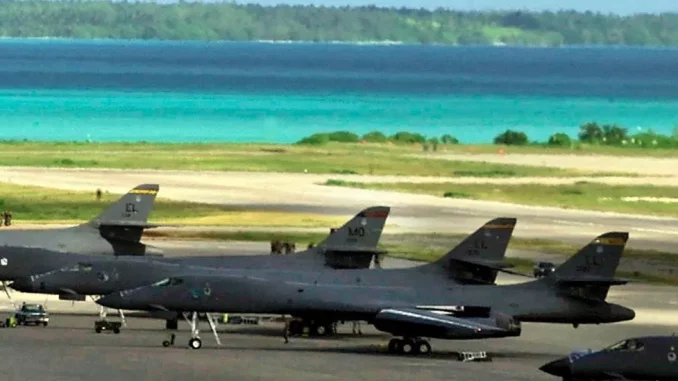
The Diego Garcia base hosts strategic assets, including bomber aircraft and naval vessels, and is crucial to Western military logistics and operations across the Middle East and Indian Ocean.
Implications for Missile Capabilities
Previously, Iranian leaders publicly claimed that their missiles were limited to shorter ranges (around 1,200 to 2,000 km), roughly covering the Middle East and parts of Eurasia. The attempted strike — even if not fully successful — suggests Tehran may have expanded its missile reach significantly, or adapted launch methods that enable longer‑range trajectories.
Military analysts caution that operational success has not been demonstrated, but the attempt itself signals Tehran’s willingness to project power farther than before and tests capabilities that Western intelligence may have underestimated.

The remains of an Iranian missile cross the sky over Tel Aviv after being intercepted early Saturday, March 21, 2026.
International Reactions and Strategic Context
- UK Response: British Foreign Secretary condemned Tehran’s action as “reckless,” stressing that the U.K. remains committed to regional security and defending its interests alongside allies.
- U.S. Position: U.S. Central Command and defense officials have declined detailed comment, but the interception effort reflects ongoing forward defense posture in the region.
- Regional Tensions: The strike comes amid an expanding Middle East conflict involving Israel, Iran, and multiple allies — with attacks on nuclear and military sites across the region.
What It Means Strategically
Experts see this as more than a symbolic gesture:
- Extended Reach: Demonstrating or attempting such a long‑range strike suggests Iranian missile development may have progressed beyond established ranges, potentially redefining threat assessments for European and naval targets.
- Deterrence Signaling: The choice of Diego Garcia — a core U.S.–U.K. hub — shows Tehran’s intent to signal capability and resolve in the broader conflict.
- Defense Posture: Western militaries may accelerate missile defense deployments, surveillance upgrades, and strategic deterrence planning in response to this event.
While missiles targeting Western military forces at such distances have never before been attempted in this war, the incident highlights that future conflicts could extend far beyond previously assumed geographical boundaries.
🔍 Analyst Insight:
The attempted missile strike on Diego Garcia underscores a key strategic lesson: capabilities and intent are both critical for assessing threats. Even though the missiles failed to hit their target, the sheer attempt indicates Tehran’s willingness to project power far beyond its immediate neighborhood.
From an operational standpoint:
- Testing Reach: Iran may be experimenting with missile technologies to extend range and accuracy, signaling potential new threats to distant military bases and regional allies.
- Strategic Signaling: Targeting a remote U.S.–U.K. base communicates both deterrence and resolve, aiming to shape Western decision-making without full-scale engagement.
- Defense Planning: Western militaries now face the challenge of anticipating unconventional attack trajectories and integrating long-range strike considerations into naval and regional defense strategies.
Overall, the incident reflects how emerging military capabilities can alter strategic calculations, even without immediate battlefield success.
👥 Human Element:
While the strike occurred over a remote base, the broader conflict carries a human dimension with tangible consequences:
- Personnel at Risk: Service members stationed at forward bases operate under heightened threat levels, requiring constant vigilance and advanced defense measures.
- Regional Civilians: Escalating missile tests and military posturing can increase tension in surrounding regions, affecting shipping, trade, and local populations indirectly.
- Global Security Awareness: Citizens in allied nations are reminded that distant conflicts can have direct implications for their safety, energy security, and economic stability.
This human perspective reinforces the importance of readiness, training, and protective measures, even in locations considered geographically secure.
🎯 Conclusion:
The attempted strike against Diego Garcia highlights that geographic distance no longer guarantees immunity from strategic threats. Iran’s actions, though not successful, demonstrate evolving missile capabilities that require careful monitoring and proactive defense planning.
For policymakers and military planners, the event underscores the need to balance diplomacy with credible deterrence, maintain robust missile defense systems, and ensure rapid response capabilities.
Ultimately, this incident reminds global actors that strategic foresight, readiness, and international coordination are essential to safeguard both military assets and civilian interests in an increasingly complex security environment.
SOURCES: THE DAILY CALLER – Iran Launches Missiles Against US-UK Base 2,500 Miles Away, Raising Questions About Its Actual Long-Range Capabilities
FORTUNE – Iran launches missiles at U.K.-U.S. base 2,500 miles away in the Indian Ocean, indicating Tehran has weapons with much longer range than once thought