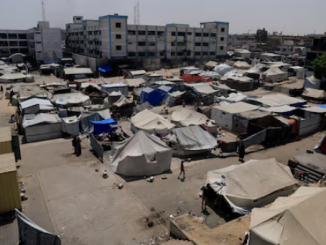
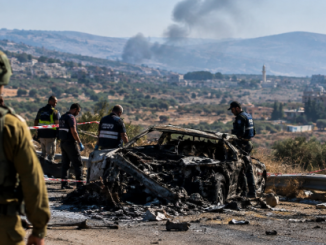
A photograph taken from the southern village of Ghandouriyeh, Lebanon, on June 16 showing ejecta scattered around a crater reportedly left by the Israeli detonation of a Hezbollah tunnel network in Qantara. PHOTO: AFP
Published June 29, 2026
BEIRUT / JERUSALEM — Israel says it has destroyed underground infrastructure used by Hezbollah in southern Lebanon, targeting what officials described as a major tunnel network containing weapons and rocket systems, even as tensions persist along the Israel–Lebanon border despite ongoing U.S.-backed diplomatic efforts.
The operation reportedly struck a tunnel complex in the Majdal Zoun area, which Israeli officials said was approximately 200 meters long and contained hundreds of weapons and rocket launchers. The strike was carried out in coordination with advance notification to the United States, according to Israeli statements.
Underground Network Targeted
Israeli authorities described the destroyed site as part of a broader Hezbollah underground infrastructure system embedded across southern Lebanon, designed to store weapons and support cross-border attacks.
Military officials said the tunnel was used as a logistics and operational hub and formed part of Hezbollah’s wider fortified network near the border with Israel.
The strike comes amid continued Israeli operations targeting Hezbollah positions, including rocket launch sites and armed militants operating in southern Lebanese areas.
Strike Amid Fragile Diplomatic Framework
The operation took place against the backdrop of a recent U.S.-brokered security arrangement between Israel and Lebanon aimed at reducing hostilities and creating conditions for phased de-escalation along the border.
While the agreement envisions reduced cross-border violence and increased Lebanese army deployment in the south, Israeli officials have repeatedly stated that operations against perceived threats will continue until security conditions are fully met.
Hezbollah Condemns Continued Attacks
Hezbollah has condemned Israel’s ongoing military actions, arguing that they violate the spirit of the recent understanding and escalate tensions rather than reduce them.
The group maintains that it retains the right to respond to Israeli strikes, raising concerns among observers that the fragile arrangement could unravel if retaliatory exchanges resume.
Lebanon Caught Between Pressure and Instability
Lebanese authorities have faced growing pressure to assert control in the south while also managing internal political divisions surrounding Hezbollah’s role.
The continued strikes highlight the difficulty of implementing any security framework on the ground, particularly in areas where armed groups maintain entrenched infrastructure.
Regional and International Concerns
The situation has drawn renewed international attention, with observers warning that continued military operations risk undermining diplomatic progress and destabilizing an already fragile regional security environment.
The United States and other mediators have reportedly urged restraint, emphasizing the importance of maintaining the framework designed to reduce escalation along the border.
Energy and security analysts also note that sustained instability in southern Lebanon could have broader implications for regional security dynamics, particularly if cross-border hostilities intensify again.
Outlook Remains Uncertain
Despite diplomatic efforts, the continued targeting of Hezbollah infrastructure underscores how far the situation remains from a lasting settlement.
Analysts say the coming weeks will be critical in determining whether the agreement can survive ongoing military activity—or whether the cycle of strikes and retaliation resumes along the Israel–Lebanon border.
 Public / Political Reactions:
🇮🇱 Israeli Government Officials
Israeli officials defended the strike on Hezbollah’s underground infrastructure as a necessary security measure aimed at preventing cross-border attacks from southern Lebanon.
- Israeli military authorities said the tunnel network was part of Hezbollah’s broader weapons and logistics system near the border.
- Officials emphasized that operations will continue against any infrastructure deemed an immediate threat to Israeli communities.
- Leaders reiterated that border security remains a top priority despite ongoing diplomatic frameworks.
➡️ Position: Israel insists its strikes are defensive and will continue targeting Hezbollah military infrastructure until security conditions improve.
🇱🇧 Lebanese Government Officials
Lebanese authorities expressed concern over continued Israeli strikes, warning that ongoing military action could undermine stability in the south.
- Officials stressed the importance of preserving national sovereignty and preventing further escalation.
- The Lebanese government reiterated support for reducing violence along the border while urging international pressure to halt strikes.
- Authorities face internal challenges balancing state control with Hezbollah’s presence in the south.
➡️ Position: Lebanon opposes continued strikes and calls for restraint to protect stability and sovereignty.
🚩 Hezbollah Representatives
Hezbollah strongly condemned Israel’s destruction of underground infrastructure, calling it an escalation and violation of Lebanese territory.
- The group accused Israel of undermining diplomatic efforts aimed at reducing border tensions.
- Hezbollah warned that continued strikes could provoke retaliation.
- The organization maintained that its military presence is part of what it describes as “resistance” against Israel.
➡️ Position: Hezbollah rejects Israel’s actions and signals potential retaliation if strikes continue.
🇺🇸 United States Officials
U.S. officials acknowledged the ongoing tensions while continuing to support efforts aimed at maintaining a fragile de-escalation framework between Israel and Lebanon.
- Washington has reportedly been briefed on Israeli operations in southern Lebanon.
- U.S. officials continue to urge restraint from all parties to prevent renewed escalation.
- Diplomatic channels remain active as part of broader regional stabilization efforts.
➡️ Position: The United States supports Israel’s security concerns but continues to push for de-escalation and stability.
🌍 International Community and Regional Observers
Global observers expressed concern that continued military operations could weaken diplomatic progress in southern Lebanon.
- Analysts warn that repeated strikes may undermine trust in the current security framework.
- International actors continue urging both sides to avoid actions that could trigger wider conflict.
- Humanitarian and security organizations are monitoring potential risks to civilian areas.
➡️ Position: The international community calls for restraint, warning that continued escalation could destabilize the region.
 Resulting Effects:
Israel’s reported destruction of Hezbollah’s underground infrastructure in southern Lebanon has intensified already fragile tensions along the border, raising concerns about the durability of recent de-escalation efforts and the risk of renewed confrontation.
1. Increased Military Pressure Along the Israel–Lebanon Border
The strike signals continued Israeli willingness to target Hezbollah assets inside Lebanese territory.
⚔️ Israeli operations are likely to continue against perceived Hezbollah infrastructure threats.
🚁 Hezbollah positions in southern Lebanon may face increased surveillance and targeting.
📍 The border region remains highly sensitive with a persistent risk of escalation.
➡️ Result: Continued strikes → sustained military pressure along the border.
2. Strain on the Fragile Security Framework
The operation places additional stress on the recently established diplomatic understanding intended to reduce hostilities.
📄 The framework’s credibility may be weakened by ongoing unilateral military actions.
🤝 Trust between parties remains limited, complicating implementation efforts.
⚠️ Each new strike increases the risk of breakdown in coordination mechanisms.
➡️ Result: Continued military activity → weakening of de-escalation arrangements.
3. Heightened Risk of Retaliation and Escalation
The potential for Hezbollah retaliation remains a central concern following the strike.
🚀 Hezbollah may respond with rocket or cross-border attacks if tensions escalate.
🛡️ Israel is expected to maintain heightened defensive readiness.
⚠️ Any retaliation cycle could quickly escalate into broader conflict.
➡️ Result: Strike–response dynamic → elevated risk of renewed hostilities.
4. Increased Pressure on Lebanon’s Internal Stability
Lebanon continues to face internal political strain as it navigates Hezbollah’s role and sovereignty concerns.
🏛️ The Lebanese government is under pressure to assert control in the south.
⚖️ Domestic divisions over Hezbollah’s military presence remain unresolved.
📉 Continued strikes may further weaken state authority in affected areas.
➡️ Result: Ongoing conflict → increased internal political and security strain.
5. Continued International Concern and Mediation Efforts
Global actors remain engaged in efforts to prevent escalation along the border.
🌍 International mediators are expected to urge restraint from both sides.
🤝 Diplomatic efforts may intensify to preserve the existing security framework.
📰 The situation remains under close international monitoring.
➡️ Result: Rising tensions → stronger calls for de-escalation and diplomatic intervention.
6. Persistent Regional Instability
The broader geopolitical environment remains highly unstable despite diplomatic efforts.
⚠️ Southern Lebanon remains a potential flashpoint for wider regional conflict.
📊 Analysts warn that repeated strikes could erode long-term peace prospects.
🧭 The situation continues to fluctuate between containment and escalation.
➡️ Result: Ongoing military activity → sustained regional uncertainty.
 Future Outlook:
Israel’s continued targeting of Hezbollah’s underground infrastructure in southern Lebanon suggests that tensions along the border are likely to remain high, with both military activity and diplomatic efforts unfolding at the same time. The situation remains fragile, with little certainty that current de-escalation efforts will hold.
1. Continued Israeli Operations Expected
Israel is likely to maintain a policy of pre-emptive strikes against perceived Hezbollah threats.
⚔️ Additional operations targeting tunnels, weapons sites, and logistics hubs may continue.
🚁 Surveillance and intelligence activity in southern Lebanon is expected to intensify.
📍 The border region will likely remain an active military zone.
➡️ Outlook: Sustained Israeli operations → ongoing low-intensity conflict environment.
2. Hezbollah Response Remains a Key Variable
Hezbollah’s reaction will play a major role in determining whether escalation follows.
🚀 Retaliatory rocket fire or cross-border attacks remain possible.
🛡️ Any response could trigger expanded Israeli military operations.
⚠️ Miscalculation by either side could quickly escalate the conflict.
➡️ Outlook: Hezbollah’s response → critical factor in escalation risk.
3. Fragility of Diplomatic Arrangements
Existing diplomatic frameworks aimed at reducing hostilities remain under strain.
🤝 Trust between Israel, Lebanon, and Hezbollah remains extremely limited.
📄 Implementation of any security arrangements faces ongoing challenges on the ground.
🌍 Mediators may struggle to enforce compliance or prevent unilateral actions.
➡️ Outlook: Weak diplomatic foundation → high risk of breakdown in agreements.
4. Lebanon Faces Continued Internal Pressure
Domestic political and security challenges in Lebanon are likely to deepen.
🏛️ The Lebanese government continues balancing sovereignty concerns with internal divisions.
⚖️ Pressure may grow to assert stronger control in the south.
📉 Continued conflict could further strain Lebanon’s already fragile institutions.
➡️ Outlook: Internal instability → prolonged political and security challenges.
5. Regional Powers Remain Closely Involved
The situation is expected to remain under close international and regional observation.
🌍 External actors, including the United States, are likely to push for restraint.
🤝 Diplomatic mediation efforts may continue but with limited enforcement power.
📰 Regional instability could draw broader geopolitical attention if escalation occurs.
➡️ Outlook: Ongoing external involvement → continued diplomatic pressure for stability.
6. Long-Term Stability Still Uncertain
Despite diplomatic efforts, the underlying conflict drivers remain unresolved.
⚠️ Core disputes over border security and armed group presence persist.
📊 Analysts warn that repeated cycles of strike and retaliation may continue.
🧭 The situation remains highly unstable with no clear path to lasting peace.
➡️ Outlook: Persistent structural tensions → continued cycle of escalation risk.
 Bottom Line:
Israel’s destruction of Hezbollah’s underground infrastructure in southern Lebanon highlights how fragile the current security situation remains along the border, even amid ongoing diplomatic efforts to reduce tensions. While Israel frames the strikes as necessary to eliminate immediate threats, Hezbollah views them as violations that could justify retaliation.
At its core, the situation remains a delicate balance between deterrence and escalation. Any miscalculation or retaliatory response could quickly unravel existing de-escalation efforts and push the region back into a broader cycle of conflict.
For now, the border remains unstable, with military action continuing to outpace diplomatic progress—and long-term calm still far from guaranteed.
SOURCES: NEWSMAX – Israel Destroys Hezbollah Underground Infrastructure in Southern Lebanon
THE STRAITS TIMES – Israel destroys Hezbollah underground infrastructure in southern Lebanon