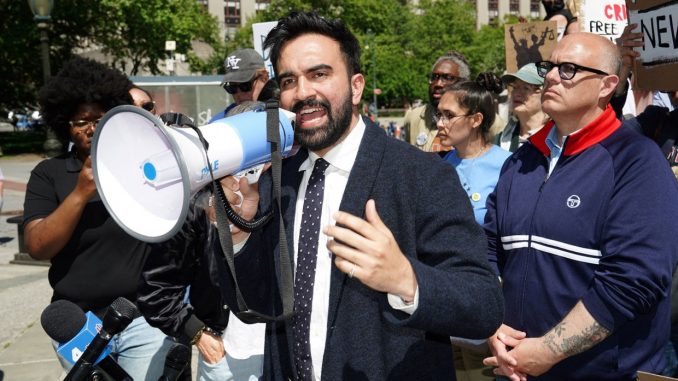
Then–Democratic NYC mayoral candidate Zohran Mamdani speaks at a Working Families Party rally denouncing the Trump administration, in New York City, May 10, 2025. (Bing Guan/Reuters)
Editor: Cherry Meigh Timbol
Published June 29, 2026
Context Signal:
The Democratic Party is undergoing a profound ideological transformation—one that critics argue has been years in the making. The victory of New York City mayoral candidate Zohran Mamdani in the Democratic primary has reignited debate over whether the party’s progressive wing has moved from the margins to the center of Democratic politics.
For many conservatives, Mamdani’s rise is not an isolated event but the culmination of a broader trend in which democratic socialists and progressive activists have steadily gained influence over the party’s agenda. Issues once considered politically fringe—including government-run healthcare, rent controls, wealth taxes, expansive public spending, and anti-capitalist rhetoric—are now championed by an increasingly vocal segment of Democratic leaders and voters.
Supporters argue that this evolution reflects changing public priorities and addresses growing concerns over inequality and affordability. Critics, however, contend that it represents a departure from the party’s traditional center-left identity.
🧠 Editorial Position:
The Democratic Party did not suddenly arrive at this moment—it has been moving toward it for years.
The rise of figures like Zohran Mamdani reflects more than the success of a single candidate. It illustrates how ideological activists have gradually reshaped the Democratic Party from within, redefining what it means to be a mainstream Democrat.
For decades, moderate Democrats balanced progressive ideals with fiscal restraint, market economics, and pragmatic governance. Today, those voices increasingly find themselves overshadowed by activists who view capitalism with skepticism, favor aggressive government intervention, and frame politics primarily through systems of economic and social inequality.
Many Democratic leaders believed they could embrace progressive rhetoric without fundamentally changing the party’s direction. Instead, critics argue, those ideas have steadily become the direction.
🌍 Supporting Context:
Several developments have contributed to this shift.
- Progressive candidates have increasingly defeated establishment Democrats in primary elections.
- Organizations aligned with democratic socialist policies have expanded their influence in local and state politics.
- Younger Democratic voters consistently express stronger support for expansive government programs than previous generations.
- Progressive activism has become increasingly influential in shaping Democratic messaging on healthcare, housing, climate policy, immigration, and criminal justice.
Conservatives argue that these changes have steadily moved the party further from political moderation.
Supporters of the Democratic Party, however, view the same developments differently. They argue that the party is responding to changing economic realities, widening inequality, and voter demands for more ambitious government action rather than experiencing a hostile ideological takeover.
⚖️ Editorial Stance:
From my point of view, the warning signs were visible long before this latest election.
Repeated concessions to the party’s activist base gradually shifted the Democratic Party’s center of gravity. Policies once dismissed as politically unrealistic are now treated as legitimate governing proposals, while moderates increasingly face pressure to adopt more progressive positions or risk losing influence.
The broader concern is not simply about one mayoral candidate or one city. It is about whether the Democratic Party still represents the political center-left that many Americans once recognized, or whether it has become increasingly defined by a movement that favors significantly expanded government power and a more confrontational view of free-market economics.
Whether one calls it evolution or ideological capture largely depends on political perspective. But it is difficult to ignore that the party today is markedly different from the one that nominated leaders such as Bill Clinton or even Barack Obama.
📌 Conclusion:
The debate over the Democratic Party’s future is no longer theoretical—it is unfolding in real time.
If recent electoral trends continue, progressive voices are likely to play an even greater role in defining Democratic priorities at both the local and national levels. Whether that transformation ultimately strengthens the party or narrows its appeal to the broader electorate remains an open political question that only future elections can answer.
From the viewpoint reflected in this editorial, what many now describe as a “hostile takeover” was less a sudden event than the predictable outcome of years of incremental ideological change. The question now is not whether the Democratic Party has changed—but how far that transformation will ultimately go.