
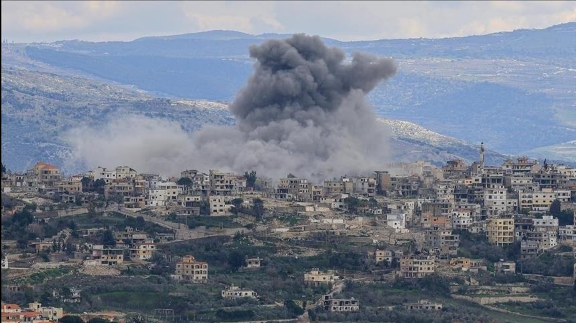
A massive plume of dark smoke rises above southern Lebanon following an Israeli airstrike, capturing the intensity of renewed fighting between Israel and Hezbollah. The image visually underscores the escalating tensions along the Israel-Lebanon border as Israeli forces continue striking what they describe as Hezbollah military targets.
Reported by:

Cherry Meigh Timbol
News Content Editor
Published August 26, 2026
BEIRUT/JERUSALEM — Israel launched fresh military strikes in southern Lebanon and the Gaza Strip Wednesday, August 26, as tensions continue to threaten already-fragile ceasefire arrangements and diplomatic efforts across the region.
In Lebanon, Israeli warplanes struck Majdal Zoun in the Tyre district early Wednesday, according to Lebanon’s official National News Agency. Initial reports did not immediately provide casualty figures or details of the damage.
The latest attack follows Israeli strikes Tuesday night against several locations in southern Lebanon, including the Ali Taher Ridge, Al-Mansouri and Al-Qantara, according to Israeli media reports.
The escalation comes despite a U.S.-mediated framework between Israel and Lebanon aimed at reducing hostilities and eventually establishing a more durable arrangement.
Southern Lebanon Becomes Flashpoint Again
Israel has repeatedly said its military operations in southern Lebanon are aimed at preventing Hezbollah from rebuilding military infrastructure, including weapons storage sites, rocket-launching capabilities and underground facilities.
The Israeli military has continued operating in portions of southern Lebanon despite diplomatic negotiations, while Lebanese officials have demanded an Israeli withdrawal.
The renewed strikes have heightened fears that the fragile arrangement could unravel completely.
Earlier this month, an Israeli strike in southern Lebanon killed one person and wounded 11 others, according to Lebanon’s Health Ministry.
The United States has been attempting to keep negotiations between Israel and Lebanon moving, but the fundamental dispute remains unresolved: Lebanon wants an Israeli withdrawal, while Israel insists Hezbollah must be disarmed.
Gaza Strikes Add to Regional Pressure
At the same time, Israeli military operations have continued in Gaza.
On August 24, Israeli airstrikes and gunfire reportedly killed at least four Palestinians, including two children, according to Palestinian medical officials cited by Reuters.
Among those killed were a 10-year-old girl in Khan Younis and a 4-year-old boy in the Bureij refugee camp. Another person was killed in Deir al-Balah.
The Israeli military said its operations were directed at Hamas targets and weapons facilities. It also said one strike targeted a Hamas militant, while denying that civilians were deliberately targeted.
The attacks have intensified criticism from regional mediators.
U.S.-Backed Ceasefire Efforts Under Strain
The latest violence comes as Washington continues pushing for progress toward a broader Gaza settlement.
Turkey, Egypt and Qatar recently condemned Israeli strikes in Gaza, warning that continued military operations could undermine diplomatic efforts to end the conflict. The mediators have called on Israel to observe the ceasefire framework.
A major sticking point remains the sequence of a potential agreement.
Israel has demanded the disarmament of Hamas before a full military withdrawal, while Hamas has insisted that Israel withdraw and commit to the ceasefire before surrendering its weapons.
That deadlock has left negotiators struggling to translate diplomatic proposals into a lasting cessation of hostilities.
Israel Says Hamas and Hezbollah Remain Threats
For Israel, the military campaign is centered on preventing its enemies from rebuilding their capabilities.
In Gaza, Israeli officials have continued to argue that Hamas remains capable of conducting attacks despite the ceasefire.
In Lebanon, Israel has similarly accused Hezbollah of rebuilding military infrastructure in violation of existing arrangements.
That security argument has become central to Israel’s decision to maintain military pressure even as negotiations continue.
Growing Humanitarian Concerns
The continued strikes are also deepening humanitarian concerns.
In Gaza, Reuters reported that Israeli attacks have continued to cause civilian deaths amid shortages of essential supplies and ongoing uncertainty surrounding the ceasefire.
In southern Lebanon, repeated attacks and continued Israeli military presence have complicated efforts by the Lebanese government to restore authority and rebuild communities affected by the fighting.
The situation has also created a dangerous dilemma for Lebanon’s government, which is attempting to strengthen the Lebanese state while confronting Hezbollah’s continued influence and Israel’s military presence.
What Comes Next?
The immediate question is whether the latest strikes remain limited or develop into a broader escalation.
1. Southern Lebanon Could See More Israeli Operations
Israel is likely to continue targeting what it identifies as Hezbollah military infrastructure unless Beirut and Hezbollah take steps that satisfy Israeli security demands.
2. Gaza Ceasefire Faces Another Test
Continued Israeli strikes and Hamas-Israel disagreements over disarmament and Israeli withdrawal threaten to undermine U.S.-backed diplomatic efforts.
3. Washington Faces Increasing Pressure
The United States is attempting to balance support for Israel’s security with efforts to prevent the Gaza and Lebanon conflicts from escalating into a wider regional confrontation.
🧩 Bottom Line:
The latest Israeli strikes in southern Lebanon and Gaza underscore how fragile the region’s ceasefire arrangements remain. In Lebanon, the attack on Majdal Zoun comes as Israel and Beirut struggle over Hezbollah’s weapons and Israel’s military presence. In Gaza, continued strikes are threatening diplomatic efforts aimed at converting a fragile ceasefire into a lasting agreement.
For Israel, the message remains clear: military pressure will continue as long as Hamas and Hezbollah are viewed as capable of rebuilding their forces. But with civilians continuing to bear the consequences, every new strike risks making an already difficult diplomatic solution even harder to achieve.
SOURCES: TURKIYE TODAY – Israel strikes southern Lebanon in latest violation of US-mediated framework
THE JERUSALEM POST – Iran, Oman negotiate framework for Hormuz transit after Trump claims all mines removed from strait
REUTERS – Israeli fire kills two young children in Gaza, medics say




