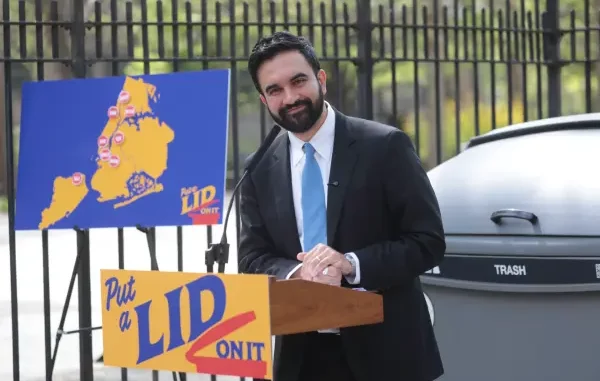
Mayor Zohran Mamdani on Friday trotted out the next phase of the controversial “Empire Bin” program — part of the city’s effort to curb trash bags littering the sidewalks.
Published April 19, 2026
NEW YORK CITY — A sweeping push to “reinvent” how America’s largest city handles trash is quickly becoming one of the most debated policy moves of the year, as Mayor Zohran Mamdani accelerates a controversial sanitation overhaul that could reshape daily life across the five boroughs.
What’s being sold as a cleaner, more modern New York is, according to critics, a high-cost gamble at a time when the city faces serious financial pressure.
🚮 Inside the Plan: From Trash Bags to Mega-Bins
At the heart of Mamdani’s strategy is the expansion of a containerized garbage system first introduced under former Mayor Eric Adams.
Instead of piling black trash bags along sidewalks — a long-standing symbol of New York — the city plans to replace them with large, sealed “Empire Bins” placed along curbs.
The newest phase alone targets:
- 25,000 additional homes
- Expansion into more neighborhoods across multiple boroughs
- Increased reliance on mechanized trash pickup systems
Supporters say it’s a long-overdue upgrade for a city still relying on decades-old sanitation practices.
But the scale is unprecedented — and so is the cost.
💰 The Price Tag: Small Change or Budget Bomb?
While City Hall frames the expansion as a necessary investment, critics argue the numbers tell a different story.
Estimates tied to the broader rollout suggest:
- Tens of millions of dollars for initial expansion phases
- Billions in long-term infrastructure upgrades
- Ongoing maintenance and operational costs that could grow annually
And all of this comes as New York City faces:
- A projected multi-billion-dollar budget shortfall
- Rising costs in housing, policing, and public services
- Economic uncertainty tied to migration trends and workforce shifts
For many observers, the concern isn’t just the program itself — it’s the timing.

The city is expanding the “containerization” program — a key initiative of Mamdani’s predecessor Eric Adams — to six districts, bringing garbage bins to 25,000 residences in larger buildings across the Big Apple.James Messerschmidt for the NY Post
🐀 The Rat Problem: Real Progress or Selective Data?
City officials have highlighted early signs of success, especially when it comes to one of New York’s most notorious problems: rats.
In areas where bins have been deployed:
- Reports of rat sightings have reportedly declined
- Trash overflow complaints have decreased
- Streets appear cleaner, particularly on collection days
But skeptics argue:
- The data is limited and localized
- Long-term effectiveness is still unproven
- Rodent populations tend to shift, not disappear
Translation: the problem may be moving — not being solved.
🚗 Parking vs. Cleanliness: A Growing Trade-Off
One of the most controversial aspects of the plan is its impact on parking — already a major headache for New Yorkers.
Projections tied to full implementation suggest:
- Tens of thousands of parking spaces could be eliminated
- Residential areas may see increased congestion
- Small businesses could face reduced accessibility
For working-class residents who rely on cars, this isn’t a minor inconvenience — it’s a daily disruption.
Critics say this highlights a broader issue: policies designed in theory often collide with real-world urban life.

The Empire Bin Initiative is aimed at eliminating mounds of trash bags on city sidewalks.James Messerschmidt for the NY Post
🏙️ The Bigger Goal: A European-Style City
Mamdani’s long-term vision is ambitious:
- Fully containerized districts by 2027
- Zero trash bags on sidewalks by 2031
- A sanitation system modeled after cities in Europe
Supporters argue this brings New York in line with global standards.
But opponents counter that comparisons to European cities ignore key differences:
- Population density
- Infrastructure design
- Cultural and logistical realities
In short: what works in Paris or Barcelona may not translate cleanly to Brooklyn or Queens.
🔍 Critical View: Big Promises, Bigger Questions
Strip away the buzzwords, and this plan comes down to a simple idea: government wants to redesign how millions of people deal with their trash — and it’s not going to be cheap.
Mayor Zohran Mamdani is pitching a cleaner, more organized city. That sounds good on paper. Nobody likes piles of garbage or rats. But the real question is whether this is the right priority — and whether everyday people will end up footing the bill for something that may not work as promised.
💸 Spending First, Results Later?
The biggest concern is cost.
When a city is already dealing with budget gaps, rising living costs, and pressure on basic services, launching a large-scale project like this raises eyebrows. Big government projects often start small — then grow, and grow, and grow.
In simple terms:
What starts as “tens of millions” can quietly turn into something much bigger.
And when that happens, it’s usually taxpayers who cover the difference.
🚗 Everyday Inconvenience Gets Ignored
Policies like this often look clean in presentations — but messy in real life.
Replacing curb space with large bins might reduce trash on sidewalks, but it also means:
- Fewer parking spaces
- More congestion
- More daily stress for working people
For someone commuting, running a small business, or just trying to park near their home, that’s not a minor issue — it’s part of daily life.
🐀 Solving the Problem — Or Moving It?
City officials highlight fewer rat sightings in some areas.
That sounds like progress — but there’s a catch.
Rats don’t disappear. They move.
So the concern is whether this plan truly solves the problem, or just shifts it somewhere else — out of sight, but not actually gone.
🏗️ One-Size-Fits-All Doesn’t Always Work
New York isn’t a small, uniform city. It’s dense, complex, and different block by block.
Trying to apply a single system across:
- High-rise apartments
- Narrow streets
- Busy commercial zones
…can create unintended problems.
What works in one neighborhood may fail in another.
🌍 Copying Other Cities Isn’t Always Simple
Supporters often point to cleaner cities overseas.
But those cities are built differently — less crowded, different layouts, different habits.
Trying to copy that model without adjusting for local reality can backfire.
📊 Reading Between the Lines (Simple Take)
Here’s the situation in plain terms:
- Cleaner streets? Possible
- Higher costs? Very likely
- Daily inconvenience? Also likely
- Long-term success? Still uncertain
⚖️ The Core Issue: Priorities
At the end of the day, this isn’t just about trash.
It’s about what comes first.
Should the city focus on:
- Lowering costs for residents?
- Improving safety and basic services?
- Or launching large, citywide redesign projects?
Because resources aren’t unlimited — and every big project means something else may get less attention.
👥 On the Ground: What This Looks Like in Real Life
On paper, the plan sounds simple: cleaner streets, fewer rats, and a more organized system. But on the ground, where people actually live and work, things tend to play out very differently.
Under Mayor Zohran Mamdani, the rollout of large trash bins is starting to change the day-to-day rhythm of neighborhoods — and not always in smooth ways.
🚶 Sidewalk Reality: Cleaner, But More Crowded
Yes, there may be fewer trash bags sitting out in the open.
But now you’ve got:
- Large bins taking up space
- Tighter walkways in already crowded areas
- More obstacles for pedestrians, seniors, and parents with strollers
So while it looks cleaner at a glance, it can feel more cramped when you’re actually walking through it.
🚗 Parking Pressure Is Getting Worse
This is one of the first things residents notice.
Where there used to be curb space, there are now bins. That means:
- Fewer places to park
- Longer time circling blocks
- More frustration after a long day of work
For people who rely on their cars — delivery drivers, small business owners, families — this hits immediately.
🏪 Small Businesses Feel the Squeeze
Local shops and restaurants are also adjusting.
Some are dealing with:
- Limited access for deliveries
- Bins placed near storefronts
- Changes in how and when trash can be disposed
It may seem like a small change, but for businesses running on tight margins, even minor disruptions can add up.
🐀 Rats: Better in Some Spots, Questionable in Others
In certain areas, people say they’re seeing fewer rats.
In others, not much has changed — or the problem just shifted a few blocks away.
So the experience isn’t consistent. It depends heavily on the neighborhood.
⏱️ Adjustment Period — Or Permanent Headache?
City officials often say, “People will get used to it.”
And maybe they will.
But the concern is whether:
- These are short-term growing pains
- Or long-term inconveniences that don’t go away
Because once the system is fully in place, it’s not easy — or cheap — to undo.
📊 Simple Breakdown (What People Are Experiencing)
- Streets look more organized — sometimes
- Daily routines are changing — definitely
- Parking is tighter — almost everywhere affected
- Overall convenience — depends who you ask
⚖️ What People Are Really Asking
On the ground, the question isn’t about big ideas or long-term visions.
It’s much simpler:
- “Does this actually make my day easier?”
- “Is this helping my neighborhood — or just changing it?”
- “Am I paying more for something I didn’t ask for?”
🎯 The Final Word:
At the end of the day, most people want the same thing: clean streets, safe neighborhoods, and a city that works without making life harder or more expensive. The plan pushed by Mayor Zohran Mamdani aims for that, but it comes with real trade-offs that can’t be ignored. Bigger spending, less convenience, and uncertain long-term results leave many wondering if this is the right approach. A cleaner city sounds good—but if it leads to higher costs and daily headaches, people are right to question whether the solution is better than the problem it’s trying to fix.