Reported by:

Cherry Meigh Timbol
News Content Editor
Published October 28, 2026
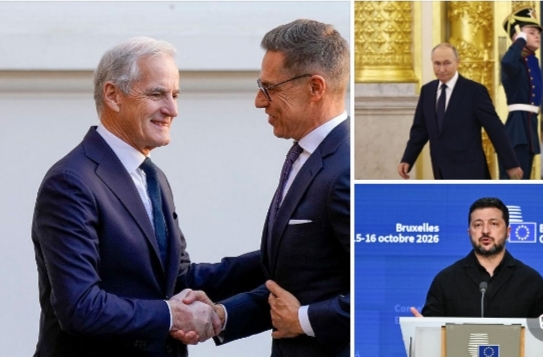
Finnish President Alexander Stubb and Norwegian Prime Minister Jonas Gahr Støre held a roughly 90-minute phone call with Russian President Vladimir Putin on October 27, 2026, urging him to pursue negotiations to end the war in Ukraine. The call was conducted in consultation with Ukraine and ahead of planned peace discussions involving Russian, Ukrainian and U.S. officials in Abu Dhabi in November.
Stubb and Støre said the discussion was frank and substantive. They stressed that Russia’s war has direct consequences for European security and called for renewed negotiations and de-escalation. Støre said the human and material costs of the conflict were enormous and that the suffering and destruction would affect generations.
Norway’s government said the two leaders initiated the call to convey their positions directly to Putin. Both countries reaffirmed their longstanding support for Ukraine and emphasized the need for peace and stability in Europe.
According to the Kremlin’s account, a lasting peace would require Russia’s interests to be fully taken into account. The Kremlin also criticized what it described as the confrontational policies of European Union and NATO countries. Russian Foreign Minister Sergei Lavrov later said the conversation had introduced nothing new to the conflict.
Reuters reported that the call lasted approximately 90 minutes. A source close to the Kremlin said Russia remained unwilling to compromise on its objective of gaining control of the entire Donbas region in eastern Ukraine. Ukraine has rejected Russian territorial demands, and no agreement on territory or a ceasefire was announced following the call.
After speaking with Putin, Stubb and Støre also spoke with Ukrainian President Volodymyr Zelenskyy. Kyiv said it had been consulted about the initiative. The Nordic leaders maintained that Ukraine’s security and Europe’s wider security were directly connected to the outcome of the war.
The initiative has drawn mixed reactions in Europe. Danish Prime Minister Mette Frederiksen questioned the decision to engage Putin directly, arguing that European countries should remain united rather than act separately. Other European officials have emphasized the importance of ensuring that Ukraine participates in decisions affecting its future.
The phone call came as diplomatic efforts continued ahead of expected discussions involving Russian, Ukrainian and U.S. representatives in Abu Dhabi in November. Norway has identified possible de-escalation measures, including stopping attacks on energy infrastructure, halting strikes on ships exporting Ukrainian grain and arranging prisoner exchanges.
The call marked a rare direct engagement between Western European leaders and Putin since Russia launched its full-scale invasion of Ukraine in February 2022. However, it produced no publicly announced ceasefire or peace agreement, and the main disagreements over territory and security guarantees remain unresolved.