
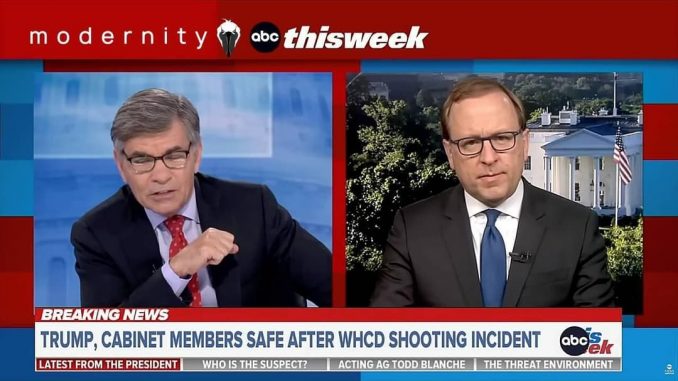
President Trump has slammed ABC News chief Washington correspondent Jonathan Karl for what he calls outright dishonest reporting after Karl inserted himself into the story of the latest assassination attempt on the president.
Published May 6, 2026
A widening dispute in U.S. political media is raising questions over accuracy and credibility after conflicting accounts emerged regarding whether President Donald Trump personally called an ABC News reporter following an assassination attempt linked to a high-profile Washington political event.
The controversy centers on ABC News chief Washington correspondent Jonathan Karl, who stated that he received a phone call from Trump the morning after the incident, during which the president allegedly checked whether he was safe following the security scare. Trump has denied the account, insisting the call did not take place and suggesting the reporting is inaccurate.
Conflicting Accounts Over Alleged Phone Call
Karl has maintained that the call came unexpectedly early the next morning, describing a brief exchange in which Trump asked about his safety following the chaotic security incident involving an attempted breach at a major political gathering. The claim quickly circulated across political media and sparked immediate scrutiny.
Trump, however, has pushed back strongly, denying that he made such a call and questioning the accuracy of the report. He has characterized the claim as misleading and suggested that the narrative being presented does not reflect what actually occurred.
The disagreement has since evolved into a broader debate over how high-profile political interactions are reported and verified, especially during rapidly unfolding events where public statements and private communications can be difficult to independently confirm.
Security Incident That Triggered the Fallout
The dispute stems from an assassination attempt at a major Washington political event that triggered an immediate security response and evacuation procedures. Authorities intervened after an armed individual allegedly attempted to breach security and reach restricted areas before being stopped.
The incident added further tension to an already politically charged environment, with lawmakers, officials, and media figures all responding to rapidly developing security concerns during and after the event.
While no major injuries were reported among attendees, the situation intensified focus on security protocols surrounding high-profile political gatherings in the capital.
Media Credibility and Verification Under Pressure
The disagreement over the alleged phone call has become part of a larger discussion about media reliability during breaking news events. Critics argue that conflicting narratives from public figures and journalists highlight the challenges of verifying private communications in real time.
Supporters of stronger reporting standards say incidents like this underline the importance of clear sourcing and documentation when covering politically sensitive events, particularly those involving national leaders.
At the same time, others caution that fast-moving situations can lead to genuine differences in recollection, especially when accounts are relayed after a highly stressful or chaotic incident.
Political and Public Reaction
The story has quickly gained traction in political circles, with supporters of the president questioning the accuracy of the media account, while others argue that public figures and reporters alike should be held to consistent standards of transparency.
The dispute has added to ongoing tensions between political leadership and major media organizations, where trust and interpretation of events often become as contested as the events themselves.
🔍 Critical View:
There is growing concern that the controversy over the alleged Trump phone call highlights deeper issues in how political stories are being reported, especially when it comes to media credibility and fact verification. Critics argue that in fast-moving, high-stakes events, unverified claims can quickly shape public perception before all facts are confirmed.
1. Media Credibility and Verification Standards (Accuracy Under Pressure)
A key issue is whether major news outlets are consistently verifying claims before presenting them as fact, especially when dealing with sensitive political figures and breaking events.
What’s at stake: accuracy of reporting, public trust in news outlets, and sourcing standards
Why it matters: once a narrative spreads, it can be difficult to correct even if details change later
Risk: incorrect or incomplete reporting may shape public understanding before full confirmation is available
In simple terms: if reports move faster than facts, public trust becomes harder to maintain.
2. Conflicting Accounts and Narrative Control (Who Gets Believed)
Another concern is how quickly different versions of the same event can emerge, especially when both political figures and journalists present opposing claims.
What’s at stake: public interpretation of events and credibility of involved parties
Why it matters: competing narratives can create confusion about what actually happened
Risk: audiences may end up choosing sides based on trust rather than verified facts
In simple terms: when stories conflict, people often decide based on who they already believe.
3. Political Sensitivity in Breaking News (High-Stakes Reporting Pressure)
The situation also raises questions about how political pressure affects reporting during major incidents, particularly those involving national leaders or security events.
What’s at stake: neutrality in reporting and speed vs accuracy balance
Why it matters: high-profile events increase pressure to publish quickly
Risk: rushed reporting can lead to disputes over details after the fact
In simple terms: the faster the news cycle moves, the easier it is for mistakes or disputes to happen.
4. Public Trust in Institutions (Long-Term Confidence Issue)
Beyond the specific incident, critics say the broader issue is declining trust in both media and political institutions when stories are disputed at a national level.
What’s at stake: trust in journalism, government communication, and public information sources
Why it matters: repeated controversies can make it harder for the public to know what is reliable
Risk: long-term skepticism may grow even when reporting is accurate
In simple terms: repeated disputes over facts can make people trust less overall, even when news is correct.
👥 On the Ground:
In Washington and across the U.S. political media space, the dispute over whether President Trump made a personal phone call to an ABC News reporter after an assassination attempt is being closely watched, with reactions splitting along lines of trust in institutions and concern over accuracy in breaking news reporting.
Media trust and credibility concerns (Accuracy under pressure)
On the ground, much of the discussion is centered on media credibility and verification standards, with viewers questioning how quickly disputed claims can spread before they are fully confirmed. The disagreement between the reporter’s account and Trump’s denial has added to ongoing public frustration over conflicting news narratives.
Conflicting narratives and public confusion (Competing versions of events)
There is also clear attention on competing accounts of the same incident, with both sides firmly standing by their version of events. This has led to confusion among audiences trying to separate confirmed facts from disputed claims, especially in a fast-moving news cycle.
Political tension surrounding major incidents (High-pressure reporting environment)
The controversy is unfolding alongside a broader high-stakes political environment, where any major security incident involving national figures quickly becomes politically sensitive. On the ground, this increases pressure on both journalists and officials to clarify details quickly, sometimes before full verification is complete.
Public reaction and trust gap (Institutional skepticism)
Among viewers and political observers, there is a noticeable trust gap in institutions, with some expressing skepticism toward media reporting and others questioning political responses to breaking events. The result is a divided public response, where interpretation of the same story often depends on existing trust levels rather than new information.
🎯 The Final Word:
At this stage, the controversy over the alleged Trump phone call has become less about a single disputed interaction and more about a broader concern over how political news is reported and verified in real time. With conflicting accounts still unresolved, critics say the situation highlights ongoing issues with media accuracy, fast-moving narratives, and public trust, especially when breaking stories involve high-profile political figures and sensitive events. In simple terms, the dispute shows how quickly different versions of the same story can emerge, and how important it is for both journalists and officials to ensure facts are fully confirmed before they shape public understanding.




