
Reported by:

Cherry Meigh Timbol
News Content Editor
Published November 23, 2026
Ukraine has claimed responsibility for a maritime drone operation that sank a Russian Navy corvette at a naval base in Benghazi, eastern Libya, marking a significant expansion of the Russia-Ukraine conflict beyond European waters.
Ukrainian President Volodymyr Zelenskyy confirmed the operation on November 23, saying Ukrainian forces deployed seven domestically manufactured naval drones to attack the Russian warship Merkury while it was docked at the Benghazi naval base.
According to Zelenskyy, the operation also destroyed a Russian Ka-27 military helicopter aboard the vessel. He described the mission as a successful operation conducted in response to Russia’s ongoing military aggression against Ukraine.
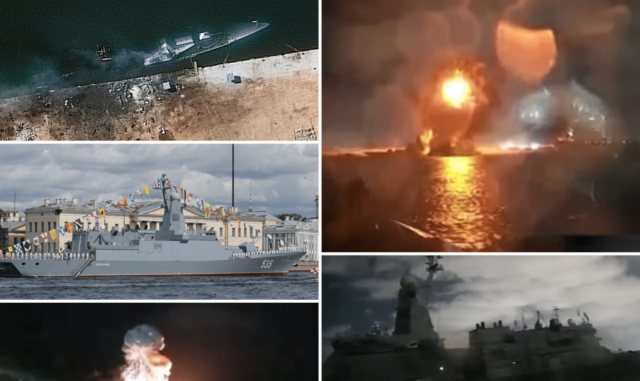
The Merkury, a Russian Navy corvette commissioned in 2023, was reportedly struck by multiple explosions during the November 22 attack. Satellite imagery later showed that most of the vessel had capsized and sunk, with only part of its bow remaining visible above the water.
Russian Cargo Ship Also Targeted
Ukraine also reported striking a second Russian vessel, the dry cargo ship MV Angara, which Kyiv alleged was being used to transport military equipment and weapons for Russia.
The Ukrainian Security Service (SBU) said the operation involved seven unmanned naval vessels transported to the designated area aboard a larger support ship before being launched toward their targets.
The SBU characterized both vessels as legitimate military targets, arguing that they contributed to Russia’s military capabilities.
However, the full extent of the damage to the cargo ship and the circumstances surrounding the second strike remain subject to further verification.
Libyan Authorities Condemn Attack
The attack has raised concerns over Libya’s security and its involvement in a conflict in which it is not a direct participant.
Libya’s eastern-based government said the Russian warship had stopped at Benghazi to refuel and receive supplies while traveling back to Russia. The stop was reportedly conducted under maritime cooperation arrangements between the two sides.
Libyan authorities condemned the suspected drone operation, describing it as a violation of the country’s sovereignty and a threat to maritime security.
The eastern administration also indicated that it would pursue legal and diplomatic measures against those responsible. It stressed that Libyan territory and territorial waters should not become a battleground for international conflicts.
The United Nations Support Mission in Libya (UNSMIL) expressed serious concern over the drone attacks and called for an independent and transparent investigation into the incidents.
Casualties and Damage
Reports concerning casualties have varied. Some local sources reported injuries among Russian and Libyan nationals following the explosion at the Benghazi naval facility, although the full extent of casualties has not been independently established.
Satellite imagery provided by Vantor showed extensive damage to the Russian corvette, with much of the vessel submerged or capsized.
The Russian government had not issued a detailed public account of the incident at the time of the initial reports.
A Significant Expansion of Ukraine’s Maritime Operations
The strike represents a notable development in Ukraine’s campaign against Russian military assets. Since Russia launched its full-scale invasion in February 2022, Ukraine has increasingly relied on maritime drones to attack Russian naval vessels and facilities, particularly in the Black Sea.
The operation in Benghazi demonstrates the potential reach of Ukraine’s unmanned naval capabilities, extending its military operations far beyond the immediate battlefront.
Libya’s eastern territories are controlled by forces aligned with military commander Khalifa Haftar, whose administration has maintained relations with Moscow. Russia has also maintained strategic interests in Libya as part of its broader military and logistical presence in Africa.
The incident could complicate those relationships and create additional diplomatic challenges for Libyan authorities, particularly as they attempt to avoid becoming directly involved in the Russia-Ukraine war.
International Implications
The attack raises broader questions about the geographical limits of the Russia-Ukraine conflict and the security of military and commercial shipping operating in the Mediterranean.
Although Ukraine has presented the operation as a successful strike against Russian military infrastructure, conducting such an operation inside a Libyan naval facility carries potential diplomatic consequences.
The incident also places pressure on Libyan authorities to investigate how the drones reached their targets and whether foreign personnel or facilities were involved in preparing the operation.
For now, the full operational details, the extent of the damage to the second vessel, and the potential consequences for Russian-Libyan military cooperation remain unclear.
The sinking of the Merkury underscores how the war between Russia and Ukraine is increasingly reaching beyond its original battlefields, creating new security challenges for countries far removed from the front lines.




