Published March 23, 2026
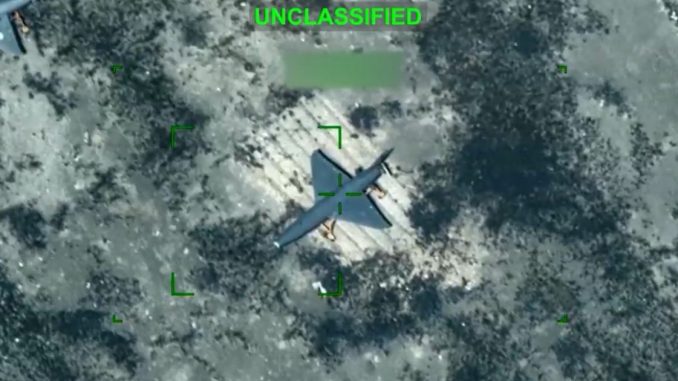
The United States Central Command (CENTCOM) has released newly declassified footage showing U.S. military operations targeting Iran’s drone capabilities. The video highlights precision strikes against what officials describe as “one-way attack drones” used in regional conflicts.
According to CENTCOM, these operations are part of an ongoing effort to neutralize threats posed by Iranian military assets, particularly systems allegedly used against civilian and strategic targets across the Middle East.
Details of the Footage
The unclassified footage reportedly captures multiple engagements, including the destruction of drone infrastructure and related military equipment. CENTCOM emphasized that these strikes are designed to degrade Iran’s offensive capabilities and limit its ability to conduct asymmetric warfare using drones.
Earlier releases from the command have also shown strikes against Iranian naval assets, including submarines and smaller vessels operating near the Strait of Hormuz—a critical global oil transit route.
Escalating Tensions in the Gulf
The footage comes amid heightened tensions between the United States and Iran, particularly surrounding control of the Strait of Hormuz. Reports indicate that Iran has restricted maritime passage, allowing only select vessels to transit while threatening broader closure.
The situation has significant global implications, as roughly 20% of the world’s oil supply passes through the strait. Disruptions have already contributed to rising oil prices and increased volatility in energy markets.

Political and Military Signals
Amid the developments, Donald Trump issued a warning that the United States could target Iranian infrastructure—including power plants—if maritime routes are not fully reopened.
Iranian officials, in turn, signaled potential retaliatory measures, including the possibility of fully closing the Strait of Hormuz and targeting regional energy infrastructure if U.S. strikes escalate further.
Broader Strategic Context
The release of such footage serves multiple purposes: demonstrating military capability, signaling deterrence, and shaping public perception of the conflict. Analysts note that visual evidence of precision strikes is increasingly used as part of modern information warfare, reinforcing narratives of control and technological superiority.
The ongoing exchange between the U.S. and Iran reflects a broader regional struggle involving energy security, military dominance, and geopolitical influence—factors that continue to drive instability across the Gulf.
President Trump’s warning comes as Iran is only allowing certain ships, including oil tankers, to pass through the Strait of Hormuz.
🔍 Analyst Insight:
Understanding the strategic intent behind military actions is essential to grasp the broader geopolitical picture. The release of operational footage is rarely just informational—it is calculated, deliberate, and tied to long-term objectives.
Key Points
- Strategic signaling through transparency
The release of footage by United States Central Command is meant to project strength and reinforce deterrence without immediate escalation.
- Information warfare is central
Modern conflicts are shaped not just by force, but by perception. Public footage influences allies, adversaries, and global opinion simultaneously.
- Testing of boundaries
Actions by Iran suggest a pattern of probing limits, especially when responses appear measured or inconsistent.
- Credibility of deterrence matters
Deterrence is only effective when backed by consistent enforcement. Ambiguity can weaken long-term strategic positioning.
- Controlled escalation strategy
The U.S. appears to be applying pressure in calculated steps—strong enough to send a message, but avoiding full-scale conflict.
👥 Human Element:
Beyond strategy and policy, conflicts are ultimately experienced by people—those who carry out decisions and those who live with the consequences. The human dimension reveals the real cost behind geopolitical tensions.
Key Points
- Decisions made in seconds
Military personnel—pilots, drone operators, analysts—carry the burden of high-stakes, real-time decisions with global consequences.
- Civilians in the crossfire of uncertainty
Communities near the Strait of Hormuz face economic and security risks tied to rising tensions.
- Global ripple effects
Disruptions impact fuel prices, supply chains, and cost of living far beyond the Middle East.
- Ordinary Iranians bear indirect costs
Citizens in Iran often face economic hardship and instability stemming from geopolitical confrontation.
- Psychological toll of instability
Ongoing threats and uncertainty create stress not only in conflict zones but across interconnected global economies.
🎯 Conclusion:
The latest footage from CENTCOM underscores the intensifying military and political standoff in the Middle East. With strategic waterways, global energy markets, and regional alliances at stake, the situation remains highly volatile.
As both sides exchange warnings and demonstrate force, the risk of further escalation remains significant—raising concerns about wider conflict and its global economic consequences.
SOURCES: THE GATEWAY PUNDIT – Central Command Releases Unclassified Footage of US Military Blowing Up Iran’s Drone Capabilities (VIDEO)
AP NEWS – US Central Command shows footage of Iranian drone carrier on fire