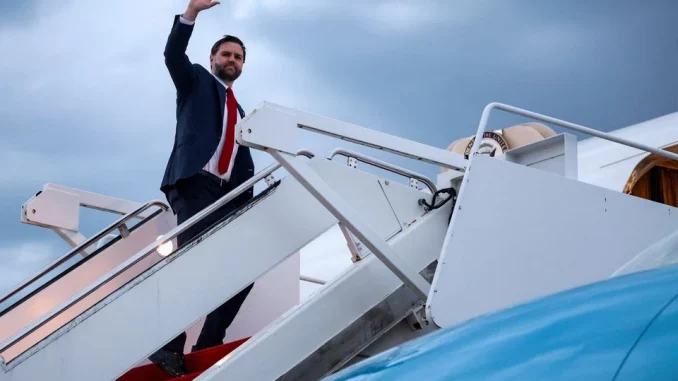
US Vice-President J.D. Vance boarding Air Force Two to depart for Budapest, Hungary, from Maryland on April 6. Analysts say US support for Hungary’s Prime Minister Viktor Orban may not be enough to sway voters. PHOTO: REUTERS
Published April 7, 2026
U.S. Vice President JD Vance made an unusual and high‑stakes trip to Budapest this week, openly backing Hungarian Prime Minister **Viktor Orbán’s reelection bid and sharply criticizing the European Union for what he called interference in Hungary’s domestic politics just days before a pivotal vote.
The two‑day visit comes only days before Hungary’s April 12 parliamentary election, where Orbán — long a controversial figure inside the EU — is facing his toughest challenge in years against a rising opposition led by **Péter Magyar and the Tisza party.
In a rare active show of support for a foreign leader in an active campaign, Vance also attacked the EU’s role, calling Brussels’ actions “disgraceful” and accusing it of trying to undermine Hungary’s economy and energy independence because of its opposition to EU policy.
US Support Comes at Critical Moment
Vance’s endorsement marks one of the most visible gestures of U.S. backing for Orbán’s leadership in recent years. While American officials have long voiced diplomatic relations with Budapest, this level of personal involvement right before an election is outside traditional diplomatic norms — and underscores just how important the Trump administration views Hungary’s outcome.
Vance is scheduled to appear at campaign events alongside Orbán, and publicly praised his policies on energy security and defense, signaling alignment with Hungary’s sovereign approach to domestic governance and foreign affairs.
Criticism of European Union Influence
At a press event in Budapest, the vice president singled out the European Union as meddling in Hungary’s internal affairs, arguing that Brussels has used funding and regulatory pressure to weaken Prime Minister Orbán’s standing and push policies unpopular with Hungarian voters.
In particular, Vance said EU actions aimed at restricting Budapest’s energy choices and economic independence were aimed at undoing a government that has pursued national sovereignty over supranational mandates — a message that echoes broader concerns about European overreach in national politics.
Orbán’s Toughest Race in Years
Orbán’s conservative government, which has been in power since 2010, faces a significant challenge — with independent polls showing his Fidesz party trailing in support as the opposition gains ground heading into the weekend vote.
Domestic issues such as economic concerns, corruption allegations and the cost of living have dominated voter priorities, analysts say, and could limit the impact of foreign endorsements even at this late stage.
Broader Geopolitical Currents
The stakes go beyond Budapest politics. Orbán has long been a critic of EU policy on Ukraine and immigration and has maintained a cautious relationship with Russian energy interests — a stance that has often put him at odds with Brussels and some NATO partners.
By publicly standing with Orbán, Vance is not only boosting a longstanding U.S. ally but also reinforcing a broader message about sovereignty, national decision‑making and resistance to external pressure from supranational institutions — including, implicitly, in other arenas such as negotiations with Iran.
🔍 Critical View:
U.S. Vice President JD Vance’s high-profile visit to Hungary this week, openly backing Prime Minister Viktor Orbán and criticizing EU interference, is more than a routine diplomatic trip—it is a deliberate and calculated signal. Coming just days before Hungary’s pivotal parliamentary election, the visit underscores America’s willingness to assert influence in Europe while simultaneously challenging supranational bodies that seek to dictate national policy.
From a strategic standpoint, the trip communicates multiple messages at once: to allies, that support will be extended to partners prioritizing national sovereignty; to adversaries, that the U.S. is willing to exercise influence decisively; and to the EU, that overreach will not go unchecked. The visit raises fundamental questions about the balance between supporting allies, respecting sovereignty, and signaling strength on the global stage.
Key Topics & Critical Angles
1. U.S. Influence in European Elections
By appearing publicly alongside Orbán and endorsing his leadership, Vance demonstrates that the U.S. is actively engaging in the political landscape of its allies. While diplomatic visits are common, direct involvement during an ongoing election is rare and sends a potent message: America is prepared to leverage its political weight to ensure stability and alignment with strategic interests. This intervention may reassure supporters but could also provoke critics who see it as crossing traditional diplomatic lines.
2. Sovereignty vs. Supranational Pressure
Vance’s outspoken critique of the European Union highlights a growing tension between national governments and supranational institutions. By framing Brussels’ actions as interference—particularly regarding energy, defense, and economic policy—Vance reinforces the principle that sovereign nations have the right to make independent choices without external coercion. The message is clear: the U.S. favors partners who maintain control over their own governance rather than simply following EU directives.
3. Timing and Electoral Impact
The timing of Vance’s visit is strategic. With parliamentary elections just days away, his presence amplifies Orbán’s messaging and serves as a morale boost to supporters. Yet the intervention is not without risk: visible U.S. involvement may be leveraged by Orbán’s opponents to argue that his campaign relies on foreign support. The optics of timing matter—while intended to strengthen the ally, the visit could also energize opposition forces and raise scrutiny from international observers.
4. Alignment on Energy and Security
Energy independence and national security were central themes of Vance’s visit. Hungary has pursued policies diverging from EU energy directives, emphasizing diversified suppliers and domestic stability. Vance’s public praise underscores that the U.S. rewards allies who take pragmatic, sovereignty-first approaches, signaling to other nations that strategic alignment and independent decision-making are valued over bureaucratic compliance.
5. EU Critique as Geopolitical Messaging
By openly challenging EU interference, Vance communicates a dual message: support for Orbán’s leadership and a warning to other European nations that overreach by supranational entities will be contested. The critique positions the U.S. as a defender of national autonomy and strategic interests, demonstrating that American diplomacy can push back against institutional pressure while reinforcing alliances.
6. Broader Implications for U.S. Foreign Policy
Vance’s actions are emblematic of a larger approach: the U.S. is willing to employ tools beyond standard diplomacy to protect strategic interests. Whether signaling resolve to Tehran or reinforcing alliances in Eastern Europe, the visit shows that American influence extends beyond words into active support and strategic positioning. This sends a warning to adversaries that the U.S. is prepared to act decisively when national and allied interests are at stake.
7. Risk of Backlash
While backing Orbán strengthens a critical ally, it comes with inherent risks. Critics inside Hungary and across the EU could frame the visit as evidence of foreign meddling in domestic politics, potentially energizing opposition groups or complicating relations with other EU member states. The U.S. must balance visible support with respect for public perception to maintain credibility and avoid unintended diplomatic friction.
8. Messaging on Global Stage
The visit projects a broader geopolitical message. By defending Orbán and criticizing EU overreach, Vance signals that the U.S. prioritizes sovereignty, decisive action, and strategic alignment in its partnerships. Allies and adversaries alike are watching: the message is clear that Washington will support nations that act independently and decisively, and push back against bureaucratic coercion.
9. Strategic Signaling Beyond Europe
Observers note that the visit also carries implicit lessons for global actors such as Iran. By publicly supporting Orbán while criticizing EU pressure, the U.S. demonstrates willingness to use political and diplomatic leverage decisively, hinting at the tools it may employ elsewhere to influence outcomes without immediate military action.
10. Long-Term Stakes for U.S.-Europe Relations
Ultimately, the trip highlights enduring questions about the U.S.-Europe partnership. It reinforces the idea that alignment is not just about treaties or shared economic interests—it is about ensuring strategic consistency, defending sovereignty, and signaling that allies who act in national interest will be backed.
👥 On the Ground: U.S. VP Vance Visits Hungary Ahead of Pivotal Election
Budapest is alive with political energy this week as U.S. Vice President JD Vance makes a high-profile appearance alongside Prime Minister Viktor Orbán, just days before Hungary’s critical parliamentary election. From campaign rallies to street-level discussions, the city reflects both excitement and tension: supporters hail the U.S. backing as validation of Orbán’s leadership, while critics argue that foreign attention risks skewing domestic politics.
On the ground, the visit demonstrates how international influence intersects with local sentiment, energy policy, security concerns, and national identity. For ordinary citizens, the visit is more than a headline—it is a visible reminder that global politics can touch daily life, from fuel prices to political confidence.
Key Topics & On-the-Ground Angles
1. Campaign Rallies and Public Response
Vance’s presence at multiple campaign events drew large crowds waving Hungarian flags and chanting slogans. Supporters greeted him with enthusiasm, viewing the visit as a sign that Orbán’s policies are recognized and valued internationally. From Orbán’s messaging on energy independence to promises of economic stability, Vance’s endorsement gave rallies an extra layer of credibility.
Meanwhile, opposition supporters staged small counter-protests, waving banners and emphasizing that foreign involvement in a domestic election is concerning. This dual reaction highlights the complexity of public sentiment: while some see it as reinforcement, others perceive it as interference.
2. Streets and Voter Sentiment
Walking through Budapest, the divide among citizens is palpable. Small business owners speak about economic stability and national control over energy supplies, praising Orbán’s record and framing the U.S. support as an assurance of continuity. Meanwhile, younger voters and university students express concern over external influence and EU pressure, questioning whether foreign endorsements overshadow local choice.
Conversations in cafes, markets, and public transport reveal a populace acutely aware of how international attention affects political dynamics, demonstrating that geopolitical events are not abstract—they play out in the daily lives of ordinary Hungarians.
3. Media and Messaging
Hungarian media have amplified Vance’s criticism of EU overreach, broadcasting segments that frame Brussels as trying to dictate Hungary’s energy and economic policies. On the ground, this messaging reinforces local conversations about sovereignty and national decision-making, while also highlighting the role of media in shaping voter perceptions during high-stakes campaigns.
Social media reactions are equally intense, with supporters posting clips from rallies and the vice president’s speeches, while critics circulate commentary questioning the legitimacy of foreign involvement.
4. Energy and Security Awareness
Energy policy emerged as a recurring topic during the visit. Citizens, analysts, and journalists discussed Hungary’s efforts to diversify energy sources, reduce dependence on EU directives, and protect pipelines and critical infrastructure. Vance’s public praise of Orbán’s policies resonates on the streets, demonstrating that energy independence is not just a policy talking point—it is a tangible concern that affects heating bills, transportation, and business operations.
Security also features prominently. Citizens note increased military presence and heightened alertness around sensitive areas, highlighting the real-world stakes of regional geopolitics and the election.
5. EU Criticism Seen Firsthand
Opposition groups and EU observers are present across Budapest, closely monitoring campaign events. Vance’s public criticism of EU interference has amplified debates about sovereignty versus supranational oversight, with onlookers debating whether the vice president’s statements strengthen democracy or risk undermining it.
Public conversations often focus on how Hungary can balance external influence with internal decision-making, reflecting a growing awareness that domestic elections have international implications.
6. Security and Visibility
Security is visible and stringent at campaign events. Police and private security personnel manage large crowds, monitor entrances, and respond to counter-protests. The heightened security presence underscores the sensitivity of foreign involvement in electoral events and the potential risks of heightened tensions, both domestically and internationally.
7. Perception of U.S. Commitment
On the ground, citizens and local commentators interpret Vance’s visit as a clear signal of U.S. support for allies who pursue independent, sovereignty-first policies. Street-level sentiment suggests that the visit reassures some Hungarians about future U.S. alignment on economic, energy, and security issues while signaling to other European nations that the U.S. will defend strategic partners.
8. Risk of Polarization
While many welcome the endorsement, opposition parties are leveraging the visit to mobilize voters concerned about foreign involvement. This dual effect highlights a central challenge of high-profile endorsements: they can strengthen support among some constituents while simultaneously energizing those opposed to perceived outside influence.
9. International Observation and Implications
Observers from neighboring EU countries and global media are closely watching the visit. Analysts note that the trip is a geopolitical statement as much as a political endorsement, signaling Washington’s readiness to support allies while challenging supranational pressure. Citizens on the ground are keenly aware that Hungary’s election is now part of a larger international conversation about sovereignty, EU influence, and U.S. strategic priorities.
10. Long-Term Stakes and Public Perception
Ultimately, Vance’s visit is shaping voter perception and public discourse in real time. Streets, cafes, and public squares are alive with debate over the implications of foreign engagement, the credibility of Orbán’s government, and the role of the EU. For citizens, this election is not merely a national event—it is a demonstration of how international alliances and influence intersect with daily life, policy, and political identity.
🎯 The Final Word:
The visit by Vice President Vance to Hungary illustrates that strategic engagement goes beyond diplomacy in conference rooms—it happens where citizens feel the impact of international decisions. By backing Orbán and challenging EU interference, the U.S. has signaled that it supports allies who assert national sovereignty and pursue pragmatic policies, while demonstrating that external pressure will be met with firm attention. On the ground, voter sentiment, media coverage, and public debate reveal that influence is measured not just in statements but in perception, energy security, and economic stability. The broader takeaway is clear: decisive support for aligned partners and a willingness to counter external overreach are essential to maintaining credibility, protecting interests, and ensuring that international signaling carries real weight.
SOURCES: REDSTATE – Vance Backs Orbán in Hungary, Blasts EU Interference, Hints at ‘Tools’ US Hasn’t Yet Used Against Iran
FINANCIAL TIMES – JD Vance jets into Hungary to boost Orbán in final week of election race
THE STRAITS TIMES – ‘The President loves you’: Vance in Hungary to boost Orban’s re-election bid