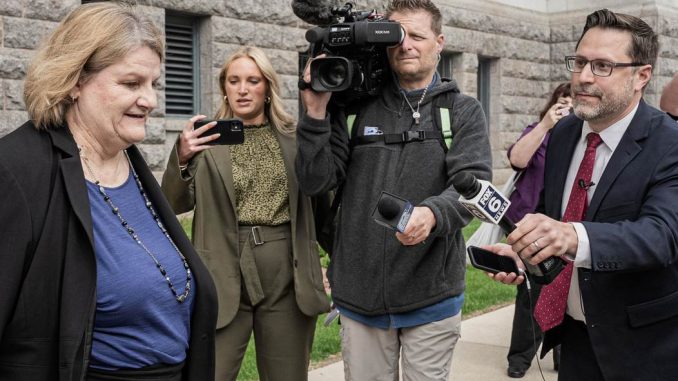
AP Photo/Andy Manis
Published April 7, 2026
Former Milwaukee County Circuit Judge Hannah Dugan — already convicted of obstructing federal immigration enforcement — just suffered another major legal defeat, as a federal court rejected her effort to overturn her guilty verdict or secure a new trial in her case involving interference with U.S. Immigration and Customs Enforcement (ICE).
Dugan, who resigned from the bench early this year after a federal jury found her guilty of felony obstruction for directing an illegal immigrant to avoid ICE agents, now faces up to five years in prison as her motion to throw out the conviction was denied by U.S. District Judge Lynn Adelman.
Conviction Upheld, Appeals Fail
In December 2025, a jury convicted Dugan of obstructing federal agents after evidence showed she misdirected ICE agents and helped an undocumented individual evade arrest at the Milwaukee County Courthouse.
Earlier this week, Dugan’s attempts to have the conviction tossed out or secure a new trial were rejected by Judge Adelman — ruling that neither a new trial nor an acquittal was justified. Her defense claims errors in jury instructions and argued that she should have judicial immunity, but the court disagreed, standing by the jury’s verdict.
The judge’s order upheld the conviction and indicated that the defense’s arguments did not meet the legal standards needed to overturn a jury’s finding, setting the stage for sentencing in the coming months.
The Incident That Sparked Federal Charges
The case began on April 18, 2025, when ICE agents were at the courthouse to arrest Eduardo Flores‑Ruiz, an undocumented immigrant appearing before Dugan on separate criminal charges. Prosecutors presented video and testimony showing Dugan directing the agents away from the public hallway toward the chief judge’s office, then facilitating Flores‑Ruiz’s exit through a restricted door — a move that allowed him to initially avoid arrest.
The FBI later arrested Dugan, and she was federally indicted on two counts — obstructing an official proceeding and concealing an individual to prevent his arrest. While she was acquitted on the misdemeanor count of concealing a person, she was convicted of the more serious felony obstruction charge.
Legal and Political Fallout
The denial of her post‑trial motions marks a significant affirmation of the jury’s decision, even as Dugan’s lawyers vow to pursue further appeals in higher courts. Members of her defense team argue that judges acting within their courtrooms should not face criminal prosecution for actions taken in their official capacity.
Critics of the conviction have labeled it a troubling expansion of federal enforcement into local judicial matters, raising questions about separation of powers and the limits of federal authority. Supporters of the verdict counter that no public official is above the law when it comes to obstructing enforcement actions of federal agents.
🔍 Critical View:
The recent federal ruling against former Wisconsin judge Hannah Dugan—denying her attempt to overturn her conviction for obstructing U.S. Immigration and Customs Enforcement (ICE)—sends a strong message about accountability for public officials. While some argue that judges should have latitude in their courtroom decisions, this case underscores the principle that no one is above federal law, particularly when actions interfere with enforcement of national immigration policies. From a strategic perspective, the ruling highlights tensions between local authority, federal jurisdiction, and the need for clear consequences when officials act outside the law.
Key Topics & Critical Angles
1. Rule of Law and Judicial Accountability
Dugan’s conviction illustrates that judges are not immune from prosecution when they deliberately obstruct federal agents. Upholding the verdict reinforces the principle that public officials must operate within legal boundaries.
2. Obstruction of Federal Immigration Enforcement
The case spotlights the risks associated with interfering in immigration enforcement. Dugan’s actions—directing an undocumented individual away from ICE agents—represent a direct challenge to federal authority, and the court’s refusal to overturn her conviction reinforces the consequences of such interference.
3. Separation of Powers vs. Federal Oversight
The case raises important questions about the limits of judicial discretion. While judges wield significant authority in their courtrooms, crossing into obstruction of federal enforcement responsibilities demonstrates the dangers of unchecked discretion and the potential for abuse.
4. Public Trust and Institutional Integrity
The Dugan case impacts public perception of both the judiciary and immigration enforcement. Upholding her conviction signals that public officials cannot manipulate the system to favor individuals contrary to federal law, reinforcing trust in institutional accountability.
5. Precedent for Future Cases
This ruling sets a legal precedent that could affect similar cases nationwide. Officials considering acts that interfere with federal law enforcement now face clearer consequences, which may deter future attempts to obstruct agencies like ICE.
6. Political and Social Implications
The case also illustrates broader societal tensions around immigration policy and enforcement. By enforcing the law against a sitting judge, the federal court underscores that policy disagreements do not excuse illegal actions, sending a strong signal to officials and the public alike.
👥 On the Ground: Public Response to Judge Dugan’s Legal Setback
The streets around the Milwaukee County Courthouse have been buzzing since a federal judge denied former Circuit Judge Hannah Dugan’s request to overturn her conviction for obstructing ICE. Supporters and critics alike have taken to public spaces, social media, and local news outlets to weigh in on what many see as a landmark decision: a public official held accountable for interfering with federal immigration enforcement. On the ground, the case reveals how national law enforcement policies intersect with local politics, public opinion, and trust in judicial institutions.
Key Topics & On-the-Ground Angles
1. Courthouse Atmosphere and Public Reaction
Outside the courthouse, a small crowd of protesters held signs supporting Dugan, arguing she was standing up for individuals in need. Meanwhile, other residents applauded the federal decision, emphasizing the importance of judicial accountability. The tension between these groups highlights the polarizing nature of immigration enforcement in local communities.
2. Media Coverage and Public Perception
Local news crews captured both sides of the debate, with coverage emphasizing Dugan’s conviction and the denial of her appeal. On social media, clips from the courthouse quickly spread, sparking discussions about the limits of judicial discretion and the consequences of obstructing federal law enforcement. Citizens on the ground noted that media framing significantly shapes how the public perceives both the judge and ICE.
3. ICE and Immigration Enforcement Visibility
Federal law enforcement’s presence outside the courthouse drew attention to the broader immigration debate. Citizens and commentators discussed how Dugan’s actions directly challenged federal authority, illustrating the stakes of enforcing national policy at the local level. Conversations centered on whether officials who obstruct federal agents should face criminal consequences, reinforcing the importance of law and order in immigration matters.
4. Local Sentiment and Community Divides
Neighborhoods around the courthouse reflected a mix of support and concern. Small business owners and residents expressed approval for holding officials accountable, while others worried about perceived harshness toward those involved in immigration cases. These discussions reveal the real-world impact of federal rulings on community attitudes and trust in government institutions.
5. Implications for Judicial Accountability
Citizens, lawyers, and local activists observed that the ruling reinforces the idea that judges cannot operate above the law, even when acting in their official capacity. On the ground, many expressed that the decision strengthens public confidence in both federal oversight and the principle that actions have consequences, regardless of office or title.
6. Political Conversations in Public Spaces
The case has sparked debates in coffee shops, markets, and community centers, with residents discussing the broader issues of immigration, rule of law, and accountability for public officials. Many noted that federal enforcement in this instance serves as a cautionary example for other elected and appointed officials across the state and nation.
🎯 The Final Word:
The federal court’s rejection of Hannah Dugan’s appeal underscores a fundamental principle: public officials are accountable for actions that obstruct the law, regardless of position or intent. While debates over immigration policy and judicial discretion continue, the ruling reinforces that interference with federal enforcement carries tangible consequences. On the ground, citizens, media, and legal observers alike see the case as a warning that violating the rule of law—especially in positions of authority—will not go unchecked, preserving trust in institutions and the integrity of the legal system.
SOURCES: REDSTATE – Judge Hannah Dugan, Convicted of Concealing an Illegal Alien From ICE, Just Got Bad News From the Court
FOX 6 MILWAUKEE – Milwaukee County Judge Dugan new trial, acquittal request denied
TOWNHALL – Court Rejects Disgraced Judge Hannah Dugan’s Request to Toss Her Guilty Verdict