Published March 10, 2025
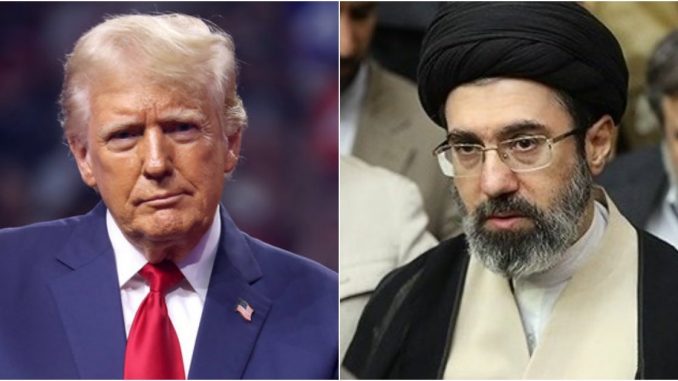
Former U.S. President Donald Trump reacted sharply after reports emerged that Iran had selected Mojtaba Khamenei as the country’s new Supreme Leader. Trump called the development troubling and suggested that Iran’s leadership transition could further destabilize an already tense region.
Mojtaba Khamenei is the son of longtime Iranian leader Ali Khamenei, who had served as Iran’s Supreme Leader since 1989. According to reports, Iran’s powerful religious leadership body moved quickly to select a successor following his death during the latest escalation in regional conflict involving Iran, Israel, and Western forces.
Trump criticized the choice publicly, describing Mojtaba Khamenei as an unsuitable figure for the role and warning that the leadership decision could worsen tensions between Iran and the United States. His comments immediately drew international attention, highlighting the potential geopolitical impact of Iran’s leadership change.
Iran Installs Khamenei’s Son as Supreme Leader
The appointment of Mojtaba Khamenei marks a historic and controversial moment for the Islamic Republic of Iran. The decision was reportedly made by the Assembly of Experts, the clerical body responsible for selecting and supervising Iran’s Supreme Leader.
Critics argue that the move resembles a dynastic succession—something the Iranian Revolution originally sought to abolish when it overthrew the monarchy of the Shah. For decades, Iran’s political system has portrayed itself as a religious republic rather than a hereditary leadership system.
Despite that claim, Mojtaba Khamenei has long been viewed as a powerful behind-the-scenes figure within Iran’s political structure. Though he has never held elected office, he reportedly built strong relationships with influential clerics and the powerful Islamic Revolutionary Guard Corps (IRGC).
Following the announcement of his appointment, several senior political and military figures in Iran publicly pledged allegiance to the new leader. The rapid consolidation of support appeared designed to signal stability within the Iranian regime during a period of intense regional conflict and uncertainty.
Trump: “Lightweight” Choice
Trump voiced strong criticism of Mojtaba Khamenei even before the official leadership decision was confirmed. The former U.S. president reportedly described him as a “lightweight” and questioned whether he possessed the authority or experience necessary to lead Iran during a time of geopolitical crisis.
Trump also suggested that the United States should not simply accept Iran’s leadership transition without scrutiny. According to reports, he warned that the new leader might struggle to maintain power if the Iranian government continued its confrontational policies toward Washington and its allies.
His comments reflect the long-standing tensions between the United States and Iran that have defined much of the Middle East’s geopolitical landscape for decades. Trump’s previous administration pursued a maximum-pressure strategy against Tehran, which included economic sanctions, diplomatic isolation, and military deterrence.
The remarks also signal that U.S. political leaders are closely watching the leadership transition in Tehran and assessing what it could mean for future relations between the two countries.
Rising Tensions in the Middle East
The leadership change in Iran comes at a time of heightened instability across the Middle East. The reported death of Ali Khamenei during joint military strikes dramatically escalated an already volatile confrontation involving Iran and Israel, raising fears of a broader regional war.
Iran has long been a central player in regional conflicts through its alliances with various militant groups and political movements throughout the Middle East. The country’s leadership transition therefore carries significant implications not only for Iran itself but also for neighboring countries and global powers.
Analysts believe Mojtaba Khamenei may adopt a hard-line approach similar to his father’s policies. Some experts warn that he may rely heavily on the Islamic Revolutionary Guard Corps and other powerful institutions inside Iran to consolidate authority and maintain control during this turbulent period.
At the same time, international observers are watching closely to see whether Iran’s new leadership might eventually seek negotiations or diplomatic engagement with the West to avoid further escalation.
For now, the appointment of Mojtaba Khamenei signals that Iran’s political system is attempting to maintain continuity during a moment of crisis—while the rest of the world waits to see how the country’s new leader will shape the future of the region.
 Implications for U.S. Policy and Global Stability
The selection of Mojtaba Khamenei as Iran’s Supreme Leader raises several important questions for U.S. national security and foreign policy.
For many observers in the United States, the leadership change reinforces long-standing concerns about the direction of the Iranian regime. The fact that power has effectively passed from Ali Khamenei to his son has been widely interpreted as a sign that the Iranian government is becoming even more centralized and insulated from internal reform.
Critics argue that such a transition strengthens the influence of powerful security institutions like the Islamic Revolutionary Guard Corps, which has played a major role in shaping Iran’s regional strategy. The IRGC has long been associated with supporting militant groups and expanding Iran’s influence across the Middle East.
From this perspective, the leadership change may signal a continuation—or even an intensification—of Iran’s confrontational posture toward the United States, Israel, and Western allies.
Supporters of a firm foreign-policy approach believe the situation underscores the importance of maintaining strong economic pressure, military readiness, and strategic alliances in the region. They argue that easing pressure on Tehran too quickly could embolden hard-line elements within the Iranian government.
At the same time, some analysts warn that the hereditary nature of the transition could weaken the regime’s legitimacy inside Iran. The Iranian Revolution originally sought to remove monarchical rule, and critics say the emergence of a family succession may contradict the principles the revolution claimed to represent.
If internal dissatisfaction grows, Iran could face increased domestic unrest in the coming years. However, others caution that the regime’s tight control over security forces and political institutions may allow it to maintain stability despite criticism.
For policymakers in Washington, the leadership shift presents both a challenge and an opportunity: a challenge because of the possibility of heightened tensions, and an opportunity to reassess strategies aimed at preventing Iran from expanding its military influence or advancing controversial nuclear ambitions.
How the United States and its allies respond in the months ahead may significantly shape the balance of power in the Middle East.
 Overall Takeaway:
The appointment of Mojtaba Khamenei as Iran’s new Supreme Leader marks a pivotal moment for the region and the world. By consolidating power within one family, Iran signals both continuity and potential hard-line escalation in its domestic and foreign policies.
For the United States and its allies, the leadership transition presents a complex challenge: balancing the need to deter aggression while remaining vigilant to the possibility of internal instability within Iran. As the world watches closely, the decisions made by Mojtaba Khamenei in the coming months could shape the future of the Middle East, influence global security, and test the effectiveness of longstanding U.S. strategies in the region.
The stakes are high, and the international community will be watching every move, weighing how this historic transfer of power will impact diplomacy, security, and regional stability.