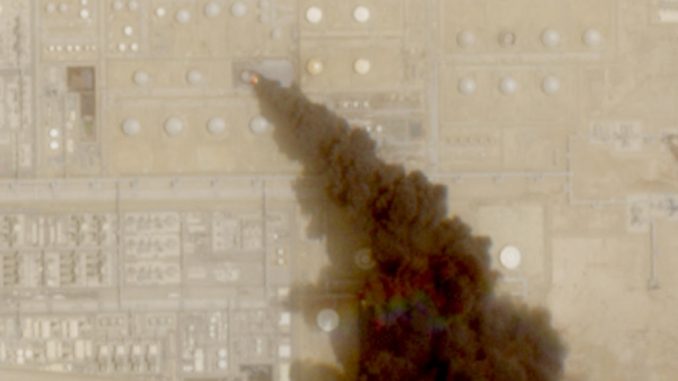
A satellite image shows a trail of smoke rising from an oil facility in Jizan, Saudi Arabia. (Reuters Photo: European Union/Copernicus Sentinel 2)
Published July 29 , 2026
WASHINGTON / BAGHDAD — The United States and Saudi Arabia launched coordinated precision strikes against Iran-backed armed groups in Iraq, marking a significant escalation in regional tensions after a series of drone attacks targeted Saudi energy infrastructure and U.S. interests.
According to the U.S. Central Command (CENTCOM), the operation targeted sites used by Iran-aligned militant groups that Washington says were directed by Iran’s Islamic Revolutionary Guard Corps (IRGC) to carry out attacks against American forces and Saudi oil facilities. Saudi Arabia confirmed it coordinated the strikes with U.S. forces, describing them as a response to repeated cross-border attacks.
CENTCOM Says Strikes Targeted Iran-Backed Militants
CENTCOM stated that the joint operation struck facilities allegedly used by Iran-backed groups responsible for launching drone attacks over the past month.
U.S. officials said the strikes were intended to degrade the militants’ operational capabilities and deter future attacks against American personnel and Saudi critical infrastructure.
Saudi officials likewise said the targeted groups had been linked to recent drone attacks on the kingdom’s petroleum facilities, which Riyadh said were successfully intercepted before causing major damage.
Fresh Fighting Follows Missile and Drone Escalation
The strikes came shortly after U.S. officials reported intercepting multiple ballistic missiles launched toward American forces in the region, an attack Washington attributed to Iran.
The renewed violence effectively ended a brief period of reduced hostilities and heightened concerns that the broader regional conflict could intensify once again.
Iran has denied directing the drone attacks against Saudi Arabia and warned that blaming Tehran for actions carried out by regional armed groups would be a “major miscalculation.”
Iraqi Militias Report Casualties
Iran-aligned elements of Iraq’s Popular Mobilization Forces (PMF) reported that several fighters were killed in the strikes.
The Iraqi groups condemned the attacks, accusing the United States and Saudi Arabia of violating Iraqi sovereignty. Independent casualty figures have not yet been fully verified.
Iraqi authorities continue monitoring the security situation as concerns grow that further retaliation could draw Iraq deeper into the regional conflict.
Regional Tensions Continue to Rise
The latest military action adds to growing instability across the Middle East, where attacks involving Iran-backed groups, the Houthis in Yemen, and other regional actors have increasingly affected energy infrastructure and international shipping.
Security analysts warn that continued exchanges between Iran, the United States, Saudi Arabia, and their respective allies increase the risk of a wider regional confrontation involving multiple fronts.
The renewed fighting also contributed to concerns over global energy markets as investors monitored potential disruptions to oil production and shipping routes.
Diplomatic Efforts Face New Challenges
Despite the military escalation, diplomatic efforts to reduce tensions continue.
Regional mediators have been seeking ways to prevent the conflict from expanding further, while international leaders continue urging restraint to avoid a broader Middle East war.
However, analysts say the latest strikes and retaliatory threats have complicated those diplomatic efforts and increased uncertainty over regional security.
👥 Public / Political Reactions:
🇺🇸 United States
U.S. officials defended the joint operation, describing it as a necessary response to attacks on American personnel and Saudi critical infrastructure.
- CENTCOM said the strikes targeted facilities used by Iran-backed armed groups responsible for recent drone attacks.
- U.S. officials emphasized that the operation was intended to deter future attacks and protect coalition forces in the region.
- Washington warned that additional attacks by Iran or its regional proxies could prompt further military action.
➡️ Position: The United States says the strikes were a defensive measure aimed at degrading the capabilities of Iran-backed militant groups and protecting regional security.
🇸🇦 Saudi Arabia
Saudi Arabia said it coordinated closely with the United States in carrying out the strikes.
- Saudi officials accused Iraq-based Iran-backed groups of launching drone attacks against the kingdom’s energy infrastructure.
- Riyadh said it has the right to defend its territory and critical facilities from continued cross-border attacks.
- Saudi leaders reiterated their commitment to regional security while warning that further aggression would be met with an appropriate response.
➡️ Position: Saudi Arabia says the operation was a legitimate act of self-defense against repeated attacks on its territory.
🇮🇷 Iran
Iran rejected allegations that it directed the attacks that prompted the joint operation.
- Iranian officials denied responsibility for the drone strikes cited by the United States and Saudi Arabia.
- Tehran warned that blaming Iran for actions carried out by regional armed groups could further destabilize the Middle East.
- Iranian leaders accused Washington and Riyadh of escalating the conflict through military action.
➡️ Position: Iran denies directing the attacks and argues that the U.S.-Saudi strikes risk further regional escalation.
🇮🇶 Iraqi Government and Iran-Backed Groups
Iraqi officials expressed concern over military operations conducted on Iraqi territory.
- Iran-aligned armed groups condemned the strikes, calling them violations of Iraqi sovereignty.
- Iraqi authorities urged restraint and warned against actions that could draw Iraq deeper into the regional conflict.
- Officials continued emphasizing that Iraqi territory should not be used as a battleground for broader regional disputes.
➡️ Position: Iraqi officials are calling for respect for Iraq’s sovereignty while seeking to prevent further escalation.
🌍 International Community
Governments and international observers voiced concern over the renewed violence.
- Diplomats warned that the latest military exchanges increase the risk of a wider regional conflict.
- Analysts noted that continued attacks could threaten global energy markets and international shipping routes.
- Several countries continued urging all parties to exercise restraint and pursue diplomatic solutions.
➡️ Position: The international community is urging de-escalation and renewed diplomatic efforts to prevent a broader Middle East conflict.
👥 Public Response
Public reaction has been divided across the region and internationally.
- Supporters of the strikes argued they were necessary to deter attacks on U.S. forces and Saudi infrastructure.
- Critics warned that additional military operations could trigger retaliation and prolong instability.
- Energy markets and regional observers remain closely focused on whether the conflict will expand further.
➡️ Position: Public opinion remains divided between support for deterrence and concern over the growing risk of a wider regional war.
🏛️ Broader Political Impact
The joint strikes have intensified geopolitical tensions across the Middle East.
- The operation is expected to influence ongoing U.S.-Iran relations and Gulf security policy.
- Regional governments are reassessing security cooperation amid fears of further attacks.
- Analysts say the latest escalation could complicate diplomatic efforts and increase pressure on all sides to avoid a broader conflict.
➡️ Position: The strikes have heightened regional tensions and reinforced the importance of diplomatic efforts to prevent a wider war.
⚠️ Resulting Effects:
The joint U.S.-Saudi strikes against Iran-backed armed groups in Iraq have significantly heightened regional tensions, raising concerns over possible retaliation, the stability of Iraq, and the broader security environment across the Middle East. While Washington and Riyadh described the operation as a defensive response to recent attacks, analysts warn that the escalation could have far-reaching military, political, and economic consequences.
1. Regional Military Tensions Intensified
The strikes have increased the risk of additional military exchanges across the region.
⚔️ Iran-backed armed groups may seek to retaliate against U.S. forces, Saudi Arabia, or allied interests.
🛡️ Coalition forces are expected to strengthen force protection measures at military installations throughout the region.
🚨 Security agencies remain on heightened alert for further missile or drone attacks.
➡️ Result: Joint military operation → increased risk of retaliatory attacks and broader regional conflict.
2. Iraq Faces Greater Security Challenges
The operation has placed additional pressure on Iraq’s security and political stability.
🏛️ Iraqi authorities continue balancing relations with the United States, neighboring Arab states, and Iran.
⚖️ Military operations conducted inside Iraq have renewed debate over the country’s sovereignty.
👥 Iraqi civilians face growing uncertainty as tensions between regional powers play out on Iraqi territory.
➡️ Result: Renewed strikes → increased security and political pressure on Iraq.
3. U.S.-Iran Relations Deteriorated Further
The latest strikes have deepened already strained relations between Washington and Tehran.
🇺🇸 The United States maintains that the operation was necessary to protect its personnel and regional partners.
🇮🇷 Iran has rejected responsibility for the attacks cited by Washington and condemned the military response.
🤝 Diplomatic engagement between the two countries has become increasingly difficult amid the renewed violence.
➡️ Result: Military escalation → further deterioration of U.S.-Iran relations.
4. Energy Markets and Regional Trade Remain on Alert
The renewed fighting has raised concerns over energy security.
⛽ Investors are closely monitoring developments involving Gulf oil infrastructure and shipping routes.
🚢 Any disruption to regional maritime traffic could affect global energy supplies and commercial trade.
📈 Markets remain sensitive to further escalation involving key oil-producing nations.
➡️ Result: Rising tensions → continued uncertainty for global energy markets.
5. Diplomatic Efforts Face New Obstacles
Regional mediation efforts have become more challenging.
🤝 International mediators continue urging restraint to prevent additional military action.
📖 Efforts to reduce tensions between the United States, Saudi Arabia, Iran, and regional armed groups have become more complicated.
🌍 Governments continue calling for dialogue to avoid a wider Middle East conflict.
➡️ Result: Renewed hostilities → greater challenges for diplomatic negotiations.
6. Regional Allies Strengthen Security Measures
Countries across the Middle East are reassessing their security posture.
🛡️ Gulf states are expected to enhance air defense and border security measures.
✈️ Military forces throughout the region remain prepared for possible follow-on attacks.
🌐 Intelligence cooperation among allied nations may increase in response to evolving threats.
➡️ Result: Heightened tensions → stronger regional security coordination.
7. Risk of Wider Conflict Remains Elevated
The latest military exchanges have increased concerns about a broader regional confrontation.
🌍 Analysts warn that additional attacks involving Iran-backed groups could trigger further military responses.
⚠️ Continued escalation could draw more regional actors into the conflict.
🕊️ Preventing further violence will depend on both effective deterrence and sustained diplomatic engagement.
➡️ Result: Continuing hostilities → increased risk of a wider Middle East war.
🔮 Future Outlook:
The situation in Iraq and the broader Middle East is expected to remain highly volatile following the joint U.S.-Saudi strikes against Iran-backed armed groups. While both Washington and Riyadh say the operation was intended to deter future attacks, regional security experts warn that the risk of retaliation remains high and that diplomatic efforts will be critical to preventing a wider conflict.
1. Retaliatory Attacks Remain a Significant Risk
Iran-backed armed groups may attempt to respond to the strikes.
🚀 U.S. military bases, coalition personnel, and Saudi infrastructure could remain potential targets.
🛡️ American and allied forces are expected to maintain heightened security and air defense readiness.
⚠️ Intelligence agencies will continue monitoring for possible missile, drone, or proxy attacks.
➡️ Outlook: Continued security threats → elevated risk of further military exchanges.
2. U.S. and Saudi Arabia Are Expected to Maintain Pressure
Washington and Riyadh are likely to continue targeting groups they identify as threats.
🎯 Military operations may continue if additional attacks are launched against coalition forces or Saudi territory.
🤝 Security cooperation between the United States and Saudi Arabia is expected to remain strong.
📡 Intelligence-sharing and surveillance efforts are likely to increase across the region.
➡️ Outlook: Continued cooperation → sustained pressure on Iran-backed armed groups.
3. Iran Will Likely Continue Balancing Deterrence and Diplomacy
Tehran is expected to continue rejecting responsibility for attacks carried out by regional allies while seeking to avoid a direct military confrontation.
🇮🇷 Iranian officials are likely to continue supporting diplomatic efforts while condemning U.S. and Saudi military actions.
⚖️ Analysts say Iran may rely on regional partners to maintain strategic pressure without triggering a full-scale war.
🌍 Regional diplomacy will remain an important factor in determining Tehran’s next steps.
➡️ Outlook: Iran’s response → continued strategic balancing between deterrence and diplomacy.
4. Iraq Faces Continued Security and Political Challenges
Iraq is expected to remain at the center of regional tensions.
🏛️ Iraqi leaders will likely continue calling for respect for the country’s sovereignty.
👥 Security forces may increase operations to prevent additional violence inside Iraq.
🤝 Baghdad is expected to work with international partners to reduce the risk of further escalation.
➡️ Outlook: Iraq’s stability → continued pressure from competing regional interests.
5. Diplomatic Efforts Will Become More Important
Regional and international mediators are expected to intensify diplomatic engagement.
🌍 Governments will likely continue urging restraint from all parties.
🤝 Diplomatic channels involving Gulf states, Iraq, Iran, and the United States may remain active despite the fighting.
📖 Any reduction in hostilities will depend on sustained communication and efforts to avoid miscalculation.
➡️ Outlook: Diplomacy → essential to preventing broader regional conflict.
6. Energy Markets Will Continue Monitoring Developments
Global markets are expected to remain sensitive to events in the Gulf region.
⛽ Any additional attacks affecting oil infrastructure or shipping routes could influence energy prices.
🚢 Maritime security in strategic waterways will remain a priority for regional and international forces.
📈 Investors are expected to closely monitor security developments for signs of further escalation.
➡️ Outlook: Regional instability → continued uncertainty for energy markets and global trade.
7. The Risk of a Wider Middle East Conflict Remains
The coming weeks will be critical in determining whether the violence remains localized or expands.
⚔️ Additional attacks by any party could trigger further military responses.
🕊️ Successful diplomatic engagement could help reduce tensions and prevent broader hostilities.
🌐 Regional stability will depend on restraint, communication, and efforts to avoid escalation among major powers and their allies.
➡️ Outlook: The Middle East remains on a fragile path, with both military deterrence and diplomacy likely to shape the next phase of the conflict.
🧩 Bottom Line:
The joint U.S.-Saudi strikes against Iran-backed armed groups in Iraq mark another significant escalation in an already volatile Middle East. While Washington and Riyadh describe the operation as a necessary response to repeated attacks on military personnel and critical infrastructure, Iran-backed groups have condemned the strikes, raising concerns that the cycle of retaliation could continue.
⚔️ The military operation underscores the growing willingness of the United States and Saudi Arabia to respond directly to attacks they attribute to Iran-backed militias operating in the region.
🌍 Regional stability remains fragile as Iraq once again finds itself at the center of competing geopolitical interests involving the United States, Iran, Saudi Arabia, and allied armed groups.
🛢️ Global implications extend beyond the battlefield, with investors and governments closely monitoring potential disruptions to energy markets, regional trade, and maritime security.
🤝 Diplomatic efforts continue, but the latest escalation highlights the increasingly difficult challenge of balancing deterrence with dialogue to prevent a broader regional war.
➡️ Bottom Line: The coming days will be critical in determining whether the latest strikes succeed in deterring further attacks or trigger another round of retaliation. With multiple regional powers involved and tensions already high, the risk of a wider Middle East conflict remains a central concern for governments, security analysts, and the international community.
SOURCES: REUTERS – US military says US, Saudi forces struck sites of Iran-backed groups in Iraq
ABC NEWS – US thwarts Iran’s ‘surprise attack’ and launches strikes with Saudi Arabia against Iraq militias
CENTCOM – U.S., Saudi Forces Strike Iran-Backed Terrorist Sites in Iraq